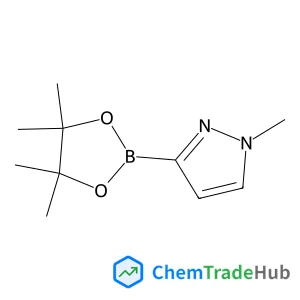
1-Methyl-3-(4,4,5,5-tetramethyl-1,3,2-dioxaborolan-2-yl)-1H-pyrazole
CAS Number:
1020174-04-2
Molecular Formula:
C10H17BN2O2
Maksim I. Hulnik, Irina V. Vasilenko, Alexei V. Radchenko, Frédéric Peruch, Francois Ganachaud
Aqueous cationic polymerization of β-myrcene, a naturally occurring monomer, was performed for the first time using a water-dispersible Lewis acid surfactant combined catalyst (LASC) prepared from ytterbium chloride and a branched sodium dodecylbenzenesulfonate surfactant. At 40 °C, poly(β-myrcene)s of high molecular weight (Mn up to 150 kg mol−1) and low glass transition temperature (Tg < −63 °C) were obtained. They possess predominantly 1,4-units (∼43% cis and ∼50% trans) and few 3,4-units (∼7%) together with both regular head-to-tail (62–72%) and inverse (5–10% head-to-head and 23–28% tail-to-tail) sequences. The LASC showed also high efficiency in catalyzing the emulsion cationic copolymerization of β-myrcene and styrene, affording the synthesis of random copolymers with high molecular weights (Mn from 60 to 120 kg mol−1) and single glass transition temperatures (Tg's from −43 to 15 °C). Finally, a simple procedure was developed to recover the catalyst from the reaction mixture, which showed high activity in the β-myrcene emulsion cationic polymerization even after five successive cycles of extraction.
Jens Reinisch, Frank Eckert, Jérôme Graton, Jean-Yves Le Questel
DOI: 10.1039/C3CP44611E
Andrew P. Ault, Defeng Zhao, Carlena J. Ebben, Michael J. Tauber, Franz M. Geiger, Vicki H. Grassian
DOI: 10.1039/C3CP43899F
Xiao Lin, Zhi-Tao Wang, Igor Lyubinetsky, Bruce D. Kay, Zdenek Dohnálek
DOI: 10.1039/C3CP44040K
Irina V. Chernyshova, Sathish Ponnurangam, Ponisseril Somasundaran
DOI: 10.1039/C3CP44264K
Dominik Oschetzki, Xiaoqing Zeng, Helmut Beckers, Klaus Banert, Guntram Rauhut
DOI: 10.1039/C3CP50268F
Ryusuke Futamura, Miguel Jorge, José R. B. Gomes
DOI: 10.1039/C3CP50193K
Yilun Liu
DOI: 10.1039/C3CP43854F
Magali Duvail, Jean-François Dufrêche, Lise Arleth, Thomas Zemb
DOI: 10.1039/C3CP43981J
Ji Chen, Qianfan Zhang, Angelos Michaelides, Enge Wang
DOI: 10.1039/C3CP50218J
Guilherme Oliveira Siqueira, Tulio Matencio, Herculano Vieira da Silva, Yara Gonçalves de Souza, José Domingos Ardisson, Geraldo Magela de Lima, Arilza de Oliveira Porto
DOI: 10.1039/C3CP50549A
When handling 4-(2-Furylmethyl)thiomorpholine 1,1-dioxide (CAS: 79206-94-3), it ...
When handling 4-Chloro-N-[2-(4-morpholinyl)ethyl]benzamide (CAS: 71320-77-9), it...
Waste containing this compound (CAS: 62921-74-8) should be handled according to ...
Waste containing (S)-Methyl 2-amino-3-cyclohexylpropanoate should be collected i...
This compound can be synthesized using a multi-step process involving the conjug...
There are several alternatives to (2E)-3-(3,4-Dichlorophenyl)acrylic acid in syn...
Ethyl 6-(2-nitrophenyl)imidazo[2,1-b][1,3]thiazole-3-carboxylate (CAS: 925437-84...
Waste containing 2-(1,3-Thiazol-2-yl)ethanamine (CAS: 18453-07-1) should be coll...
Methyl 5-iodo-2-methylbenzoate can be synthesized through the iodination of meth...
5-Chloro[1,2,4]triazolo[1,5-a]pyridine is commonly synthesized via the condensat...

Polymer Chemistry welcomes submissions in all areas of polymer science that have a strong focus on macromolecular chemistry. Manuscripts may cover a broad range of fields, yet no direct application focus is required.
![4-{2-[4-(2-Methyl-2-propanyl)phenyl]ethoxy}quinazoline structure](https://static.chemtradehub.com/structs/120/120928-09-8-d3db.webp "4-{2-[4-(2-Methyl-2-propanyl)phenyl]ethoxy}quinazoline structure")