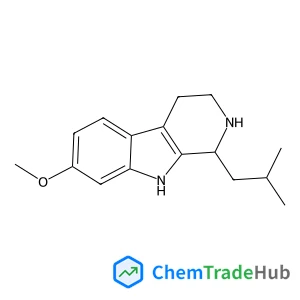
1-Isobutyl-7-methoxy-2,3,4,9-tetrahydro-1H-beta-carboline
CAS Number:
175975-76-5
Molecular Formula:
C16H22N2O
Irina V. Chernyshova, Sathish Ponnurangam, Ponisseril Somasundaran
A better understanding of interaction with dissolved CO2 is required to rationally design and model the (photo)catalytic and sorption processes on metal (hydr)oxide nanoparticles (NPs) in aqueous media. Using in situ FTIR spectroscopy, we address this problem for rhombohedral 38 nm hematite (α-Fe2O3) nanoparticles as a model. We not only resolve the structures of the adsorbed carbonate species, but also specify their adsorption sites and their location on the nanoparticle surface. The spectral relationships obtained present a basis for a new method of characterizing the microscopic structural and acid–base properties (related to individual adsorption sites) of hydrated metal (hydr)oxide NPs using atmospherically derived CO2 as a probe. Specifically, we distinguish two carbonate species suggesting two principally different adsorption mechanisms. One species, which is more weakly adsorbed, has an inner-sphere mononuclear monodentate structure which is formed by a conventional ligand-exchange mechanism. At natural levels of dissolved carbonate and pH from 3 to 11, this species is attached to the most acidic/reactive surface cations (surface states) associated with ferrihydrite-like surface defects. The second species, which is more strongly adsorbed, presents a mixed C and O coordination of bent CO2. This species uniquely recognizes the stoichiometric rhombohedral {104} facets in the NP texture. Like in gas phase, it is formed through the surface coordination of molecular CO2. We address how the adsorption sites hosting these two carbonate species are affected by the annealing and acid etching of the NPs. These results support the nanosize-induced phase transformation of hematite towards ferrihydrite under hydrous conditions, and additionally show that the process starts from the roughened areas of the facet intersections.

Journal of Medicinal Chemistry

Proceedings of the National Academy of Sciences of the United States of America

Science

Russian Chemical Reviews

Journal of Catalysis

Science Progress

Organic Preparations and Procedures International

Molecular Pharmacology

Journal of Physics and Chemistry of Solids

Planta Medica
Vicky FitzGerald, Veijo Honkimaki, Mark A. Roberts, Tessa Brennan, Richard A. Martin, George A. Saunders, Robert J. Newport
DOI: 10.1039/C3CP44298E
Javier Catalán
DOI: 10.1039/C3CP44627A
Oliver L. G. Alderman, Dinu Iuga, Andrew P. Howes, Diane Holland, Ray Dupree
DOI: 10.1039/C3CP50772F
D. Fazzi, A. Milani, D. Brida, C. Manzoni, E. Cinquanta, M. Devetta, L. Ravagnan, P. Milani, F. Cataldo, L. Lüer, R. Wannemacher, J. Cabanillas-Gonzalez, M. Negro, S. Stagira, C. Vozzi
DOI: 10.1039/C3CP50508A
Xiaohao Yang, Ahmad S. Masadeh, James R. McBride, Emil S. Božin, Sandra J. Rosenthal
DOI: 10.1039/C3CP00111C
Ying Dai, Baibiao Huang, Timo Jacob
DOI: 10.1039/C3CP51078F
Jakub Goclon, Bernd Meyer
DOI: 10.1039/C3CP44546A
Mark A. Newton, Marco Di Michiel, Songhak Yoon, Gian Luca Chiarello, Santhosh Kumar Matam, Myriam H. Aguirre, Anke Weidenkaff, Fei Wen, Jürgen Gieshoff
DOI: 10.1039/C3CP44638G
Yuma Matsumoto, Mai Tsubamoto, Ryoji Sugimura, Masatoshi Kozaki, Kenshi Kimoto, Munetaka Iwamura, Koichi Nozaki, Naoki Senju, Chiasa Uragami, Yohei Muramatsu, Akinori Konno
DOI: 10.1039/C3CP50182E
Jiangli Xue, Yang Zhao, Huhu Cheng, Chuangang Hu, Yue Hu, Yuning Meng, Huibo Shao, Zhipan Zhang, Liangti Qu
DOI: 10.1039/C3CP51571K
N-(4-Methoxybenzyl)-2-pyridinamine (CAS: 52818-63-0) is increasingly being used ...
When handling Ethyl 4-(2-chlorophenyl)-1,3-thiazole-2-carboxylate, appropriate p...
Diethyldiselane (CAS: 628-39-7) is classified under the Globally Harmonized Syst...
The market for oxocopper (CAS: 12053-18-8) is primarily driven by its use in cat...
The market for 5-{[(2-Methyl-2-propanyl)oxy]carbonyl}-5-azaspiro[2.4]heptane-7-c...
2-(1-Pyrrolidinyl)-4-pyridinamine is a chemical compound with the CAS number 359...
2-(3-Pyridinyl)-1-azabicyclo[2.2.2]octane (CAS: 91556-75-1) is a crystalline sol...
(S)-Alpha-allyl-proline hydrochloride is usually synthesized via a Wittig reacti...
3-Methyl-1,2-oxazole-5-carboxylic acid (CAS: 4857-42-5) is an organic compound w...
Lys-SMCC-DM1 is synthesized via a multi-step process involving the coupling of S...

Physical Chemistry Chemical Physics (PCCP) is an international journal co-owned by 19 physical chemistry and physics societies from around the world. This journal publishes original, cutting-edge research in physical chemistry, chemical physics and biophysical chemistry. To be suitable for publication in PCCP, articles must include significant innovation and/or insight into physical chemistry; this is the most important criterion that reviewers and Editors will judge against when evaluating submissions. The journal has a broad scope and welcomes contributions spanning experiment, theory, computation and data science. Topical coverage includes spectroscopy, dynamics, kinetics, statistical mechanics, thermodynamics, electrochemistry, catalysis, surface science, quantum mechanics, quantum computing and machine learning. Interdisciplinary research areas such as polymers and soft matter, materials, nanoscience, energy, surfaces/interfaces, and biophysical chemistry are welcomed if they demonstrate significant innovation and/or insight into physical chemistry. Joined experimental/theoretical studies are particularly appreciated when complementary and based on up-to-date approaches.
![5'-Fluoro-[2,3'-biindolinylidene]-2',3-dione structure](https://static.chemtradehub.com/structs/251/251903-00-1-9cb1.webp "5'-Fluoro-[2,3'-biindolinylidene]-2',3-dione structure")