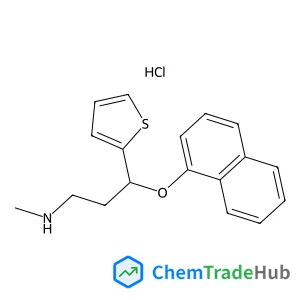
N-Methyl-3-(1-naphthyloxy)-3-(2-thienyl)-1-propanamine hydrochloride (1:1)
CAS Number:
1188266-11-6
Molecular Formula:
C18H20ClNOS
Guilherme Oliveira Siqueira, Tulio Matencio, Herculano Vieira da Silva, Yara Gonçalves de Souza, José Domingos Ardisson, Geraldo Magela de Lima, Arilza de Oliveira Porto
Zinc sulphide was obtained through hydrothermal decomposition of [Zn(S2CNEt2)] under different experimental conditions such as temperatures and reaction times. Hydrothermal reactions were carried out in a stainless steel autoclave at 160, 180 and 200 °C for 3, 6 and 24 hours. The obtained products were characterized using X-ray diffraction, scanning and high resolution transmission electron microscopies. Particle size and microstrain were determined by Rietveld refinement of experimental X-ray diffraction patterns. The obtained crystal size values were in the range of 6.1 to 30 nm and as the temperature and reaction times increase the particle size also increases. Band gap values are in the range of 3.34 to 3.60 eV and are highly dependent on the crystal microstrain. The catalyst activities were studied through the degradation of methylene blue dye solutions under ultraviolet radiation.
U. Hoppe, L. Delevoye, L. Montagne, M. v. Zimmermann, A. C. Hannon
DOI: 10.1039/C2CP42772A
Małgorzata Wierzbowska, Adam Dominiak, Kamil Tokar
DOI: 10.1039/C3CP44378G
Mauro Coduri, Michela Brunelli, Paolo Masala
DOI: 10.1039/C3CP44300K
Deepthi Jose, A. Nijamudheen
DOI: 10.1039/C3CP51028J
V. Petkov, Y. Ren, S. Kabekkodu, D. Murphy
DOI: 10.1039/C2CP43378H
Katleen Korthout, Anthony B. Parmentier, Philippe F. Smet, Dirk Poelman
DOI: 10.1039/C3CP44334E
Chunhui Li, Lei Yang, Junyan Xiao, Yih-Chyng Wu, Martin Søndergaard, Yanhong Luo, Dongmei Li, Qingbo Meng, Bo Brummerstedt Iversen
DOI: 10.1039/C3CP50365H
Ane K. di Gennaro, Leonid Gurevich, Esben Skovsen, Michael T. Overgaard, Peter Fojan
DOI: 10.1039/C3CP50742D
N-(4-Methoxybenzyl)-2-pyridinamine (CAS: 52818-63-0) is increasingly being used ...
When handling Ethyl 4-(2-chlorophenyl)-1,3-thiazole-2-carboxylate, appropriate p...
Diethyldiselane (CAS: 628-39-7) is classified under the Globally Harmonized Syst...
The market for oxocopper (CAS: 12053-18-8) is primarily driven by its use in cat...
The market for 5-{[(2-Methyl-2-propanyl)oxy]carbonyl}-5-azaspiro[2.4]heptane-7-c...
2-(1-Pyrrolidinyl)-4-pyridinamine is a chemical compound with the CAS number 359...
2-(3-Pyridinyl)-1-azabicyclo[2.2.2]octane (CAS: 91556-75-1) is a crystalline sol...
(S)-Alpha-allyl-proline hydrochloride is usually synthesized via a Wittig reacti...
3-Methyl-1,2-oxazole-5-carboxylic acid (CAS: 4857-42-5) is an organic compound w...
Lys-SMCC-DM1 is synthesized via a multi-step process involving the coupling of S...

Physical Chemistry Chemical Physics (PCCP) is an international journal co-owned by 19 physical chemistry and physics societies from around the world. This journal publishes original, cutting-edge research in physical chemistry, chemical physics and biophysical chemistry. To be suitable for publication in PCCP, articles must include significant innovation and/or insight into physical chemistry; this is the most important criterion that reviewers and Editors will judge against when evaluating submissions. The journal has a broad scope and welcomes contributions spanning experiment, theory, computation and data science. Topical coverage includes spectroscopy, dynamics, kinetics, statistical mechanics, thermodynamics, electrochemistry, catalysis, surface science, quantum mechanics, quantum computing and machine learning. Interdisciplinary research areas such as polymers and soft matter, materials, nanoscience, energy, surfaces/interfaces, and biophysical chemistry are welcomed if they demonstrate significant innovation and/or insight into physical chemistry. Joined experimental/theoretical studies are particularly appreciated when complementary and based on up-to-date approaches.