













Achieving two-photon fluorescence bioimaging and photodynamic therapy for D–A conjugated polymers through manipulating twisted intramolecular charge transfer
Literature Information
Publication Date
2023-11-10
DOI
10.1039/D3PY01093G
Impact Factor
5.582
Authors
Shengzu Liao, Tianze Hu, Peiling Chen, Chunxiao Wang, Ting Guo, Renqiang Yang
View Original
Abstract
Two-photon fluorescence bioimaging holds immense promise for deep tissue imaging. However, its widespread application is hampered by the relatively low fluorescence quantum yields (ϕPL) and small two-photon absorption cross-sections (δ2). Herein, we report the achievement of high ϕPL for donor–acceptor alternating conjugated polymers comprising dibenzothiophene-S,S-dioxide derivatives as electron acceptors and a triphenylamine derivative as an electron donor, which is accomplished by manipulating twisted intramolecular charge transfer (TICT). The resulting polymer PDA5 exhibits intensified green-light emission with a high ϕPL value of 70.7% in toluene. Its corresponding nanoparticles (PDA5 NPs), which are fabricated by the nanoprecipitation method, display a uniform size of around 83 nm, a large two-photon absorption cross-section (δ2) of 5.03 × 10⁵ GM in water upon excitation by an NIR laser (840 nm), and a moderate ϕPL value of 40.7% in aqueous medium. These nanoparticles also present good photostability and outstanding two-photon fluorescence imaging with penetrating bladder blood vessels of 225 μm as well as real-time monitoring. Furthermore, PDA5 nanoparticles with impressive reactive oxygen species generation capability under irradiation of a white light source are implemented for photodynamic therapy in in vitro cancer cells. The observations manifest that efficient conjugated polymers with high ϕPL and large δ2 can be materialized for two-photon fluorescence imaging and photodynamic therapy by manipulating twisted intramolecular charge transfer.
Related Literature
Cell-inspired biointerfaces constructed from patterned smart hydrogels for immunoassays in whole blood
Jianwen Hou, Runhai Chen, Zhirong Xin, Hengchong Shi, Shing-Chung Wong, Jinghua Yin, Qiang Shi
2017-02-27
Paper
DOI: 10.1039/C6TB03385G
Optical fiber sensor for the detection of tetracycline using surface plasmon resonance and molecular imprinting
Roli Verma, Banshi D. Gupta
2013-09-13
Paper
DOI: 10.1039/C3AN01098H
ATR-FTIR spectroscopy as a tool to probe surface adsorption on nanoparticles at the liquid–solid interface in environmentally and biologically relevant media
Imali A. Mudunkotuwa, Alaa Al Minshid, Vicki H. Grassian
2013-12-02
Minireview
DOI: 10.1039/C3AN01684F
An overview of recent developments in the determination of aluminium in serum by furnace atomic absorption spectrometry
Paper
DOI: 10.1039/JA9860100281
A turn-on homodimer fluorescent probe based on homo-FRET for the sensing of biothiols in lysosome: a trial of a new turn-on strategy
Ying-Jie Tang, Wen-Le Fang, Kui Ren, Xiao-Feng Guo, Hong Wang
2021-03-11
Paper
DOI: 10.1039/D1AN00161B
Identification of bacterial species by untargeted NMR spectroscopy of the exo-metabolome
T. L. Palama, I. Canard, G. J. P. Rautureau, C. Mirande, S. Chatellier, B. Elena-Herrmann
2016-06-16
Communication
DOI: 10.1039/C6AN00393A
Electrochemical sensing of hepatocyte viability
Shang-heng Tsai, Wei-Jen Ting, Chao-Chin Hu, C. Bor Fuh
2014-02-21
Paper
DOI: 10.1039/C3AN02226A
Hollow double-layered polymer nanoparticles with S-nitrosothiols for tumor targeted therapy
Tuanwei Liu, Jingjing Hu, Xiaoye Ma, Bing Kong, Jilan Wang, Zhide Zhang, Dian-Shun Guo, Xinlin Yang
2017-08-17
Paper
DOI: 10.1039/C7TB01715D
Development of a focused high-energy macromolecular ion beam
Ming-Lee Chu, Jung-Lee Lin
2021-03-03
Paper
DOI: 10.1039/D0AN02478C
You might also like
Compound Q&A
What is the market or research trend for N-(4-Methoxybenzyl)-2-pyridinamine (CAS: 52818-63-0)?
N-(4-Methoxybenzyl)-2-pyridinamine (CAS: 52818-63-0) is increasingly being used ...
52818-63-0N-(4-Methoxybenzyl)-...
Compound Q&A
What precautions should be taken when handling Ethyl 4-(2-chlorophenyl)-1,3-thiazole-2-carboxylate (CAS: 1050507-06-6)?
When handling Ethyl 4-(2-chlorophenyl)-1,3-thiazole-2-carboxylate, appropriate p...
1050507-06-6Ethyl 4-(2-chlorophe...
Compound Q&A
What regulatory guidelines apply to diethyldiselane (CAS: 628-39-7)?
Diethyldiselane (CAS: 628-39-7) is classified under the Globally Harmonized Syst...
628-39-7Diethyldiselane
Compound Q&A
What is the market or research trend for oxocopper (CAS: 12053-18-8)?
The market for oxocopper (CAS: 12053-18-8) is primarily driven by its use in cat...
12053-18-8oxocopper; oxo-(oxoc...
Compound Q&A
What is the market or research trend for 5-{[(2-Methyl-2-propanyl)oxy]carbonyl}-5-azaspiro[2.4]heptane-7-carboxylic acid?
The market for 5-{[(2-Methyl-2-propanyl)oxy]carbonyl}-5-azaspiro[2.4]heptane-7-c...
1268519-54-55-{[(2-Methyl-2-prop...
Compound Q&A
What is 2-(1-Pyrrolidinyl)-4-pyridinamine (CAS: 35981-63-6)?
2-(1-Pyrrolidinyl)-4-pyridinamine is a chemical compound with the CAS number 359...
35981-63-62-(1-Pyrrolidinyl)-4...
Compound Q&A
What are the physical and chemical properties of 2-(3-Pyridinyl)-1-azabicyclo[2.2.2]octane (CAS: 91556-75-1)?
2-(3-Pyridinyl)-1-azabicyclo[2.2.2]octane (CAS: 91556-75-1) is a crystalline sol...
91556-75-12-(3-Pyridinyl)-1-az...
Compound Q&A
How is (S)-Alpha-allyl-proline hydrochloride (CAS: 129704-91-2) typically synthesized?
(S)-Alpha-allyl-proline hydrochloride is usually synthesized via a Wittig reacti...
129704-91-2(S)-Alpha-allyl-prol...
Compound Q&A
What is 3-Methyl-1,2-oxazole-5-carboxylic acid (CAS: 4857-42-5)?
3-Methyl-1,2-oxazole-5-carboxylic acid (CAS: 4857-42-5) is an organic compound w...
4857-42-53-Methyl-1,2-oxazole...
Compound Q&A
How is Lys-SMCC-DM1 (CAS: 1281816-04-3) typically synthesized?
Lys-SMCC-DM1 is synthesized via a multi-step process involving the coupling of S...
1281816-04-3Lys-SMCC-DM1
Source Journal
Polymer Chemistry

CiteScore:
8.6
Self-citation Rate:
7.3%
Articles per Year:
457
Polymer Chemistry welcomes submissions in all areas of polymer science that have a strong focus on macromolecular chemistry. Manuscripts may cover a broad range of fields, yet no direct application focus is required.
Recommended Compounds
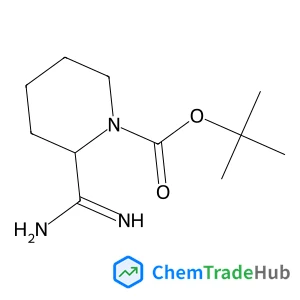
2-Methyl-2-propanyl 2-carbamimidoyl-1-piperidinecarboxylate
CAS Number:
1258640-98-0
Molecular Formula:
C11H21N3O2
![N-{[(2-Methyl-2-propanyl)oxy]carbonyl}-L-methionylglycine structure](https://static.chemtradehub.com/structs/234/23446-03-9-e1e5.webp "N-{[(2-Methyl-2-propanyl)oxy]carbonyl}-L-methionylglycine structure")
N-{[(2-Methyl-2-propanyl)oxy]carbonyl}-L-methionylglycine
CAS Number:
23446-03-9
Molecular Formula:
C12H22N2O5S
Recommended Suppliers






Disclaimer
This page provides academic journal information for reference and research purposes only. We are not affiliated with any journal publishers and do not handle publication submissions. For publication-related inquiries, please contact the respective journal publishers directly.
If you notice any inaccuracies in the information displayed, please contact us at support@chemtradehub.com. We will promptly review and address your concerns.