












Cell-inspired biointerfaces constructed from patterned smart hydrogels for immunoassays in whole blood
Literature Information
Publication Date
2017-02-27
DOI
10.1039/C6TB03385G
Impact Factor
6.331
Authors
Jianwen Hou, Runhai Chen, Zhirong Xin, Hengchong Shi, Shing-Chung Wong, Jinghua Yin, Qiang Shi
View Original
Abstract
Immunoassays have shown great advances in the fields of biomedical diagnosis. However, successful immunoassays in blood plasma or whole blood based on the designed biointerfaces are still rare. Here, a newly cell-inspired biointerface for immunoassays in blood is demonstrated. Inspired by the high resistance to protein and cell adhesion and extraordinary biological recognition of stem cells, the biointerfaces are constructed by patterning smart hydrogels (PNIPAAm-co-PNaAc) on hydrophilic layers (PEG), followed by immobilization of antibodies on the patterned hydrogels. The hierarchical biointerfaces are hydrophilic to resist blood plasma and blood cell adhesion, but exhibit high affinity to the target antigens. As a result, successful immunoassays in blood are achieved. In addition, the detection signal is further enhanced by the manipulation of the phase transition of the smart hydrogels with temperature, and the sensitivity is higher than that of the widely-used poly(acrylic acid)/(polyacrylate) platform. The biointerface is versatile and effective in antibody–antigen recognition, which offers a potential new approach for developing highly sensitive immunoassays in blood.
Related Literature
A rationally designed novel receptor for probing cooperative interaction between metal ions and bivalent tryptophan side chain in solution
Yitong Li, Chi Ming Yang
2003-10-22
Communication
DOI: 10.1039/B310543A
Single-molecule magnets: control by a single solvent molecule of Jahn–Teller isomerism in [Mn12O12(O2CCH2But)16(H2O)4]
Mònica Soler, Wolfgang Wernsdorfer, Ziming Sun, John C. Huffman, David N. Hendrickson, George Christou
2003-09-25
Communication
DOI: 10.1039/B306246E
First in-situSAXS studies of the mesostructuration of spherical silica and titania particles during spray-drying process
C. Boissiere, D. Grosso, H. Amenitsch, A. Gibaud, A. Coupé, N. Baccile, C. Sanchez
2003-10-14
Communication
DOI: 10.1039/B308694A
Fluorescence studies of protein thermostability in ionic liquids
Sheila N. Baker, T. Mark McCleskey, Siddharth Pandey, Gary A. Baker
2004-03-19
Communication
DOI: 10.1039/B401304M
Noncovalent attachment of oxidenanoparticles onto carbon nanotubes using water-in-oil microemulsions
Jing Sun, Lian Gao, Mikio Iwasa
2004-02-27
Communication
DOI: 10.1039/B400817K
Luminescent Ln3+ nitrobenzoato complexes: first examples of sensitization of green and red emission
Ana de Bettencourt Dias, Subha Viswanathan
2004-03-23
Communication
DOI: 10.1039/B402038C
Novel label-free DNA sensors based on poly(3,4-ethylenedioxythiophene)
K. Krishnamoorthy, Rajesh S. Gokhale, Aliasgar Q. Contractor, Anil Kumar
2004-02-24
Communication
DOI: 10.1039/B316794A
Selective deposition of polystyrene nanoparticles in a nanoetchpit array on a silicon substrate
Manabu Tanaka, Takumi Hosaka, Takashi Tanii, Iwao Ohdomari, Hiroyuki Nishide
2004-03-16
Communication
DOI: 10.1039/B315816K
A new class of C1-symmetric monosulfoximine ligands for enantioselective hetero Diels–Alder reactions
Carsten Bolm, Marinella Verrucci, Oliver Simic, Pier Giorgio Cozzi, Gerhard Raabe, Hiroaki Okamura
2003-10-13
Communication
DOI: 10.1039/B309556H
You might also like
Compound Q&A
What is the market or research trend for N-(4-Methoxybenzyl)-2-pyridinamine (CAS: 52818-63-0)?
N-(4-Methoxybenzyl)-2-pyridinamine (CAS: 52818-63-0) is increasingly being used ...
52818-63-0N-(4-Methoxybenzyl)-...
Compound Q&A
What precautions should be taken when handling Ethyl 4-(2-chlorophenyl)-1,3-thiazole-2-carboxylate (CAS: 1050507-06-6)?
When handling Ethyl 4-(2-chlorophenyl)-1,3-thiazole-2-carboxylate, appropriate p...
1050507-06-6Ethyl 4-(2-chlorophe...
Compound Q&A
What regulatory guidelines apply to diethyldiselane (CAS: 628-39-7)?
Diethyldiselane (CAS: 628-39-7) is classified under the Globally Harmonized Syst...
628-39-7Diethyldiselane
Compound Q&A
What is the market or research trend for oxocopper (CAS: 12053-18-8)?
The market for oxocopper (CAS: 12053-18-8) is primarily driven by its use in cat...
12053-18-8oxocopper; oxo-(oxoc...
Compound Q&A
What is the market or research trend for 5-{[(2-Methyl-2-propanyl)oxy]carbonyl}-5-azaspiro[2.4]heptane-7-carboxylic acid?
The market for 5-{[(2-Methyl-2-propanyl)oxy]carbonyl}-5-azaspiro[2.4]heptane-7-c...
1268519-54-55-{[(2-Methyl-2-prop...
Compound Q&A
What is 2-(1-Pyrrolidinyl)-4-pyridinamine (CAS: 35981-63-6)?
2-(1-Pyrrolidinyl)-4-pyridinamine is a chemical compound with the CAS number 359...
35981-63-62-(1-Pyrrolidinyl)-4...
Compound Q&A
What are the physical and chemical properties of 2-(3-Pyridinyl)-1-azabicyclo[2.2.2]octane (CAS: 91556-75-1)?
2-(3-Pyridinyl)-1-azabicyclo[2.2.2]octane (CAS: 91556-75-1) is a crystalline sol...
91556-75-12-(3-Pyridinyl)-1-az...
Compound Q&A
How is (S)-Alpha-allyl-proline hydrochloride (CAS: 129704-91-2) typically synthesized?
(S)-Alpha-allyl-proline hydrochloride is usually synthesized via a Wittig reacti...
129704-91-2(S)-Alpha-allyl-prol...
Compound Q&A
What is 3-Methyl-1,2-oxazole-5-carboxylic acid (CAS: 4857-42-5)?
3-Methyl-1,2-oxazole-5-carboxylic acid (CAS: 4857-42-5) is an organic compound w...
4857-42-53-Methyl-1,2-oxazole...
Compound Q&A
How is Lys-SMCC-DM1 (CAS: 1281816-04-3) typically synthesized?
Lys-SMCC-DM1 is synthesized via a multi-step process involving the coupling of S...
1281816-04-3Lys-SMCC-DM1
Source Journal
Journal of Materials Chemistry B
CiteScore:
12
Self-citation Rate:
4.9%
Articles per Year:
831
Journal of Materials Chemistry A, B & C cover high quality studies across all fields of materials chemistry. The journals focus on those theoretical or experimental studies that report new understanding, applications, properties and synthesis of materials. The journals have a strong history of publishing quality reports of interest to interdisciplinary communities and providing an efficient and rigorous service through peer review and publication. The journals are led by an international team of Editors-in-Chief and Associate Editors who are all active researchers in their fields. Journal of Materials Chemistry A, B & C are separated by the intended application of the material studied. Broadly, applications in energy and sustainability are of interest to Journal of Materials Chemistry A, applications in biology and medicine are of interest to Journal of Materials Chemistry B, and applications in optical, magnetic and electronic devices are of interest to Journal of Materials Chemistry C. More than one Journal of Materials Chemistry journal may be suitable for certain fields and researchers are encouraged to submit their paper to the journal that they feel best fits for their particular article. Example topic areas within the scope of Journal of Materials Chemistry B are listed below. This list is neither exhaustive nor exclusive. Antifouling coatings Biocompatible materials Bioelectronics Bioimaging Biomimetics Biomineralisation Bionics Biosensors Diagnostics Drug delivery Gene delivery Immunobiology Nanomedicine Regenerative medicine & Tissue engineering Scaffolds Soft robotics Stem cells Therapeutic devices image block All articles published in Journal of Materials Chemistry B from 2019 onwards will be indexed in MEDLINE®. Articles that primarily focus on providing insight into the underlying science and performance of biomaterials within a biological environment are more suited to our companion journal, Biomaterials Science.
Recommended Compounds
![1-[6-(1H-Imidazol-1-yl)-3-pyridinyl]methanamine structure](https://static.chemtradehub.com/structs/914/914637-08-4-8825.webp "1-[6-(1H-Imidazol-1-yl)-3-pyridinyl]methanamine structure")
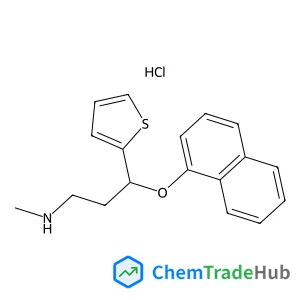
N-Methyl-3-(1-naphthyloxy)-3-(2-thienyl)-1-propanamine hydrochloride (1:1)
CAS Number:
1188266-11-6
Molecular Formula:
C18H20ClNOS
Recommended Suppliers




Disclaimer
This page provides academic journal information for reference and research purposes only. We are not affiliated with any journal publishers and do not handle publication submissions. For publication-related inquiries, please contact the respective journal publishers directly.
If you notice any inaccuracies in the information displayed, please contact us at support@chemtradehub.com. We will promptly review and address your concerns.