


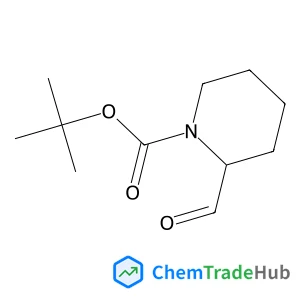
2-Methyl-2-propanyl (2R)-2-formyl-1-piperidinecarboxylate
CAS Number:
134526-69-5
Molecular Formula:
C11H19NO3
Jessica J. Cash, Matthew C. Davis, Michael D. Ford, Thomas J. Groshens, Andrew J. Guenthner, Benjamin G. Harvey, Kevin R. Lamison, Joseph M. Mabry, Heather A. Meylemans, Josiah T. Reams, Christopher M. Sahagun
The tricyanate esters of the natural product resveratrol (1) and dihydroresveratrol (2) were synthesized and subjected to thermal curing which gave polycyanurate network polymers which exhibited glass transition temperatures of >340 °C and 334 °C, respectively. Thermal decomposition temperatures of 412 °C and 403 °C for polycyanurates of 1 and 2, respectively, were typical of this class. However, char yields (600 °C) of 71% and 66% for 1 and 2, respectively, were more than double that from the polycyanurate of bisphenol A dicyanate (25%).

Anti-Corrosion Methods and Materials

Ferroelectrics

Corrosion Science

Chemistry of Natural Compounds

Chemical & Pharmaceutical Bulletin

Bulletin of the Chemical Society of Japan

Journal of the American Chemical Society

Accounts of Chemical Research

Chemistry of Heterocyclic Compounds

Canadian Metallurgical Quarterly
J. S. Eardley, N. Warner, L. Z. Deng, E. Wrede
DOI: 10.1039/C7CP00458C
Shangqian Zhu, Xiaomeng Hu, Minhua Shao
DOI: 10.1039/C7CP00404D
Akira Takakado, Yusuke Nakasone, Masahide Terazima
DOI: 10.1039/C7CP03686H
Jenna W. J. Wu, Ryoichi Moriyama, Keijiro Ohshimo, Fuminori Misaizu
DOI: 10.1039/C7CP04017B
DOI: 10.1039/C7CP01985H
Illia Dobryden, Gen Li, Yunjuan He, Hui Huang, Per-Anders Thorén, David B. Haviland
DOI: 10.1039/C7CP02612A
Bin Zhao, Bo Zhou, Ning Qi, Zhiquan Chen, Wei Zhou
DOI: 10.1039/C6CP07483A
Chaoping Liang, Yongping Zheng, Nickolas Ashburn, Young Jun Oh, Fantai Kong, Chenxi Zhang, Yifan Nie, Jian Sun, Kaihua He, Yu Ye, Rong Chen, Kyeongjae Cho
DOI: 10.1039/C7CP04611A
Sara Macchi, Riccardo Nifosì, Sebastiano Di Pietro, Claudia Boccardi, Francesca D'Autilia, Fabio Beltram, Francesco Cardarelli
DOI: 10.1039/C7CP04320A
6-(3-Fluorophenyl)picolinic acid is generally considered safe for laboratory use...
(3R)-3-Pyrrolidinol is used in the pharmaceutical industry as a precursor for dr...
When handling (4R,5R)-4,5-Diethoxycarbonyl-2,2-dimethyldioxolane (CAS: 59779-75-...
1-(6-Chloroimidazo[1,2-b]pyridazin-3-yl)ethanone is often synthesized via a mult...
The market for N-Ethyl-3,4-dimethylbenzylamine (CAS: 39180-83-1) remains steady,...
Tert-butyl 3-(pyrrolidin-1-yl)azetidine-1-carboxylate is a chemical compound wit...
1-Bromo-3-chloro-2,4-dimethoxybenzene (CAS: 1228956-93-1) falls under the classi...
The safety of 8-Bromo-2-methyl-3,4-dihydroisoquinolin-1(2H)-one (CAS: 1368622-07...
Benzyl [(3S)-2,6-dioxo-3-piperidinyl]carbamate is generally safe when handled wi...
1-{[4-(4,4,5,5-Tetramethyl-1,3,2-dioxaborolan-2-yl)phenyl]sulfonyl}pyrrolidine s...

Polymer Chemistry welcomes submissions in all areas of polymer science that have a strong focus on macromolecular chemistry. Manuscripts may cover a broad range of fields, yet no direct application focus is required.
![4-[(2,4-Dihydroxyphenyl)diazenyl]-5-hydroxy-2,7-naphthalenedisulfonic acid structure](https://static.chemtradehub.com/structs/362/3627-01-8-79ac.webp "4-[(2,4-Dihydroxyphenyl)diazenyl]-5-hydroxy-2,7-naphthalenedisulfonic acid structure")



