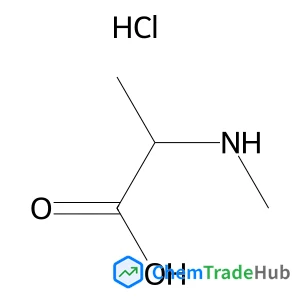
(R)-2-(Methylamino)propanoic acid hydrochloride
CAS Number:
1155878-14-0
Molecular Formula:
C4H10ClNO2
A graphical abstract is available for this content
Dominik Konkolewicz, Angus Gray-Weale, Sébastien Perrier
DOI: 10.1039/C0PY00064G
Qingli Hao, Wu Lei, Mingzhu Xia, Fengyun Wang, Xujie Yang
DOI: 10.1039/C1PY00008J
Shengang Xu, Tao Chen, Hongwu Guo, Qiongyan Liu, Baoxian Ye, Zhi Zhang, Zhiqun He, Shaokui Cao
DOI: 10.1039/C0PY00096E
Jacques Lalevée, Jean Pierre Fouassier
DOI: 10.1039/C1PY00073J
Zhenhua Zhang, Bo Liu, Chunyue Pan, Yongfang Li, Yuehui He, Kechao Zhou, Yingping Zou
DOI: 10.1039/C0PY00136H
Fang Liu, William L. Jarrett, Marek W. Urban
DOI: 10.1039/C0PY00366B
Rong Fu, Guo-Dong Fu
DOI: 10.1039/C0PY00174K
Jinping Zhou, Qian Li, Yongbo Song, Lina Zhang, Xiaoyan Lin
DOI: 10.1039/C0PY00163E
Patigul Imin, Fuyong Cheng, Alex Adronov
DOI: 10.1039/C0PY00286K
Marleen Kamperman, LaShanda T. J. Korley, Billy Yau, Kelly M. Johansen, Yong L. Joo, Ulrich Wiesner
DOI: 10.1039/C0PY00146E
6-(3-Fluorophenyl)picolinic acid is generally considered safe for laboratory use...
(3R)-3-Pyrrolidinol is used in the pharmaceutical industry as a precursor for dr...
When handling (4R,5R)-4,5-Diethoxycarbonyl-2,2-dimethyldioxolane (CAS: 59779-75-...
1-(6-Chloroimidazo[1,2-b]pyridazin-3-yl)ethanone is often synthesized via a mult...
The market for N-Ethyl-3,4-dimethylbenzylamine (CAS: 39180-83-1) remains steady,...
Tert-butyl 3-(pyrrolidin-1-yl)azetidine-1-carboxylate is a chemical compound wit...
1-Bromo-3-chloro-2,4-dimethoxybenzene (CAS: 1228956-93-1) falls under the classi...
The safety of 8-Bromo-2-methyl-3,4-dihydroisoquinolin-1(2H)-one (CAS: 1368622-07...
Benzyl [(3S)-2,6-dioxo-3-piperidinyl]carbamate is generally safe when handled wi...
1-{[4-(4,4,5,5-Tetramethyl-1,3,2-dioxaborolan-2-yl)phenyl]sulfonyl}pyrrolidine s...

Physical Chemistry Chemical Physics (PCCP) is an international journal co-owned by 19 physical chemistry and physics societies from around the world. This journal publishes original, cutting-edge research in physical chemistry, chemical physics and biophysical chemistry. To be suitable for publication in PCCP, articles must include significant innovation and/or insight into physical chemistry; this is the most important criterion that reviewers and Editors will judge against when evaluating submissions. The journal has a broad scope and welcomes contributions spanning experiment, theory, computation and data science. Topical coverage includes spectroscopy, dynamics, kinetics, statistical mechanics, thermodynamics, electrochemistry, catalysis, surface science, quantum mechanics, quantum computing and machine learning. Interdisciplinary research areas such as polymers and soft matter, materials, nanoscience, energy, surfaces/interfaces, and biophysical chemistry are welcomed if they demonstrate significant innovation and/or insight into physical chemistry. Joined experimental/theoretical studies are particularly appreciated when complementary and based on up-to-date approaches.
![4-[(2,4-Dihydroxyphenyl)diazenyl]-5-hydroxy-2,7-naphthalenedisulfonic acid structure](https://static.chemtradehub.com/structs/362/3627-01-8-79ac.webp "4-[(2,4-Dihydroxyphenyl)diazenyl]-5-hydroxy-2,7-naphthalenedisulfonic acid structure")
![2-Methyl-2-propanyl [(2S)-1-hydroxy-3-(4-hydroxyphenyl)-2-propanyl]carbamate structure](https://static.chemtradehub.com/structs/833/83345-46-4-eec2.webp "2-Methyl-2-propanyl [(2S)-1-hydroxy-3-(4-hydroxyphenyl)-2-propanyl]carbamate structure")