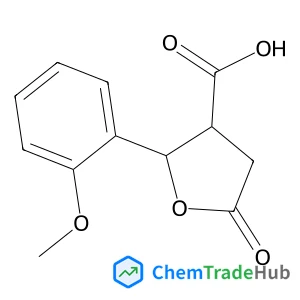
trans-2-(2-Methoxyphenyl)-5-oxotetrahydrofuran-3-carboxylic acid
CAS Number:
99226-02-5
Molecular Formula:
C12H12O5
Jenna W. J. Wu, Ryoichi Moriyama, Keijiro Ohshimo, Fuminori Misaizu
Herein, the compositions and geometrical structures of niobium oxide cluster ions were studied and compared with those of the lighter Group 5 counterpart vanadium oxide cluster ions by ion-mobility mass spectrometry (IM-MS). As a result of collision-induced dissociation in IM-MS, the compositions were found to be dependent on an odd and even number of niobium atoms, whereby the ions with (NbO2)(Nb2O5)(m−1)/2+ and (NbO3)(Nb2O5)(m−1)/2− were identified as stable compositions for an odd number of Nb atoms, whereas (Nb2O5)m/2± and (Nb2O6)(Nb2O5)(m−2)/2− were identified as stable compositions for an even number of Nb atom clusters. Furthermore, structural transitions were observed between m = 8 and 9 for cluster cations and m = 7 and 8 for cluster anions for experimental collision cross-sections (CCSs), which were determined from the arrival times in the ion-mobility measurements. Quantum chemical calculations were conducted on several structural candidates of these compositions for m = 2–12. For cluster cations with the sizes between m = 2 and 8 and cluster anions with m = 2–7, the structures were found to be similar to those of vanadium oxide cluster ions upon comparing the experimental CCSs with the theoretical CCSs of optimized structures. As compared to the vanadium oxide cluster ions, niobium oxide cluster cations with m ≥ 9 and anions with m ≥ 8 consisted of structures where some niobium atoms had more than five oxygen-atom coordination; thus, compact structures could be achieved in the case of niobium oxide cluster ions.
Qingli Hao, Wu Lei, Mingzhu Xia, Fengyun Wang, Xujie Yang
DOI: 10.1039/C1PY00008J
Konstantinos Bebis, Mathew W. Jones, David M. Haddleton, Matthew I. Gibson
DOI: 10.1039/C0PY00408A
Ken Cham-Fai Leung, Kwun-Ngai Lau
DOI: 10.1039/B9PY00380K
Taina Matos, Rui Li, Jason E. Lewis, Jian Zhang, Xiaomei Jiang
DOI: 10.1039/B9PY00324J
Maria Asplund, Tobias Nyberg, Olle Inganäs
DOI: 10.1039/C0PY00077A
Yung-Chung Chen, Wen-Yi Wu, Tzong-Yuan Juang, Shenghong A. Dai, Wen-Chiung Su, Ying-Ling Liu, Rong-Ho Lee, Ru-Jong Jeng
DOI: 10.1039/C0PY00358A
Irakli Javakhishvili, Søren Hvilsted
DOI: 10.1039/C0PY00226G
Niels M. B. Smeets, Jan Meuldijk, Johan P. A. Heuts, Ard C. J. Koeken
DOI: 10.1039/C0PY00111B
6-(3-Fluorophenyl)picolinic acid is generally considered safe for laboratory use...
(3R)-3-Pyrrolidinol is used in the pharmaceutical industry as a precursor for dr...
When handling (4R,5R)-4,5-Diethoxycarbonyl-2,2-dimethyldioxolane (CAS: 59779-75-...
1-(6-Chloroimidazo[1,2-b]pyridazin-3-yl)ethanone is often synthesized via a mult...
The market for N-Ethyl-3,4-dimethylbenzylamine (CAS: 39180-83-1) remains steady,...
Tert-butyl 3-(pyrrolidin-1-yl)azetidine-1-carboxylate is a chemical compound wit...
1-Bromo-3-chloro-2,4-dimethoxybenzene (CAS: 1228956-93-1) falls under the classi...
The safety of 8-Bromo-2-methyl-3,4-dihydroisoquinolin-1(2H)-one (CAS: 1368622-07...
Benzyl [(3S)-2,6-dioxo-3-piperidinyl]carbamate is generally safe when handled wi...
1-{[4-(4,4,5,5-Tetramethyl-1,3,2-dioxaborolan-2-yl)phenyl]sulfonyl}pyrrolidine s...

Physical Chemistry Chemical Physics (PCCP) is an international journal co-owned by 19 physical chemistry and physics societies from around the world. This journal publishes original, cutting-edge research in physical chemistry, chemical physics and biophysical chemistry. To be suitable for publication in PCCP, articles must include significant innovation and/or insight into physical chemistry; this is the most important criterion that reviewers and Editors will judge against when evaluating submissions. The journal has a broad scope and welcomes contributions spanning experiment, theory, computation and data science. Topical coverage includes spectroscopy, dynamics, kinetics, statistical mechanics, thermodynamics, electrochemistry, catalysis, surface science, quantum mechanics, quantum computing and machine learning. Interdisciplinary research areas such as polymers and soft matter, materials, nanoscience, energy, surfaces/interfaces, and biophysical chemistry are welcomed if they demonstrate significant innovation and/or insight into physical chemistry. Joined experimental/theoretical studies are particularly appreciated when complementary and based on up-to-date approaches.