













Temperature-dependent ozonolysis kinetics of selected alkenes in the gas phase: an experimental and structure–activity relationship (SAR) study
Literature Information
Publication Date
2010-02-02
DOI
10.1039/B919731A
Impact Factor
3.676
Authors
Kimberley E. Leather, Max R. McGillen, Carl J. Percival
View Original
Abstract
The kinetics of the reactions of ozone with several alkenes have been measured at atmospheric pressure between 217 and 301 K using EXTRA (EXTreme RAnge chamber). This work represents the first kinetic determinations of the system and focuses on the temperature-dependence of alkene ozonolysis, which is an important tropospheric process impacting upon climate and human health, yet few studies have investigated these reactions as a function of temperature. Temperature-dependent rate coefficients have been established for 3,3-dimethyl-1-butene, 2,4,4-trimethyl-1-pentene and 4-methyl-1-pentene at 217–301 K and atmospheric pressure. The derived Arrhenius expressions are as follows: k = (2.68+2.23−1.23) × 10−15 exp[−(16.29 ± 1.20/RT)], k = (7.31+9.39−4.05) × 10−15 exp[−(15.33 ± 1.84/RT)] and k = (5.21+2.85−1.85) × 10−15 exp[−(15.66 ± 0.87/RT)] cm3 molecule−1 s−1 for 3,3-dimethyl-1-butene, 2,4,4-trimethyl-1-pentene and 4-methyl-1-pentene, respectively. A strong linear correlation has been observed between a simple structure–activity relationship (SAR) and the activation energy, Ea, possessing an R2 value of 0.90. However, no significant correlation was observed for the A-factor. Notwithstanding, with accurate predictions of the SAR for Ea and log k298, values for the A-factor can be retrieved, and hence the prediction of k at any temperature. The newly acquired data agree well with the original SAR and suggest that the factors controlling the rate of ozonolysis reaction are captured accurately by the SAR index.
Recommended Journals
Related Literature
How do ligands influence the quantum yields of cyclometalated platinum(ii) complexes, a theoretical research study
Baozhu Yang, Shuang Huang, Jianhao Wang
2017-08-08
Paper
DOI: 10.1039/C7CP02710A
Characterization of secondary phosphine oxide ligands on the surface of iridium nanoparticles
Israel Cano, Luis M. Martínez-Prieto, Pier F. Fazzini, Bruno Chaudret, Piet W. N. M. van Leeuwen
2017-07-28
Paper
DOI: 10.1039/C7CP03439C
Elucidating the impact of A-site cation change on photocatalytic H2 and O2 evolution activities of perovskite-type LnTaON2 (Ln = La and Pr)
Maged F. Bekheet, Judy N. Hart, Junie Jhon M. Vequizo, Akira Yamakata, Kunio Yubuta, Aleksander Gurlo, Masashi Hasegawa, Kazunari Domen
2017-07-31
Paper
DOI: 10.1039/C7CP03714G
Tunable AIEE fluorescence constructed from a triphenylamine luminogen containing quinoline – application in a reversible and tunable pH sensor
Mengmeng Zhang, Wen Yang, Tingfeng Gong, Weiqun Zhou, Renyu Xue
2017-07-18
Paper
DOI: 10.1039/C7CP03234J
Swollen micelles and alcohol–surfactant co-adsorption: structures and mechanisms from liquid- and solid-state 1H–1H NMR spectroscopy
Christian Totland, Anne Marit Blokhus
2017-02-23
Paper
DOI: 10.1039/C6CP08506G
Theoretical tuning of the singlet–triplet energy gap to achieve efficient long-wavelength thermally activated delayed fluorescence emitters: the impact of substituents
Lijuan Wang, Tao Li, Peicheng Feng, Yan Song
2017-07-17
Paper
DOI: 10.1039/C7CP02615C
Does the endohedral borospherene supersalt FLi2@B39 maintain the “super” properties of its subunits?
A. J. Stasyuk, M. Solà
2017-07-24
Communication
DOI: 10.1039/C7CP02550E
The nature of selenium hydrogen bonding: gas phase spectroscopy and quantum chemistry calculations
Kamal K. Mishra, Santosh K. Singh, Aloke Das
2017-08-15
Paper
DOI: 10.1039/C7CP05265K
Silica nanoparticle monolayers on a macroion modified surface: formation mechanism and stability
M. Morga, Z. Adamczyk, D. Kosior
2017-07-27
Paper
DOI: 10.1039/C7CP03876C
Atomic structure of Mg-based metallic glasses from molecular dynamics and neutron diffraction
Anastasia Gulenko, Louis Forto Chungong, Junheng Gao, Iain Todd, Alex C. Hannon, Richard A. Martin
2017-03-03
Paper
DOI: 10.1039/C6CP03261C
You might also like
Compound Q&A
What are the main uses of 4-Nitrophenyl phosphate disodium salt hexahydrate (CAS: 333338-18-4)?
4-Nitrophenyl phosphate disodium salt hexahydrate is primarily used as a substra...
333338-18-44-Nitrophenyl phosph...
Compound Q&A
What are the main uses of 2-(Trifluoromethyl)-1,3-oxazole-4-carboxylic Acid (CAS: 1060816-01-4)?
2-(Trifluoromethyl)-1,3-oxazole-4-carboxylic Acid (CAS: 1060816-01-4) is widely ...
1060816-01-42-(Trifluoromethyl)-...
Compound Q&A
How should 2-Fluoro-4-biphenylcarboxylic acid (CAS: 137045-30-8) be stored?
2-Fluoro-4-biphenylcarboxylic acid should be stored in a cool, dry place at room...
137045-30-82-Fluoro-4-biphenylc...
Compound Q&A
What industries use Prednisolone-21-Carboxylic Acid (CAS: 61549-70-0)?
Prednisolone-21-Carboxylic Acid is primarily used in the pharmaceutical industry...
61549-70-0Prednisolone-21-Carb...
Compound Q&A
How should 4-(Hydrazinomethyl)-1,2,3-benzenetriol (CAS: 3614-72-0) be stored?
4-(Hydrazinomethyl)-1,2,3-benzenetriol (CAS: 3614-72-0) should be stored in a co...
3614-72-04-(Hydrazinomethyl)-...
Compound Q&A
What industries use 4-Amino-1-methyl-1H-pyrazole-5-carboxylic acid hydrochloride (CAS: 92534-70-8)?
4-Amino-1-methyl-1H-pyrazole-5-carboxylic acid hydrochloride (CAS: 92534-70-8) i...
92534-70-84-Amino-1-methyl-1H-...
Compound Q&A
What regulatory guidelines apply to dehydropachymic acid (CAS: 77012-31-8)?
Dehydropachymic acid (CAS: 77012-31-8) is regulated by various agencies. It fall...
77012-31-8Dehydropachymic acid
Compound Q&A
What is the market or research trend for 6-[(2,2-Dimethylpropanoyl)amino]nicotinic acid (CAS: 898561-66-5)?
The market and research trends for 6-[(2,2-Dimethylpropanoyl)amino]nicotinic aci...
898561-66-56-[(2,2-Dimethylprop...
Compound Q&A
How should 1,10-Phenanthroline-2,9-dicarbaldehyde (CAS: 57709-62-3) be stored?
1,10-Phenanthroline-2,9-dicarbaldehyde should be stored in a cool, dry place awa...
57709-62-31,10-Phenanthroline-...
Compound Q&A
How is 5-Carbamoyl-11-oxo-10,11-dihydro-5H-dibenzo[b,f]azepin-10-yl acetate (CAS: 113952-21-9) typically synthesized?
5-Carbamoyl-11-oxo-10,11-dihydro-5H-dibenzo[b,f]azepin-10-yl acetate can be synt...
113952-21-95-Carbamoyl-11-oxo-1...
Source Journal
Physical Chemistry Chemical Physics

CiteScore:
5.5
Self-citation Rate:
10.3%
Articles per Year:
3036
Physical Chemistry Chemical Physics (PCCP) is an international journal co-owned by 19 physical chemistry and physics societies from around the world. This journal publishes original, cutting-edge research in physical chemistry, chemical physics and biophysical chemistry. To be suitable for publication in PCCP, articles must include significant innovation and/or insight into physical chemistry; this is the most important criterion that reviewers and Editors will judge against when evaluating submissions. The journal has a broad scope and welcomes contributions spanning experiment, theory, computation and data science. Topical coverage includes spectroscopy, dynamics, kinetics, statistical mechanics, thermodynamics, electrochemistry, catalysis, surface science, quantum mechanics, quantum computing and machine learning. Interdisciplinary research areas such as polymers and soft matter, materials, nanoscience, energy, surfaces/interfaces, and biophysical chemistry are welcomed if they demonstrate significant innovation and/or insight into physical chemistry. Joined experimental/theoretical studies are particularly appreciated when complementary and based on up-to-date approaches.
Recommended Compounds
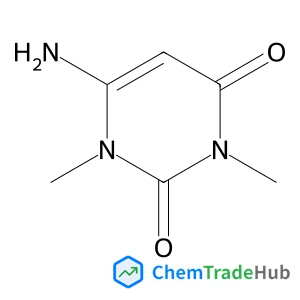
6-amino-1,3-dimethyl-1,2,3,4-tetrahydropyrimidine-2,4-dione
CAS Number:
6642-31-5
Molecular Formula:
C6H9N3O2
Recommended Suppliers




Disclaimer
This page provides academic journal information for reference and research purposes only. We are not affiliated with any journal publishers and do not handle publication submissions. For publication-related inquiries, please contact the respective journal publishers directly.
If you notice any inaccuracies in the information displayed, please contact us at support@chemtradehub.com. We will promptly review and address your concerns.