












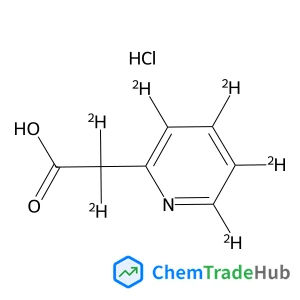
2,2-dideuterio-2-(3,4,5,6-tetradeuterio-2-pyridyl)acetic acid;hydrochloride
CAS Number:
1329799-67-8
Molecular Formula:
C7H2ClD6NO2
Lijuan Wang, Tao Li, Peicheng Feng, Yan Song
Great progress has been made in developing highly efficient thermally activated delayed fluorescent (TADF) materials. However, developing highly efficient long-wavelength TADF emitters is still a challenge because a small energy gap (ΔEST) between the lowest singlet (S1) and triplet excited states (T1) and a relatively high fluorescence rate are difficult to achieve simultaneously in one molecule. Here, eleven donor–acceptor (D–A) type molecules using N3,N3,N6,N6-tetraphenyl-9H-carbazole-3,6-diamine (named DAC-II) as the electron donor and the 2-phenyl-quinoxaline-based electron acceptor are designed via introducing different electron-donating and electron-withdrawing groups into the acceptor and changing the connection position between the donor (D) and the acceptor (A). Quantum chemical calculations indicated that introducing the electron-donating groups (–OCH3, –CH3) into the phenyl ring of the acceptor, molecules 2 and 3, cannot change the emission property of molecule 1, thus molecules 2 and 3 could also be used as green TADF emitters like molecule 1. Introducing an electron-withdrawing unit (–CF3) into molecule 1, molecule 4, reduces the ΔEST value to 0.10 eV, while the radiative decay rate (kVE) is also reduced correspondingly. Changing the connection position between D and A, molecules 5 to 8, cannot reduce the ΔEST value and lowers the kVE value compared with molecules 1 to 4. However, introducing electron-withdrawing groups (–2F, –4F and –CN) into the quinoxaline moiety, molecules 9 to 11, contributes to both small ΔEST and large kVE for the emission process. The values of ΔEST of molecules 9 to 11 are in the range of 0.21 to 0.30 eV, and the maximum emission wavelengths of molecules 10 and 11 are 576 and 590 nm, respectively, which are promising to be used as efficient yellow and orange TADF emitters in organic light-emitting diodes.
Robert J. Kieber, III, Samantha A. Silver, Justin G. Kennemur
DOI: 10.1039/C7PY00949F
Sang Thi Duong, Michiya Fujiki
DOI: 10.1039/C7PY00958E
Limiao Lin, Chun-Ting He, Jiaxiang Qin, Zhong Li, Shuanjin Wang, Min Xiao, Yuezhong Meng
DOI: 10.1039/C7PY00403F
G. Bissadi, R. Weberskirch
DOI: 10.1039/C6PY01034B
Kenjiro Yazawa, Joan Gimenez-Dejoz, Takaaki Hikima, Keiji Numata
DOI: 10.1039/C7PY00770A
Weihong Lu, Xiangqiang Pan, Zhengbiao Zhang, Jian Zhu, Nianchen Zhou, Xiulin Zhu
DOI: 10.1039/C7PY00719A
Hao Ren, Dong Chen, Yan Shi, Haifeng Yu, Zhifeng Fu
DOI: 10.1039/C4PY01062K
Marianne S. Rolph, Anaïs Pitto-Barry, Rachel K. O'Reilly
DOI: 10.1039/C7PY00219J
4-Nitrophenyl phosphate disodium salt hexahydrate is primarily used as a substra...
2-(Trifluoromethyl)-1,3-oxazole-4-carboxylic Acid (CAS: 1060816-01-4) is widely ...
2-Fluoro-4-biphenylcarboxylic acid should be stored in a cool, dry place at room...
Prednisolone-21-Carboxylic Acid is primarily used in the pharmaceutical industry...
4-(Hydrazinomethyl)-1,2,3-benzenetriol (CAS: 3614-72-0) should be stored in a co...
4-Amino-1-methyl-1H-pyrazole-5-carboxylic acid hydrochloride (CAS: 92534-70-8) i...
Dehydropachymic acid (CAS: 77012-31-8) is regulated by various agencies. It fall...
The market and research trends for 6-[(2,2-Dimethylpropanoyl)amino]nicotinic aci...
1,10-Phenanthroline-2,9-dicarbaldehyde should be stored in a cool, dry place awa...
5-Carbamoyl-11-oxo-10,11-dihydro-5H-dibenzo[b,f]azepin-10-yl acetate can be synt...

Physical Chemistry Chemical Physics (PCCP) is an international journal co-owned by 19 physical chemistry and physics societies from around the world. This journal publishes original, cutting-edge research in physical chemistry, chemical physics and biophysical chemistry. To be suitable for publication in PCCP, articles must include significant innovation and/or insight into physical chemistry; this is the most important criterion that reviewers and Editors will judge against when evaluating submissions. The journal has a broad scope and welcomes contributions spanning experiment, theory, computation and data science. Topical coverage includes spectroscopy, dynamics, kinetics, statistical mechanics, thermodynamics, electrochemistry, catalysis, surface science, quantum mechanics, quantum computing and machine learning. Interdisciplinary research areas such as polymers and soft matter, materials, nanoscience, energy, surfaces/interfaces, and biophysical chemistry are welcomed if they demonstrate significant innovation and/or insight into physical chemistry. Joined experimental/theoretical studies are particularly appreciated when complementary and based on up-to-date approaches.
![S-[2,3-Bis(palmitoyloxy)propyl]-N-[(9H-fluoren-9-ylmethoxy)(hydroxy)methylene]cysteine structure](https://static.chemtradehub.com/structs/210/210532-98-2-f6a7.webp "S-[2,3-Bis(palmitoyloxy)propyl]-N-[(9H-fluoren-9-ylmethoxy)(hydroxy)methylene]cysteine structure")
![[(1S,2S,3R,4S,7R,9S,10S,12R,15S)-4,12-Diacetyloxy-15-[(2R,3S)-3-benzamido-3-phenyl-2-(2,2,2-trichloroethoxycarbonyloxy)propanoyl]oxy-1,9-dihydroxy-10,14,17,17-tetramethyl-11-oxo-6-oxatetracyclo[11.3.1.03,10.04,7]heptadec-13-en-2-yl] benzoate structure](https://static.chemtradehub.com/structs/100/100431-55-8-7104.webp "[(1S,2S,3R,4S,7R,9S,10S,12R,15S)-4,12-Diacetyloxy-15-[(2R,3S)-3-benzamido-3-phenyl-2-(2,2,2-trichloroethoxycarbonyloxy)propanoyl]oxy-1,9-dihydroxy-10,14,17,17-tetramethyl-11-oxo-6-oxatetracyclo[11.3.1.03,10.04,7]heptadec-13-en-2-yl] benzoate structure")
phosphoryl}methyl 4-methylbenzenesulfonate structure](https://static.chemtradehub.com/structs/864/864068-45-1-ba7c.webp "{[3-(Hexadecyloxy)propoxy](hydroxy)phosphoryl}methyl 4-methylbenzenesulfonate structure")



