












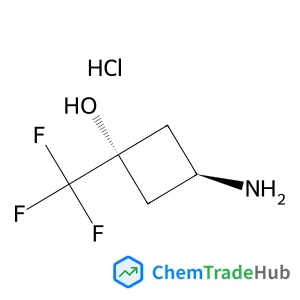
cis-3-Amino-1-(trifluoromethyl)cyclobutanol hydrochloride (1:1)
CAS Number:
1408075-16-0
Molecular Formula:
C5H9ClF3NO
Maged F. Bekheet, Judy N. Hart, Junie Jhon M. Vequizo, Akira Yamakata, Kunio Yubuta, Aleksander Gurlo, Masashi Hasegawa, Kazunari Domen
Transition metal (oxy)nitrides with perovskite-type structures have been regarded as one of the promising classes of inorganic semiconductor materials that can be used in solar water splitting systems for the production of hydrogen as a renewable and storable energy carrier. The performance of transition metal (oxy)nitrides in solar water splitting is strongly influenced by the crystal structure-related dynamics of photogenerated charge carriers. Here, we have systematically assessed the influence of A-site cation exchange on the visible-light-induced photocatalytic H2 and O2 evolution activities, photoanodic response, and dynamics of photogenerated charge carriers of perovskite-type LnTaON2 (Ln = La and Pr). The structural refinement results reveal the orthorhombic Imma and Pnma structures for LaTaON2 and PrTaON2, respectively; the latter has a more distorted crystal structure from the ideal cubic perovskite due to the smaller size of Pr3+ cations. Compared with LaTaON2, PrTaON2 exhibits lower photocatalytic H2 and O2 gas evolution activities and photoanodic response owing to an excessive amount of intrinsic defects associated with anionic vacancies and reduced tantalum species stemming from a long high-temperature nitridation process under reductive NH3 atmosphere. Transient absorption signals evidence the faster decay of photogenerated electrons (holes) in Pt (CoOx)-loaded LaTaON2 than that in Pt (CoOx)-loaded PrTaON2, consistent with the photocatalytic and photoelectrochemical performance of the two photocatalysts. This study suggests that in addition to selecting a suitable A-site cation, it is prerequisite to synthesize LnTaON2 (Ln = La and Pr) crystals with a low defect density to improve their photo-conversion efficiency for solar water splitting.
Takaya Terashima, Mitsuo Sawamoto, Heather D. Maynard
DOI: 10.1039/C4PY01346H
Q. Chai, Y. Huang, T. L. Kirley, N. Ayres
DOI: 10.1039/C7PY00204A
Xing Wang, Juan Wang
DOI: 10.1039/C7PY00698E
Barbara E. Rolfe, Pamela J. Russell, Brian W.-C. Tse
DOI: 10.1039/C4PY00999A
Fagui He, Jidong Zhang
DOI: 10.1039/C6PY00920D
Mengxia Gao, Bin Chen, Yinan Wang, Wenjun Zhou, Wallace W. H. Wong, Trevor A. Smith, Zujin Zhao
DOI: 10.1039/C7PY00564D
DOI: 10.1039/C5PY01937K
Hong Du, Xuxia Yao, Xiaodong Li, Zhiquan Shen
DOI: 10.1039/C6PY01346E
Limiao Lin, Chun-Ting He, Jiaxiang Qin, Zhong Li, Shuanjin Wang, Min Xiao, Yuezhong Meng
DOI: 10.1039/C7PY00403F
Sang Thi Duong, Michiya Fujiki
DOI: 10.1039/C7PY00958E
4-Nitrophenyl phosphate disodium salt hexahydrate is primarily used as a substra...
2-(Trifluoromethyl)-1,3-oxazole-4-carboxylic Acid (CAS: 1060816-01-4) is widely ...
2-Fluoro-4-biphenylcarboxylic acid should be stored in a cool, dry place at room...
Prednisolone-21-Carboxylic Acid is primarily used in the pharmaceutical industry...
4-(Hydrazinomethyl)-1,2,3-benzenetriol (CAS: 3614-72-0) should be stored in a co...
4-Amino-1-methyl-1H-pyrazole-5-carboxylic acid hydrochloride (CAS: 92534-70-8) i...
Dehydropachymic acid (CAS: 77012-31-8) is regulated by various agencies. It fall...
The market and research trends for 6-[(2,2-Dimethylpropanoyl)amino]nicotinic aci...
1,10-Phenanthroline-2,9-dicarbaldehyde should be stored in a cool, dry place awa...
5-Carbamoyl-11-oxo-10,11-dihydro-5H-dibenzo[b,f]azepin-10-yl acetate can be synt...

Physical Chemistry Chemical Physics (PCCP) is an international journal co-owned by 19 physical chemistry and physics societies from around the world. This journal publishes original, cutting-edge research in physical chemistry, chemical physics and biophysical chemistry. To be suitable for publication in PCCP, articles must include significant innovation and/or insight into physical chemistry; this is the most important criterion that reviewers and Editors will judge against when evaluating submissions. The journal has a broad scope and welcomes contributions spanning experiment, theory, computation and data science. Topical coverage includes spectroscopy, dynamics, kinetics, statistical mechanics, thermodynamics, electrochemistry, catalysis, surface science, quantum mechanics, quantum computing and machine learning. Interdisciplinary research areas such as polymers and soft matter, materials, nanoscience, energy, surfaces/interfaces, and biophysical chemistry are welcomed if they demonstrate significant innovation and/or insight into physical chemistry. Joined experimental/theoretical studies are particularly appreciated when complementary and based on up-to-date approaches.
![N-[2-(4-Hydroxyphenoxy)-4-nitrophenyl]methanesulfonamide structure](https://static.chemtradehub.com/structs/109/109032-22-6-7c88.webp "N-[2-(4-Hydroxyphenoxy)-4-nitrophenyl]methanesulfonamide structure")
![(2E)-3-(3-Chlorophenyl)-N-{2-[4-(methylsulfonyl)-1-piperazinyl]-2-oxoethyl}acrylamide structure](https://static.chemtradehub.com/structs/250/2505001-54-5-c1e9.webp "(2E)-3-(3-Chlorophenyl)-N-{2-[4-(methylsulfonyl)-1-piperazinyl]-2-oxoethyl}acrylamide structure")




