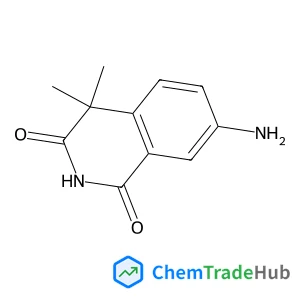
1,3(2H,4H)-Isoquinolinedione, 7-amino-4,4-dimethyl-
CAS Number:
14576-22-8
Molecular Formula:
C11H12N2O2
Christian Totland, Anne Marit Blokhus
Mixtures of surfactants and medium chained alcohols display an anomalous phase behaviour, with the formation of swollen micelles in mid-range surfactant concentrations, which transition into larger non-swollen aggregates when the surfactant concentration increases above a critical point. These alcohols also affect the adsorption behaviour of the surfactants. In this study, intermolecular proximities are measured for such systems by 1H–1H NMR dipolar correlation experiments, giving molecular localizations. The medium chained 1-heptanol and an anionic surfactant sodium dodecyl sulphate (SDS) are studied, both solubilized and adsorbed on alumina. Nuclear Overhauser Effect Spectroscopy (NOESY) shows that 1-heptanol localizes in both the palisade layer and in the core of SDS micelles when the 1-heptanol : SDS mole ratio increases beyond 2. The micelle diameter then increases with increasing 1-heptanol : SDS mole ratios due to more 1-heptanol partitioning in the micelle interior. When the micelle diameter increases beyond ∼6 nm, some SDS moves into the micelle interior, which may be a driving force for the structural transition at higher SDS concentrations. After being adsorbed on alumina, 1H–1H double-quantum magic angle spinning (DQ MAS) shows that SDS/1-heptanol bilayers are formed where 1-heptanol localizes in the palisade layer only, but with slightly different localizations compared to that in micelles. Three different 1-heptanol environments are identified on the surface by 2H NMR using 2H labelled 1-heptanol. However, in contrast to in solution, no 1-heptanol adsolubilizes in the bilayer interior.
Kun Wei, Lei Wang, Lei Li, Sixun Zheng
DOI: 10.1039/C4PY00786G
Yang Zheng, Yucheng Huang, Zaid M. Abbas, Brian C. Benicewicz
DOI: 10.1039/C6PY01319H
Sang Thi Duong, Michiya Fujiki
DOI: 10.1039/C7PY00958E
Barbara E. Rolfe, Pamela J. Russell, Brian W.-C. Tse
DOI: 10.1039/C4PY00999A
Gianpiero Lazzari, Patrick Couvreur, Simona Mura
DOI: 10.1039/C7PY00559H
Qiaomei Chen, Qing Wan, Ke Wang, Jinying Yuan, Xiaoyong Zhang, Lei Tao, Yen Wei
DOI: 10.1039/C7PY00926G
4-Nitrophenyl phosphate disodium salt hexahydrate is primarily used as a substra...
2-(Trifluoromethyl)-1,3-oxazole-4-carboxylic Acid (CAS: 1060816-01-4) is widely ...
2-Fluoro-4-biphenylcarboxylic acid should be stored in a cool, dry place at room...
Prednisolone-21-Carboxylic Acid is primarily used in the pharmaceutical industry...
4-(Hydrazinomethyl)-1,2,3-benzenetriol (CAS: 3614-72-0) should be stored in a co...
4-Amino-1-methyl-1H-pyrazole-5-carboxylic acid hydrochloride (CAS: 92534-70-8) i...
Dehydropachymic acid (CAS: 77012-31-8) is regulated by various agencies. It fall...
The market and research trends for 6-[(2,2-Dimethylpropanoyl)amino]nicotinic aci...
1,10-Phenanthroline-2,9-dicarbaldehyde should be stored in a cool, dry place awa...
5-Carbamoyl-11-oxo-10,11-dihydro-5H-dibenzo[b,f]azepin-10-yl acetate can be synt...

Physical Chemistry Chemical Physics (PCCP) is an international journal co-owned by 19 physical chemistry and physics societies from around the world. This journal publishes original, cutting-edge research in physical chemistry, chemical physics and biophysical chemistry. To be suitable for publication in PCCP, articles must include significant innovation and/or insight into physical chemistry; this is the most important criterion that reviewers and Editors will judge against when evaluating submissions. The journal has a broad scope and welcomes contributions spanning experiment, theory, computation and data science. Topical coverage includes spectroscopy, dynamics, kinetics, statistical mechanics, thermodynamics, electrochemistry, catalysis, surface science, quantum mechanics, quantum computing and machine learning. Interdisciplinary research areas such as polymers and soft matter, materials, nanoscience, energy, surfaces/interfaces, and biophysical chemistry are welcomed if they demonstrate significant innovation and/or insight into physical chemistry. Joined experimental/theoretical studies are particularly appreciated when complementary and based on up-to-date approaches.
![[(1S,2S,3R,4S,7R,9S,10S,12R,15S)-4,12-Diacetyloxy-15-[(2R,3S)-3-benzamido-3-phenyl-2-(2,2,2-trichloroethoxycarbonyloxy)propanoyl]oxy-1,9-dihydroxy-10,14,17,17-tetramethyl-11-oxo-6-oxatetracyclo[11.3.1.03,10.04,7]heptadec-13-en-2-yl] benzoate structure](https://static.chemtradehub.com/structs/100/100431-55-8-7104.webp "[(1S,2S,3R,4S,7R,9S,10S,12R,15S)-4,12-Diacetyloxy-15-[(2R,3S)-3-benzamido-3-phenyl-2-(2,2,2-trichloroethoxycarbonyloxy)propanoyl]oxy-1,9-dihydroxy-10,14,17,17-tetramethyl-11-oxo-6-oxatetracyclo[11.3.1.03,10.04,7]heptadec-13-en-2-yl] benzoate structure")