












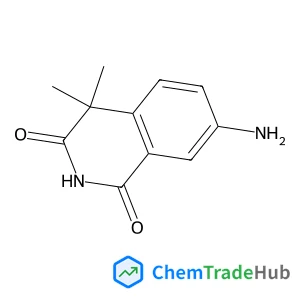
1,3(2H,4H)-Isoquinolinedione, 7-amino-4,4-dimethyl-
CAS Number:
14576-22-8
Molecular Formula:
C11H12N2O2
Israel Cano, Luis M. Martínez-Prieto, Pier F. Fazzini, Bruno Chaudret, Piet W. N. M. van Leeuwen
The synthesis of iridium nanoparticles (IrNPs) ligated by various secondary phosphine oxides (SPOs) is described. This highly reproducible and simple method via H2 reduction produces well dispersed, small nanoparticles (NPs), which were characterized by the state-of-the-art techniques, such as TEM, HRTEM, WAXS and ATR FT-IR spectroscopy. In particular, multinuclear solid state MAS-NMR spectroscopy with and without cross polarization (CP) enabled us to investigate the different binding modes adopted by the ligand at the nanoparticle surface, suggesting the presence of three possible types of coordination: as a purely anionic ligand Ir–P(O)R2, as a neutral acid R2P–O–H and as a monoanionic bidentate H-bonded dimer R2P–O–H⋯OPR2. Specifically, the higher basicity of the dicyclohexyl system leads to the formation of IrNPs in which the bidentate binding mode is most abundant. Such cyclohexyl groups are bent towards the edges, as is suggested by the study of 13CO coordination on the NP surface. This study also showed that the number of surface sites on faces available for bridging CO molecules is higher than the number of sites for terminal CO species on edges and apices, which is unexpected taking into account the small size of the nanoparticles. In addition, the IrNPs present a high chemoselectivity in the hydrogenation of cinnamaldehyde to the unsaturated alcohol.
Ryan Guterman, Tristan D. Harrison, Paul J. Ragogna
DOI: 10.1039/C7PY00438A
Jean-Rémi Pouliot, Bin Sun, Mikaël Leduc, Ahmed Najari, Yuning Li, Mario Leclerc
DOI: 10.1039/C4PY01222D
Yang Zheng, Yucheng Huang, Zaid M. Abbas, Brian C. Benicewicz
DOI: 10.1039/C6PY01319H
Takaya Terashima, Mitsuo Sawamoto, Heather D. Maynard
DOI: 10.1039/C4PY01346H
T. Hoeks, E. Kung, J. P. Lens, P. J. McCloskey, B. A. J. Noordover, J. P. A. Heuts
DOI: 10.1039/C6PY00925E
Mariano J. Garcia-Soto, Karsten Haupt, Carlo Gonzato
DOI: 10.1039/C7PY01113J
Fagui He, Jidong Zhang
DOI: 10.1039/C6PY00920D
Yuanzheng Cui, Yuchuan Liu, Jiancong Liu, Jianfeng Du, Yue Yu, Shun Wang, Zhiqiang Liang, Jihong Yu
DOI: 10.1039/C7PY00856B
Tianchi Xu, Lifen Zhang, Zhenping Cheng, Xiulin Zhu
DOI: 10.1039/C7PY00709D
4-Nitrophenyl phosphate disodium salt hexahydrate is primarily used as a substra...
2-(Trifluoromethyl)-1,3-oxazole-4-carboxylic Acid (CAS: 1060816-01-4) is widely ...
2-Fluoro-4-biphenylcarboxylic acid should be stored in a cool, dry place at room...
Prednisolone-21-Carboxylic Acid is primarily used in the pharmaceutical industry...
4-(Hydrazinomethyl)-1,2,3-benzenetriol (CAS: 3614-72-0) should be stored in a co...
4-Amino-1-methyl-1H-pyrazole-5-carboxylic acid hydrochloride (CAS: 92534-70-8) i...
Dehydropachymic acid (CAS: 77012-31-8) is regulated by various agencies. It fall...
The market and research trends for 6-[(2,2-Dimethylpropanoyl)amino]nicotinic aci...
1,10-Phenanthroline-2,9-dicarbaldehyde should be stored in a cool, dry place awa...
5-Carbamoyl-11-oxo-10,11-dihydro-5H-dibenzo[b,f]azepin-10-yl acetate can be synt...

Physical Chemistry Chemical Physics (PCCP) is an international journal co-owned by 19 physical chemistry and physics societies from around the world. This journal publishes original, cutting-edge research in physical chemistry, chemical physics and biophysical chemistry. To be suitable for publication in PCCP, articles must include significant innovation and/or insight into physical chemistry; this is the most important criterion that reviewers and Editors will judge against when evaluating submissions. The journal has a broad scope and welcomes contributions spanning experiment, theory, computation and data science. Topical coverage includes spectroscopy, dynamics, kinetics, statistical mechanics, thermodynamics, electrochemistry, catalysis, surface science, quantum mechanics, quantum computing and machine learning. Interdisciplinary research areas such as polymers and soft matter, materials, nanoscience, energy, surfaces/interfaces, and biophysical chemistry are welcomed if they demonstrate significant innovation and/or insight into physical chemistry. Joined experimental/theoretical studies are particularly appreciated when complementary and based on up-to-date approaches.
![1-[(4-Methylphenyl)sulfonyl]-3-(4,4,5,5-tetramethyl-1,3,2-dioxaborolan-2-yl)-1H-pyrrolo[2,3-b]pyridine-5-carbonitrile structure](https://static.chemtradehub.com/structs/143/1434747-57-5-fc0d.webp "1-[(4-Methylphenyl)sulfonyl]-3-(4,4,5,5-tetramethyl-1,3,2-dioxaborolan-2-yl)-1H-pyrrolo[2,3-b]pyridine-5-carbonitrile structure")

![N-[2-(4-Hydroxyphenoxy)-4-nitrophenyl]methanesulfonamide structure](https://static.chemtradehub.com/structs/109/109032-22-6-7c88.webp "N-[2-(4-Hydroxyphenoxy)-4-nitrophenyl]methanesulfonamide structure")




