













Tunable AIEE fluorescence constructed from a triphenylamine luminogen containing quinoline – application in a reversible and tunable pH sensor
Literature Information
Publication Date
2017-07-18
DOI
10.1039/C7CP03234J
Impact Factor
3.676
Authors
Mengmeng Zhang, Wen Yang, Tingfeng Gong, Weiqun Zhou, Renyu Xue
View Original
Abstract
Herein, tunable emissions in aggregation processes of triphenylamine derivatives (TPAQs) and their protonated cations, as well as protonated processes have been described. In this study, three triphenylamine-based compounds (TPAQs) were synthesized and their optical properties were investigated. Initially, the TPAQs displayed aggregation-induced emission enhancement (AIEE) properties via the restricted intramolecular charge transfer (ICT) state. Interestingly, the single-branched fluorophore (STPAQ) and its protonated cation emitted different color fluorescence in the solution and aggregation state. They emitted green fluorescence, which originated from the intramolecular charge transfer (ICT) state in a strong polar solvent, but the fluorescence bands turned blue, which was attributed to the LE state in the aggregated state. However, the cations of triple-branched fluorophores (TTPAQs) exhibited an inverse tunable emission process from bluish violet fluorescence of the LE state in a weak polar solvent (e.g., THF) to green fluorescence of the ICT state in the aggregated state. In a THF/water mixture solution (fw = 10%), the STPAQ could switch its emission between blue and green in the pH range of 10.0–0.5. This phenomenon enabled STPAQ to serve as a fluorescent pH sensor in solution. In the powder state, double-branched fluorophores (DTPAQs) could be used as a fluorescent sensor for the detection of acidic and basic organic vapors in the solid state.
Related Literature
Enhanced stability of conductive polyacetylene in ladder-like surface-grafted brushes
Michał Szuwarzyński, Karol Wolski, Szczepan Zapotoczny
2016-08-22
Paper
DOI: 10.1039/C6PY00977H
Thiophene-substituted phenothiazine-based photosensitisers for radical and cationic photopolymerization reactions under visible laser beams (405 and 455 nm)
Renquan Gu, Xiaoyu Ma, Yuming Zhao
2016-07-21
Paper
DOI: 10.1039/C6PY01095D
Design of well-defined shape memory networks with high homogeneity: towards advanced shape memory polymeric materials
Yi Pan, Zhaohui Zheng, Xiaobin Ding
2017-06-15
Communication
DOI: 10.1039/C7PY00904F
Tailoring degree of esterification and branching of poly(glycerol sebacate) by energy efficient microwave irradiation
Chi Ching Lau, Mustafa Kemal Bayazit, Junwang Tang
2017-06-12
Paper
DOI: 10.1039/C7PY00862G
Development of a polymer theranostic for prostate cancer
Barbara E. Rolfe, Pamela J. Russell, Brian W.-C. Tse
2014-09-04
Paper
DOI: 10.1039/C4PY00999A
Kinetic and mechanistic investigation for the copolymerization of CO2 and cyclohexene oxide catalyzed by trizinc complexes
Limiao Lin, Chun-Ting He, Jiaxiang Qin, Zhong Li, Shuanjin Wang, Min Xiao, Yuezhong Meng
2017-05-22
Paper
DOI: 10.1039/C7PY00403F
Amphiphilic/fluorous random copolymers as a new class of non-cytotoxic polymeric materials for protein conjugation
Takaya Terashima, Mitsuo Sawamoto, Heather D. Maynard
2014-10-23
Paper
DOI: 10.1039/C4PY01346H
Photoresponsive liquid crystalline polymer single-chain nanoparticles
Weizheng Fan, Xia Tong, Guo Li, Yue Zhao
2017-05-09
Paper
DOI: 10.1039/C7PY00668C
A three-dimensional porphyrin-based porous organic polymer with excellent biomimetic catalytic performance
Wei Zhu, Zheng-Dong Ding, Xuan Wang, Tao Li, Rui Shen, Yunxing Li, Zaijun Li, Xuehong Ren, Zhi-Guo Gu
2017-07-05
Communication
DOI: 10.1039/C7PY00876G
You might also like
Compound Q&A
What are the main uses of 4-Nitrophenyl phosphate disodium salt hexahydrate (CAS: 333338-18-4)?
4-Nitrophenyl phosphate disodium salt hexahydrate is primarily used as a substra...
333338-18-44-Nitrophenyl phosph...
Compound Q&A
What are the main uses of 2-(Trifluoromethyl)-1,3-oxazole-4-carboxylic Acid (CAS: 1060816-01-4)?
2-(Trifluoromethyl)-1,3-oxazole-4-carboxylic Acid (CAS: 1060816-01-4) is widely ...
1060816-01-42-(Trifluoromethyl)-...
Compound Q&A
How should 2-Fluoro-4-biphenylcarboxylic acid (CAS: 137045-30-8) be stored?
2-Fluoro-4-biphenylcarboxylic acid should be stored in a cool, dry place at room...
137045-30-82-Fluoro-4-biphenylc...
Compound Q&A
What industries use Prednisolone-21-Carboxylic Acid (CAS: 61549-70-0)?
Prednisolone-21-Carboxylic Acid is primarily used in the pharmaceutical industry...
61549-70-0Prednisolone-21-Carb...
Compound Q&A
How should 4-(Hydrazinomethyl)-1,2,3-benzenetriol (CAS: 3614-72-0) be stored?
4-(Hydrazinomethyl)-1,2,3-benzenetriol (CAS: 3614-72-0) should be stored in a co...
3614-72-04-(Hydrazinomethyl)-...
Compound Q&A
What industries use 4-Amino-1-methyl-1H-pyrazole-5-carboxylic acid hydrochloride (CAS: 92534-70-8)?
4-Amino-1-methyl-1H-pyrazole-5-carboxylic acid hydrochloride (CAS: 92534-70-8) i...
92534-70-84-Amino-1-methyl-1H-...
Compound Q&A
What regulatory guidelines apply to dehydropachymic acid (CAS: 77012-31-8)?
Dehydropachymic acid (CAS: 77012-31-8) is regulated by various agencies. It fall...
77012-31-8Dehydropachymic acid
Compound Q&A
What is the market or research trend for 6-[(2,2-Dimethylpropanoyl)amino]nicotinic acid (CAS: 898561-66-5)?
The market and research trends for 6-[(2,2-Dimethylpropanoyl)amino]nicotinic aci...
898561-66-56-[(2,2-Dimethylprop...
Compound Q&A
How should 1,10-Phenanthroline-2,9-dicarbaldehyde (CAS: 57709-62-3) be stored?
1,10-Phenanthroline-2,9-dicarbaldehyde should be stored in a cool, dry place awa...
57709-62-31,10-Phenanthroline-...
Compound Q&A
How is 5-Carbamoyl-11-oxo-10,11-dihydro-5H-dibenzo[b,f]azepin-10-yl acetate (CAS: 113952-21-9) typically synthesized?
5-Carbamoyl-11-oxo-10,11-dihydro-5H-dibenzo[b,f]azepin-10-yl acetate can be synt...
113952-21-95-Carbamoyl-11-oxo-1...
Source Journal
Physical Chemistry Chemical Physics

CiteScore:
5.5
Self-citation Rate:
10.3%
Articles per Year:
3036
Physical Chemistry Chemical Physics (PCCP) is an international journal co-owned by 19 physical chemistry and physics societies from around the world. This journal publishes original, cutting-edge research in physical chemistry, chemical physics and biophysical chemistry. To be suitable for publication in PCCP, articles must include significant innovation and/or insight into physical chemistry; this is the most important criterion that reviewers and Editors will judge against when evaluating submissions. The journal has a broad scope and welcomes contributions spanning experiment, theory, computation and data science. Topical coverage includes spectroscopy, dynamics, kinetics, statistical mechanics, thermodynamics, electrochemistry, catalysis, surface science, quantum mechanics, quantum computing and machine learning. Interdisciplinary research areas such as polymers and soft matter, materials, nanoscience, energy, surfaces/interfaces, and biophysical chemistry are welcomed if they demonstrate significant innovation and/or insight into physical chemistry. Joined experimental/theoretical studies are particularly appreciated when complementary and based on up-to-date approaches.
Recommended Compounds


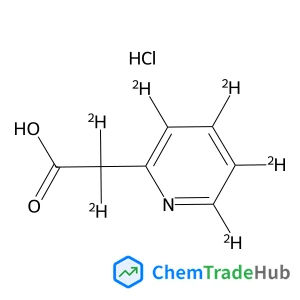
2,2-dideuterio-2-(3,4,5,6-tetradeuterio-2-pyridyl)acetic acid;hydrochloride
CAS Number:
1329799-67-8
Molecular Formula:
C7H2ClD6NO2
Recommended Suppliers



Disclaimer
This page provides academic journal information for reference and research purposes only. We are not affiliated with any journal publishers and do not handle publication submissions. For publication-related inquiries, please contact the respective journal publishers directly.
If you notice any inaccuracies in the information displayed, please contact us at support@chemtradehub.com. We will promptly review and address your concerns.