












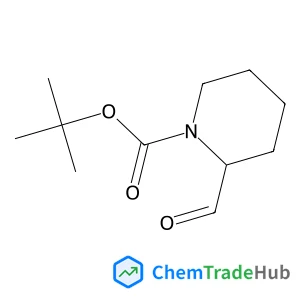
2-Methyl-2-propanyl (2R)-2-formyl-1-piperidinecarboxylate
CAS Number:
134526-69-5
Molecular Formula:
C11H19NO3
Brian E. Hayden, Derek Pletcher, Jens-Peter Suchsland, Laura J. Williams
A range of platinum deposits, equivalent thicknesses (δ) 0.2–2.5 nm, have been synthesised on carbon and reduced titania (TiOx) supports using physical vapour deposition on (10 × 10) arrays of electrodes. For δ < 1.0 nm, discrete platinum centres are formed and the TiOx supported platinum show two distinct characteristics: (a) a strong positive shift in the potential for the oxidation of monolayers of CO with decreasing loading of Pt leading to an inability to oxidise the CO on the lowest loadings and (b) a strong negative shift in the potential for the reduction of oxygen. Both observations can be understood in terms of an increase in the irreversibility of the Pt/PtO couple at such surfaces. The same trends, although significantly weaker, are seen with the carbon supported platinum, δ < 1.0 nm, and it is suggested that the Pt/PtO couple on carbon shows intermediate kinetics between Pt on TiOx and bulk Pt. These results have significant implications for understanding the mechanism of oxygen reduction on supported Pt catalysts and hence for the search for alternative supports to platinum for ORR electrocatalysts.
Miroslav Gál, Magdaléna Hromadová, Jana Bulíčková, Viliam Kolivoška, Josef Cvačka, Kateřina Nováková, Ladislav Kavan, Markéta Zukalová, Lothar Dunsch
DOI: 10.1039/C0CP00986E
Yi-Lei Wang, Ya-Fan Zhao, Ai-Qin Wang, Tao Zhang, Jun Li
DOI: 10.1039/B921367H
Masaoki Iwasaki, Hirofumi Shinjoh
DOI: 10.1039/B923938C
Maroof Ali, Vinod Kumar, Sheila N. Baker, Gary A. Baker, Siddharth Pandey
DOI: 10.1039/B920500D
Oliver Zech, Johannes Hunger, Joshua R. Sangoro, Ciprian Iacob, Friedrich Kremer, Werner Kunz, Richard Buchner
DOI: 10.1039/C0CP00840K
Seok-Jun Seo, Jung-Je Woo, Sung-Hyun Yun, Hong-Joo Lee, Jin-Soo Park, Tongwen Xu, Tae-Hyun Yang, Jaeyoung Lee, Seung-Hyeon Moon
DOI: 10.1039/C0CP00662A
Orlando Omar Prieto Mahaney, Ryu Abe, Bunsho Ohtani
DOI: 10.1039/B917399D
Aljaž Godec, Miran Gaberšček, Janko Jamnik, Dušanka Janežič, Franci Merzel
DOI: 10.1039/C004435K
Haiguang Zhao, Mohamed Chaker, Dongling Ma
DOI: 10.1039/C0CP01305F
Tatiana Korona
DOI: 10.1039/C0CP00474J
6-(3-Fluorophenyl)picolinic acid is generally considered safe for laboratory use...
(3R)-3-Pyrrolidinol is used in the pharmaceutical industry as a precursor for dr...
When handling (4R,5R)-4,5-Diethoxycarbonyl-2,2-dimethyldioxolane (CAS: 59779-75-...
1-(6-Chloroimidazo[1,2-b]pyridazin-3-yl)ethanone is often synthesized via a mult...
The market for N-Ethyl-3,4-dimethylbenzylamine (CAS: 39180-83-1) remains steady,...
Tert-butyl 3-(pyrrolidin-1-yl)azetidine-1-carboxylate is a chemical compound wit...
1-Bromo-3-chloro-2,4-dimethoxybenzene (CAS: 1228956-93-1) falls under the classi...
The safety of 8-Bromo-2-methyl-3,4-dihydroisoquinolin-1(2H)-one (CAS: 1368622-07...
Benzyl [(3S)-2,6-dioxo-3-piperidinyl]carbamate is generally safe when handled wi...
1-{[4-(4,4,5,5-Tetramethyl-1,3,2-dioxaborolan-2-yl)phenyl]sulfonyl}pyrrolidine s...

Physical Chemistry Chemical Physics (PCCP) is an international journal co-owned by 19 physical chemistry and physics societies from around the world. This journal publishes original, cutting-edge research in physical chemistry, chemical physics and biophysical chemistry. To be suitable for publication in PCCP, articles must include significant innovation and/or insight into physical chemistry; this is the most important criterion that reviewers and Editors will judge against when evaluating submissions. The journal has a broad scope and welcomes contributions spanning experiment, theory, computation and data science. Topical coverage includes spectroscopy, dynamics, kinetics, statistical mechanics, thermodynamics, electrochemistry, catalysis, surface science, quantum mechanics, quantum computing and machine learning. Interdisciplinary research areas such as polymers and soft matter, materials, nanoscience, energy, surfaces/interfaces, and biophysical chemistry are welcomed if they demonstrate significant innovation and/or insight into physical chemistry. Joined experimental/theoretical studies are particularly appreciated when complementary and based on up-to-date approaches.
![2-Methyl-2-propanyl [(2S)-1-hydroxy-3-(4-hydroxyphenyl)-2-propanyl]carbamate structure](https://static.chemtradehub.com/structs/833/83345-46-4-eec2.webp "2-Methyl-2-propanyl [(2S)-1-hydroxy-3-(4-hydroxyphenyl)-2-propanyl]carbamate structure")
![4-[(2,4-Dihydroxyphenyl)diazenyl]-5-hydroxy-2,7-naphthalenedisulfonic acid structure](https://static.chemtradehub.com/structs/362/3627-01-8-79ac.webp "4-[(2,4-Dihydroxyphenyl)diazenyl]-5-hydroxy-2,7-naphthalenedisulfonic acid structure")





