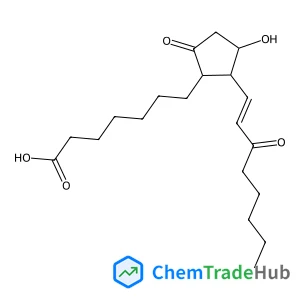
(11alpha,13E)-11-Hydroxy-9,15-dioxoprost-13-en-1-oic acid
CAS Number:
22973-19-9
Molecular Formula:
C20H32O5
Tatiana Korona
A new coupled cluster model of the polarization propagator, denoted as XCC2, is presented. The XCC2 approach employs time-independent coupled cluster theory of polarization propagators of Moszynski et al. [Collect. Czech. Chem. Commun., 2005, 70, 1109] and excitation operators from the time-dependent (TD) CC2 method. The performance of XCC2 was investigated by calculating static and dynamic dipole polarizabilities for a test set of over 20 molecules and comparing them with TD-CCSD results. The quality of XCC2 dispersion coefficients for several noncovalent molecular complexes was also tested against the benchmark values. This numerical study reveals that the average percent error of XCC2 is significantly reduced in comparison to the TD-CC2 method (4-fold reduction for the mean polarizabilities and 2-fold reduction for anisotropic polarizabilities is observed). Since the computational requirements of both XCC2 and TD-CC2 methods are virtually the same, the new XCC2 method can be viewed as a practical alternative for TD-CC2 for property calculations, giving the second-order polarization propagators of near-CCSD quality in many cases, but retaining at the same time the lower computational cost of the TD-CC2 model.
Takao Otsuka, Hironori Izawa, Kenji Morihashi
DOI: 10.1039/C7CP07877C
I. León, I. Peña, C. Cabezas, E. R. Alonso, J. L. Alonso
DOI: 10.1039/C8CP01734D
Anand Narayanan Kirshnamoorthy, Kristina Oldiges, Andreas Heuer, Isidora Cekic-Laskovic, Christian Holm
DOI: 10.1039/C8CP04102D
Ke-Qiu Chen
DOI: 10.1039/C7CP07795E
Irene Isturiz, Carlo Marini, Marta Avila, Masashi Okubo, Huiqiao Li, Haoshen Zhou, Takashi Mizokawa, Naurang Lal Saini, Laura Simonelli
DOI: 10.1039/C8CP00716K
Omer Meroz, Yaniv Gelbstein
DOI: 10.1039/C7CP06176E
Swapnil Varhade, Zahid M. Bhat, Ravikumar Thimmappa, Mruthyunjayachari C. Devendrachari, Alagar R. Kottaichamy, Manu Gautam, Shahid P. Shafi, Musthafa Ottakam Thotiyl
DOI: 10.1039/C8CP03768J
Chun-Teh Chen, Markus J. Buehler
DOI: 10.1039/C8CP05037F
Weilin Chen, Zhiqiang Zhu, Chang Yin, Yibao Li, Yi Liu, Yuting Zhang, Yulan Fan, Xiaolin Fan
DOI: 10.1039/C7CP05845D
6-(3-Fluorophenyl)picolinic acid is generally considered safe for laboratory use...
(3R)-3-Pyrrolidinol is used in the pharmaceutical industry as a precursor for dr...
When handling (4R,5R)-4,5-Diethoxycarbonyl-2,2-dimethyldioxolane (CAS: 59779-75-...
1-(6-Chloroimidazo[1,2-b]pyridazin-3-yl)ethanone is often synthesized via a mult...
The market for N-Ethyl-3,4-dimethylbenzylamine (CAS: 39180-83-1) remains steady,...
Tert-butyl 3-(pyrrolidin-1-yl)azetidine-1-carboxylate is a chemical compound wit...
1-Bromo-3-chloro-2,4-dimethoxybenzene (CAS: 1228956-93-1) falls under the classi...
The safety of 8-Bromo-2-methyl-3,4-dihydroisoquinolin-1(2H)-one (CAS: 1368622-07...
Benzyl [(3S)-2,6-dioxo-3-piperidinyl]carbamate is generally safe when handled wi...
1-{[4-(4,4,5,5-Tetramethyl-1,3,2-dioxaborolan-2-yl)phenyl]sulfonyl}pyrrolidine s...

Physical Chemistry Chemical Physics (PCCP) is an international journal co-owned by 19 physical chemistry and physics societies from around the world. This journal publishes original, cutting-edge research in physical chemistry, chemical physics and biophysical chemistry. To be suitable for publication in PCCP, articles must include significant innovation and/or insight into physical chemistry; this is the most important criterion that reviewers and Editors will judge against when evaluating submissions. The journal has a broad scope and welcomes contributions spanning experiment, theory, computation and data science. Topical coverage includes spectroscopy, dynamics, kinetics, statistical mechanics, thermodynamics, electrochemistry, catalysis, surface science, quantum mechanics, quantum computing and machine learning. Interdisciplinary research areas such as polymers and soft matter, materials, nanoscience, energy, surfaces/interfaces, and biophysical chemistry are welcomed if they demonstrate significant innovation and/or insight into physical chemistry. Joined experimental/theoretical studies are particularly appreciated when complementary and based on up-to-date approaches.
![2-[({[(2-Methyl-2-propanyl)oxy]carbonyl}amino)methyl]isonicotinic acid structure](https://static.chemtradehub.com/structs/473/473924-63-9-973b.webp "2-[({[(2-Methyl-2-propanyl)oxy]carbonyl}amino)methyl]isonicotinic acid structure")
![Benzyl spiro[indole-3,4'-piperidine]-1(2H)-carboxylate hydrochloride (1:1) structure](https://static.chemtradehub.com/structs/159/159635-46-8-8de0.webp "Benzyl spiro[indole-3,4'-piperidine]-1(2H)-carboxylate hydrochloride (1:1) structure")