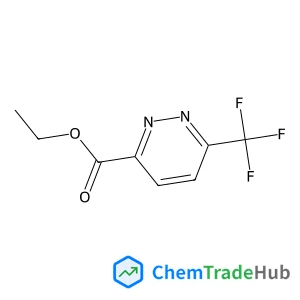
Ethyl 6-(trifluoromethyl)pyridazine-3-carboxylate
CAS Number:
1192155-06-8
Molecular Formula:
C8H7F3N2O2
Oliver Zech, Johannes Hunger, Joshua R. Sangoro, Ciprian Iacob, Friedrich Kremer, Werner Kunz, Richard Buchner
The ionic liquid (IL) [Na][TOTO], with sodium as the cation and an oligoethercarboxylate as the anion, shows properties that differ significantly from conventional ionic liquids, like imidazolium salts. Its polarity, determined in the temperature range of (293–333) K from measurements of Reichardt's ENT value and the Kamlet–Taft parameters is extraordinarily low and matches the dielectric constant extrapolated from frequency dependent complex permittivity measurements. The dielectric spectra also reveal split dynamics with the dominating slow mode probably associated with the reorientation of –COO−⋯Na+ ion pairs and the fast mode arising from the flexibility of the oligoethylene moieties of the anion. This assignment, supported by the derived effective dipole moments, argues against our previous hypothesis [O. Zech et al., Chem.–Eur. J., 2009, 15, 1341–1345] that salts, such as [Na][TOTO], have low melting points because of cation complexation in a pseudo crown ether-like fashion and resulting “intra-molecular” charge neutralization. The present data rule out a rigid chelate-like complex as the dominating species. Considering the present findings together with the viscosities of [TOTO]− salts, a crosslinked structure of the ionic liquid with strong –COO−⋯Na+ interactions and relatively weaker forces between cations and ether oxygen groups of the anions appears to be plausible.
Pierre Florian, James W. E. Drewitt, Louis Hennet, Vincent Sarou-Kanian, Dominique Massiot, Henry E. Fischer, Daniel R. Neuville
DOI: 10.1039/C8CP04908D
Violeta Fuentes-Landete, Karsten W. Köster, Roland Böhmer, Thomas Loerting
DOI: 10.1039/C8CP03786H
Michael Schneider, Marie-Luise Hebestreit, Mirko Matthias Lindic, Hilda Parsian, América Yareth Torres-Boy, Leonardo Álvarez-Valtierra, W. Leo Meerts, Ralf Kühnemuth, Michael Schmitt
DOI: 10.1039/C8CP04020F
Chun-Teh Chen, Markus J. Buehler
DOI: 10.1039/C8CP05037F
DOI: 10.1039/C8CP91824D
Jianhui Han, Xiaochun Liu, Hui Li, Hang Yin, Huifang Zhao, Lina Ma, Yaodong Song, Ying Shi
DOI: 10.1039/C8CP05716H
Sergey V. Zybin, William A. Goddard, III, Tao Cheng, Saber Naserifar, Andres Jaramillo-Botero, Fenglei Huang
DOI: 10.1039/C7CP07321F
Takao Otsuka, Hironori Izawa, Kenji Morihashi
DOI: 10.1039/C7CP07877C
Arkamita Bandyopadhyay, Dibyajyoti Ghosh
DOI: 10.1039/C7CP07165E
6-(3-Fluorophenyl)picolinic acid is generally considered safe for laboratory use...
(3R)-3-Pyrrolidinol is used in the pharmaceutical industry as a precursor for dr...
When handling (4R,5R)-4,5-Diethoxycarbonyl-2,2-dimethyldioxolane (CAS: 59779-75-...
1-(6-Chloroimidazo[1,2-b]pyridazin-3-yl)ethanone is often synthesized via a mult...
The market for N-Ethyl-3,4-dimethylbenzylamine (CAS: 39180-83-1) remains steady,...
Tert-butyl 3-(pyrrolidin-1-yl)azetidine-1-carboxylate is a chemical compound wit...
1-Bromo-3-chloro-2,4-dimethoxybenzene (CAS: 1228956-93-1) falls under the classi...
The safety of 8-Bromo-2-methyl-3,4-dihydroisoquinolin-1(2H)-one (CAS: 1368622-07...
Benzyl [(3S)-2,6-dioxo-3-piperidinyl]carbamate is generally safe when handled wi...
1-{[4-(4,4,5,5-Tetramethyl-1,3,2-dioxaborolan-2-yl)phenyl]sulfonyl}pyrrolidine s...

Physical Chemistry Chemical Physics (PCCP) is an international journal co-owned by 19 physical chemistry and physics societies from around the world. This journal publishes original, cutting-edge research in physical chemistry, chemical physics and biophysical chemistry. To be suitable for publication in PCCP, articles must include significant innovation and/or insight into physical chemistry; this is the most important criterion that reviewers and Editors will judge against when evaluating submissions. The journal has a broad scope and welcomes contributions spanning experiment, theory, computation and data science. Topical coverage includes spectroscopy, dynamics, kinetics, statistical mechanics, thermodynamics, electrochemistry, catalysis, surface science, quantum mechanics, quantum computing and machine learning. Interdisciplinary research areas such as polymers and soft matter, materials, nanoscience, energy, surfaces/interfaces, and biophysical chemistry are welcomed if they demonstrate significant innovation and/or insight into physical chemistry. Joined experimental/theoretical studies are particularly appreciated when complementary and based on up-to-date approaches.
![2-[({[(2-Methyl-2-propanyl)oxy]carbonyl}amino)methyl]isonicotinic acid structure](https://static.chemtradehub.com/structs/473/473924-63-9-973b.webp "2-[({[(2-Methyl-2-propanyl)oxy]carbonyl}amino)methyl]isonicotinic acid structure")
![[4-Chloro-3-(diethylcarbamoyl)phenyl]boronic acid structure](https://static.chemtradehub.com/structs/871/871332-68-2-0e3b.webp "[4-Chloro-3-(diethylcarbamoyl)phenyl]boronic acid structure")