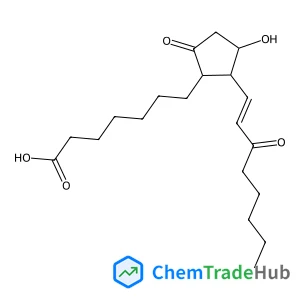
(11alpha,13E)-11-Hydroxy-9,15-dioxoprost-13-en-1-oic acid
CAS Number:
22973-19-9
Molecular Formula:
C20H32O5
Miroslav Gál, Magdaléna Hromadová, Jana Bulíčková, Viliam Kolivoška, Josef Cvačka, Kateřina Nováková, Ladislav Kavan, Markéta Zukalová, Lothar Dunsch
A transfer of fullerene C60 to water was achieved by sonication of a two-phase system of water and C60 in organic solvents, namely, benzene and toluene. Resulting aqueous dispersions were analyzed electrochemically, spectroscopically, by MALDI-MS and AFM methods. Samples prepared from benzene yield the formal redox potential very close to a value expected from the correlation of redox potentials and solvent donor numbers. However, these samples are not stable and C60 precipitates out of the aqueous dispersion. Sonication of the toluene/water system produces stable system, in which the measured formal redox potential of C60 is less negative. Stabilization of C60 clusters in water is achieved by the presence of an organic amphiphile and spectroscopic methods indicate the presence of benzoate formed during sonication of a toluene/water mixture.
Alessandro Senocrate, Igor Moudrakovski, Joachim Maier
DOI: 10.1039/C8CP01535J
Christopher D. Daub, Natalie M. Cann, D. Bratko, Alenka Luzar
DOI: 10.1039/C8CP03791D
Ruma Das, Gone Rajender
DOI: 10.1039/C7CP06994D
Zakhar Reveguk, Roman Lysenko, Ruslan Ramazanov, Alexei Kononov
DOI: 10.1039/C8CP05727C
Michael Schneider, Marie-Luise Hebestreit, Mirko Matthias Lindic, Hilda Parsian, América Yareth Torres-Boy, Leonardo Álvarez-Valtierra, W. Leo Meerts, Ralf Kühnemuth, Michael Schmitt
DOI: 10.1039/C8CP04020F
Xiao Hua Wang, Da Wei Wang, Ai Jun Yang, Nikhil Koratkar, Ji Feng Chu, Pin Lei Lv, Ming Zhe Rong
DOI: 10.1039/C7CP07906K
Cristian Celis-Barros, María J. Beltrán-Leiva
DOI: 10.1039/C7CP06585J
Sergey V. Zybin, William A. Goddard, III, Tao Cheng, Saber Naserifar, Andres Jaramillo-Botero, Fenglei Huang
DOI: 10.1039/C7CP07321F
Yiming Rong, Pengfei Ji, Mengzhe He, Yuwen Zhang, Yong Tang
DOI: 10.1039/C8CP03017K
Guang-Feng Wei, Ling-Ran Zhang, Zhi-Pan Liu
DOI: 10.1039/C8CP05079A
6-(3-Fluorophenyl)picolinic acid is generally considered safe for laboratory use...
(3R)-3-Pyrrolidinol is used in the pharmaceutical industry as a precursor for dr...
When handling (4R,5R)-4,5-Diethoxycarbonyl-2,2-dimethyldioxolane (CAS: 59779-75-...
1-(6-Chloroimidazo[1,2-b]pyridazin-3-yl)ethanone is often synthesized via a mult...
The market for N-Ethyl-3,4-dimethylbenzylamine (CAS: 39180-83-1) remains steady,...
Tert-butyl 3-(pyrrolidin-1-yl)azetidine-1-carboxylate is a chemical compound wit...
1-Bromo-3-chloro-2,4-dimethoxybenzene (CAS: 1228956-93-1) falls under the classi...
The safety of 8-Bromo-2-methyl-3,4-dihydroisoquinolin-1(2H)-one (CAS: 1368622-07...
Benzyl [(3S)-2,6-dioxo-3-piperidinyl]carbamate is generally safe when handled wi...
1-{[4-(4,4,5,5-Tetramethyl-1,3,2-dioxaborolan-2-yl)phenyl]sulfonyl}pyrrolidine s...

Physical Chemistry Chemical Physics (PCCP) is an international journal co-owned by 19 physical chemistry and physics societies from around the world. This journal publishes original, cutting-edge research in physical chemistry, chemical physics and biophysical chemistry. To be suitable for publication in PCCP, articles must include significant innovation and/or insight into physical chemistry; this is the most important criterion that reviewers and Editors will judge against when evaluating submissions. The journal has a broad scope and welcomes contributions spanning experiment, theory, computation and data science. Topical coverage includes spectroscopy, dynamics, kinetics, statistical mechanics, thermodynamics, electrochemistry, catalysis, surface science, quantum mechanics, quantum computing and machine learning. Interdisciplinary research areas such as polymers and soft matter, materials, nanoscience, energy, surfaces/interfaces, and biophysical chemistry are welcomed if they demonstrate significant innovation and/or insight into physical chemistry. Joined experimental/theoretical studies are particularly appreciated when complementary and based on up-to-date approaches.