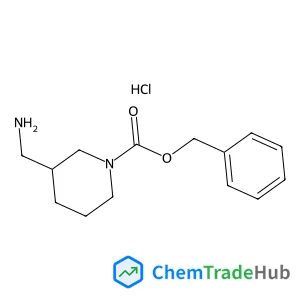
Benzyl 3-(aminomethyl)piperidine-1-carboxylate hydrochloride
CAS Number:
1186663-23-9
Molecular Formula:
C14H21ClN2O2
Masaoki Iwasaki, Hirofumi Shinjoh
States of NO2 adsorption and kinetics of NO2 desorption over a Fe-loaded ZSM-5 type zeolite were investigated using Fourier transform infrared (FT-IR) spectroscopy and temperature-programmed desorption (TPD). The FT-IR spectra in NO2/N2 flows showed that several adsorption species (NO2, nitrite, nitrate, and NO+) existed; except for NO2, these were considered to be formed via NO2 dimerization and disproportionation reactions. The TPD spectra showed two distinct peaks, a low-temperature (LT) peak that can be assigned to weakly adsorbed NOx in the zeolite channel and a high-temperature (HT) peak that can be assigned to chemisorbed NOx bonded to ion-exchanged Fe sites. By varying flow rates and heating rates in TPD measurements, the peak maximum temperatures in the both peaks were found to be constant with the former, but shifted to higher temperatures with the latter; this suggests that desorption is not controlled by an adsorption/desorption equilibrium, i.e., in the no-readsorption limit. Furthermore, it was found that desorption at both LT and HT peaks proceeds at second order; this implies that the reverse reaction of NO2 dimerization and disproportionation and/or some sort of lateral interaction between NO2 molecules might be occurring. The desorption energies and the pre-exponential factors were estimated to be 67 ± 1 kJ mol−1 and 105.5±0.2 s−1 for the LT peak and 138 ± 4 kJ mol−1 and 109.8±0.3 s−1 for the HT peak. These values show that interaction strengths between adsorbed NOx and Fe sites are relatively large.
David Peyrot, Mathieu G. Silly, Fabien Silly
DOI: 10.1039/C7CP06488H
Hamzeh Yaghoubi, Masumeh Foroutan
DOI: 10.1039/C8CP03762K
Yiming Rong, Pengfei Ji, Mengzhe He, Yuwen Zhang, Yong Tang
DOI: 10.1039/C8CP03017K
DOI: 10.1039/C7CP07769F
Ibrahim Sadiek, Tommi Mikkonen, Juha Toivonen, Aleksandra Foltynowicz
DOI: 10.1039/C8CP05666H
Weilin Chen, Zhiqiang Zhu, Chang Yin, Yibao Li, Yi Liu, Yuting Zhang, Yulan Fan, Xiaolin Fan
DOI: 10.1039/C7CP05845D
Shriram Janghela, Nagendra Singh Neeraj, Kavita Agarwal, Debmalya Roy, Kingsuk Mukhopadhyay, Namburi Eswara Prasad
DOI: 10.1039/C8CP05570J
D. Kaiser, E. Reusch, P. Hemberger, A. Bodi, E. Welz, B. Engels, I. Fischer
DOI: 10.1039/C7CP08055G
Christian F. Pantoja, Y. Mauricio Muñoz-Muñoz, Lorraine Guastar, Jadran Vrabec, Julien Wist
DOI: 10.1039/C8CP05539D
6-(3-Fluorophenyl)picolinic acid is generally considered safe for laboratory use...
(3R)-3-Pyrrolidinol is used in the pharmaceutical industry as a precursor for dr...
When handling (4R,5R)-4,5-Diethoxycarbonyl-2,2-dimethyldioxolane (CAS: 59779-75-...
1-(6-Chloroimidazo[1,2-b]pyridazin-3-yl)ethanone is often synthesized via a mult...
The market for N-Ethyl-3,4-dimethylbenzylamine (CAS: 39180-83-1) remains steady,...
Tert-butyl 3-(pyrrolidin-1-yl)azetidine-1-carboxylate is a chemical compound wit...
1-Bromo-3-chloro-2,4-dimethoxybenzene (CAS: 1228956-93-1) falls under the classi...
The safety of 8-Bromo-2-methyl-3,4-dihydroisoquinolin-1(2H)-one (CAS: 1368622-07...
Benzyl [(3S)-2,6-dioxo-3-piperidinyl]carbamate is generally safe when handled wi...
1-{[4-(4,4,5,5-Tetramethyl-1,3,2-dioxaborolan-2-yl)phenyl]sulfonyl}pyrrolidine s...

Physical Chemistry Chemical Physics (PCCP) is an international journal co-owned by 19 physical chemistry and physics societies from around the world. This journal publishes original, cutting-edge research in physical chemistry, chemical physics and biophysical chemistry. To be suitable for publication in PCCP, articles must include significant innovation and/or insight into physical chemistry; this is the most important criterion that reviewers and Editors will judge against when evaluating submissions. The journal has a broad scope and welcomes contributions spanning experiment, theory, computation and data science. Topical coverage includes spectroscopy, dynamics, kinetics, statistical mechanics, thermodynamics, electrochemistry, catalysis, surface science, quantum mechanics, quantum computing and machine learning. Interdisciplinary research areas such as polymers and soft matter, materials, nanoscience, energy, surfaces/interfaces, and biophysical chemistry are welcomed if they demonstrate significant innovation and/or insight into physical chemistry. Joined experimental/theoretical studies are particularly appreciated when complementary and based on up-to-date approaches.