












Measuring and predicting ΔvapH298 values of ionic liquids
Literature Information
Publication Date
2009-07-27
DOI
10.1039/B908209C
Impact Factor
3.676
Authors
Alexey Deyko, Kevin R. J. Lovelock, Jo-Anne Corfield, Alasdair W. Taylor, Peter N. Gooden, Ignacio J. Villar-Garcia, Peter Licence, Robert G. Jones, Vladimir G. Krasovskiy, Elena A. Chernikova, Leonid M. Kustov
View Original
Abstract
We report the enthalpies of vaporisation (measured using temperature programmed desorption by mass spectrometry) of twelve ionic liquids (ILs), covering four imidazolium, [CmCnIm]+, five pyrrolidinium, [CnCmPyrr]+, two pyridinium, [CnPy]+, and a dication, [C3(C1Im)2]2+ based IL. These cations were paired with a range of anions: [BF4]−, [FeCl4]−, [N(CN)2]−, [PF3(C2F5)3]− ([FAP]−), [(CF3SO2)2N]− ([Tf2N]−) and [SCN]−. Using these results, plus those for a further eight imidazolium based ILs published earlier (which include the anions [CF3SO3]− ([TfO]−), [PF6]− and [EtSO4]−), we show that the enthalpies of vaporisation can be decomposed into three components. The first component is the Coulombic interaction between the ions, ΔUCou,R, which is a function of the IL molar volume, Vm, and a parameter Rr which quantifies the relative change in anion–cation distance on evaporation from the liquid phase to the ion pair in the gas phase. The second and third components are the van der Waals contributions from the anion, ΔHvdw,A, and the cation, ΔHvdw,C. We derive a universal value for Rr, and individual values of ΔHvdw,A and ΔHvdw,C for each of the anions and cations considered in this study. Given the molar volume, it is possible to estimate the enthalpies of vaporisation of ILs composed of any combination of the ions considered here; values for fourteen ILs which have not yet been studied experimentally are given.
Related Literature
A highly efficient growth mechanism of polycyclic aromatic hydrocarbons
Bikau Shukla, Mitsuo Koshi
2010-01-21
Paper
DOI: 10.1039/B919644G
Measurement of multiple torsional angles from one-dimensional solid-state NMR spectra: application to the conformational analysis of a ligand in its biological receptor site
Rachel Edwards, Jillian Madine, Lee Fielding, David A. Middleton
2010-09-28
Paper
DOI: 10.1039/C0CP00326C
Quantum-chemical study and FTIR jet spectroscopy of CHCl3–NH3 association in the gas phase
Michael Hippler, Susanne Hesse, Martin A. Suhm
2010-08-09
Paper
DOI: 10.1039/C0CP00530D
Reply to the ‘Comment on “An explanation for the charge on water's surface”’ by R. Vácha, D. Horinek, R. Buchner, B. Winter and P. Jungwirth, Phys. Chem. Chem. Phys., 2010, 12, DOI: 10.1039/c001492c
Angus Gray-Weale, James K. Beattie
2010-09-23
Comment
DOI: 10.1039/C0CP00688B
Reply to “Comment on ‘NMR spectroscopic studies of cellobiose solvation in EmimAc aimed to understand the dissolution mechanism of cellulose in ionic liquids’” by R. C. Remsing, I. D. Petrik, Z. Liu and G. Moyna, Phys. Chem. Chem. Phys., 2010, 12, DOI: 10.1039/c004203j
Jinming Zhang, Hao Zhang, Jin Wu, Jun Zhang, Jiasong He, Junfeng Xiang
2010-10-19
Comment
DOI: 10.1039/C005453B
Confinement effects on excitation energies and regioselectivity as probed by the Fukui function and the molecular electrostatic potential
Alex Borgoo, David J. Tozer, Paul Geerlings, Frank De Proft
2009-03-12
Paper
DOI: 10.1039/B820114E
XCC2—a new coupled cluster model for the second-order polarization propagator
Tatiana Korona
2010-10-15
Paper
DOI: 10.1039/C0CP00474J
Chemical and electronic properties of the ITO/Al2O3 interface
Yvonne Gassenbauer, André Wachau, Andreas Klein
2009-03-11
Paper
DOI: 10.1039/B822848E
Growth dynamics and kinetics of monolayer and multilayer graphene on a 6H-SiC(0001) substrate
Siew Wai Poon, Wei Chen, Andrew T. S. Wee, Eng Soon Tok
2010-09-20
Paper
DOI: 10.1039/B927452A
You might also like
Compound Q&A
Is 6-(3-Fluorophenyl)picolinic acid (CAS: 887982-40-3) safe?
6-(3-Fluorophenyl)picolinic acid is generally considered safe for laboratory use...
887982-40-36-(3-Fluorophenyl)pi...
Compound Q&A
What industries use (3R)-3-Pyrrolidinol (CAS: 2799-21-5)?
(3R)-3-Pyrrolidinol is used in the pharmaceutical industry as a precursor for dr...
2799-21-5(3R)-3-Pyrrolidinol
Compound Q&A
What precautions should be taken when handling (4R,5R)-4,5-Diethoxycarbonyl-2,2-dimethyldioxolane (CAS: 59779-75-8)?
When handling (4R,5R)-4,5-Diethoxycarbonyl-2,2-dimethyldioxolane (CAS: 59779-75-...
59779-75-8(4R,5R)-4,5-Diethoxy...
Compound Q&A
How is 1-(6-Chloroimidazo[1,2-b]pyridazin-3-yl)ethanone (CAS: 90734-71-7) typically synthesized?
1-(6-Chloroimidazo[1,2-b]pyridazin-3-yl)ethanone is often synthesized via a mult...
90734-71-71-(6-Chloroimidazo[1...
Compound Q&A
What is the market or research trend for N-Ethyl-3,4-dimethylbenzylamine (CAS: 39180-83-1)?
The market for N-Ethyl-3,4-dimethylbenzylamine (CAS: 39180-83-1) remains steady,...
39180-83-1N-Ethyl-3,4-dimethyl...
Compound Q&A
What is Tert-butyl 3-(pyrrolidin-1-yl)azetidine-1-carboxylate (CAS: 1019008-21-9)?
Tert-butyl 3-(pyrrolidin-1-yl)azetidine-1-carboxylate is a chemical compound wit...
1019008-21-9Tert-butyl 3-(pyrrol...
Compound Q&A
What regulatory guidelines apply to 1-Bromo-3-chloro-2,4-dimethoxybenzene (CAS: 1228956-93-1)?
1-Bromo-3-chloro-2,4-dimethoxybenzene (CAS: 1228956-93-1) falls under the classi...
1228956-93-11-Bromo-3-chloro-2,4...
Compound Q&A
Is 8-Bromo-2-methyl-3,4-dihydroisoquinolin-1(2H)-one (CAS: 1368622-07-4) safe?
The safety of 8-Bromo-2-methyl-3,4-dihydroisoquinolin-1(2H)-one (CAS: 1368622-07...
1368622-07-48-Bromo-2-methyl-3,4...
Compound Q&A
Is Benzyl [(3S)-2,6-dioxo-3-piperidinyl]carbamate (CAS: 22785-43-9) safe?
Benzyl [(3S)-2,6-dioxo-3-piperidinyl]carbamate is generally safe when handled wi...
22785-43-9Benzyl [(3S)-2,6-dio...
Compound Q&A
How should 1-{[4-(4,4,5,5-Tetramethyl-1,3,2-dioxaborolan-2-yl)phenyl]sulfonyl}pyrrolidine (CAS: 928657-21-0) be stored?
1-{[4-(4,4,5,5-Tetramethyl-1,3,2-dioxaborolan-2-yl)phenyl]sulfonyl}pyrrolidine s...
928657-21-01-{[4-(4,4,5,5-Tetra...
Source Journal
Physical Chemistry Chemical Physics

CiteScore:
5.5
Self-citation Rate:
10.3%
Articles per Year:
3036
Physical Chemistry Chemical Physics (PCCP) is an international journal co-owned by 19 physical chemistry and physics societies from around the world. This journal publishes original, cutting-edge research in physical chemistry, chemical physics and biophysical chemistry. To be suitable for publication in PCCP, articles must include significant innovation and/or insight into physical chemistry; this is the most important criterion that reviewers and Editors will judge against when evaluating submissions. The journal has a broad scope and welcomes contributions spanning experiment, theory, computation and data science. Topical coverage includes spectroscopy, dynamics, kinetics, statistical mechanics, thermodynamics, electrochemistry, catalysis, surface science, quantum mechanics, quantum computing and machine learning. Interdisciplinary research areas such as polymers and soft matter, materials, nanoscience, energy, surfaces/interfaces, and biophysical chemistry are welcomed if they demonstrate significant innovation and/or insight into physical chemistry. Joined experimental/theoretical studies are particularly appreciated when complementary and based on up-to-date approaches.
Recommended Compounds
![4-[(2,4-Dihydroxyphenyl)diazenyl]-5-hydroxy-2,7-naphthalenedisulfonic acid structure](https://static.chemtradehub.com/structs/362/3627-01-8-79ac.webp "4-[(2,4-Dihydroxyphenyl)diazenyl]-5-hydroxy-2,7-naphthalenedisulfonic acid structure")
4-[(2,4-Dihydroxyphenyl)diazenyl]-5-hydroxy-2,7-naphthalenedisulfonic acid
CAS Number:
3627-01-8
Molecular Formula:
C16H12N2O9S2
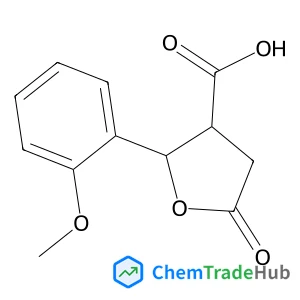
trans-2-(2-Methoxyphenyl)-5-oxotetrahydrofuran-3-carboxylic acid
CAS Number:
99226-02-5
Molecular Formula:
C12H12O5
Recommended Suppliers





Disclaimer
This page provides academic journal information for reference and research purposes only. We are not affiliated with any journal publishers and do not handle publication submissions. For publication-related inquiries, please contact the respective journal publishers directly.
If you notice any inaccuracies in the information displayed, please contact us at support@chemtradehub.com. We will promptly review and address your concerns.