












A highly efficient growth mechanism of polycyclic aromatic hydrocarbons
Literature Information
Publication Date
2010-01-21
DOI
10.1039/B919644G
Impact Factor
3.676
Authors
Bikau Shukla, Mitsuo Koshi
View Original
Abstract
A highly efficient growth mechanism of polycyclic aromatic hydrocarbons (PAHs) initiated and accelerated by phenyl radicals has been investigated on the basis of kinetic analysis of gas phase reaction products of pyrolysis of benzene with and without addition of acetylene and acetylene only. Pyrolytic reactions were performed in a flow tube reactor and the resulting products were detected by an in situ direct sampling mass spectrometric technique using a vacuum ultraviolet (VUV) single photon ionization (SPI) time of flight mass spectrometry (TOFMS). The detected species varies from smaller to larger PAHs up to m/z = 454 (C36H22) including primary PAHs, polyphenyl-PAHs and cyclopentafused-PAHs (CP-PAHs). The peculiarity of this result is an appearance of mass peaks at regular mass number intervals of ∼76 that correspond to phenyl-PAHs produced by phenyl radical addition (+C6H5, +77) followed by hydrogen elimination (−H, −1). All such mass peaks were found diminishing with appearance of −2 mass number peaks with increasing temperatures, certainly due to a conversion of thermally rather unstable phenyl-PAHs into stable condensed PAHs through a dehydrocyclization (−H2, −2) process. In the same way, in the case of only acetylene pyrolysis, mass peaks at regular mass number intervals of 24 corresponding to the HACA (hydrogen abstraction/C2H2 addition) products, were observed. Kinetic analysis of formation pathways of those observed products showed the active role of PAC (phenyl addition/cyclization) because of its efficiency to continue the endless growth of PAHs, while the HACA was only found efficient for producing symmetrical PAHs by filling a triple fusing site (four carbon bay structure). Especially, acetylene was mixed with benzene to understand the impact of HACA on the PAC path ways that resulted in enhancement of phenyl-PAHs production in spite of trapping of active and chain carrier species phenyl radicals by C2H2 to form phenylacetylene. The comparison of HACA and PAC concluded that PAC is a highly efficient mechanism for the growth of PAHs and lastly their combined roles in combustion have been discussed. Hopefully, PAC will be useful to understand the process of aromatic growth, from furnaces to stellar atmospheres.
Recommended Journals
Related Literature
Triphenylamine based yellowish-orange light emitting organic dyes (donor–π–acceptor) for hybrid WLEDs and OLEDs: synthesis, characterization and theoretical study
Aravind Babu Kajjam, P. Shyam Vinod Kumar, V. Subramanian, Sivakumar Vaidyanathan
2018-01-15
Paper
DOI: 10.1039/C7CP08670A
The last link of the x-aminobutyric acid series: the five conformers of β-aminobutyric acid
I. León, I. Peña, C. Cabezas, E. R. Alonso, J. L. Alonso
2018-05-11
Paper
DOI: 10.1039/C8CP01734D
Ordering of lipid membranes altered by boron nitride nanosheets
Yonghui Zhang, Zhen Li, Chun Chan, Jiale Ma, Chunyi Zhi, Xiaolin Cheng
2017-11-22
Paper
DOI: 10.1039/C7CP07136A
Anisotropic and amphoteric characteristics of diverse carbenes
D. ChangMo Yang, Jenica Marie L. Madridejos, Amir Hajibabaei, Chunggi Baig, Kwang S. Kim
2018-03-15
Paper
DOI: 10.1039/C8CP00457A
Directional control of charge and valley currents in a graphene-based device
M. Berdakin, J. E. Barrios Vargas, L. E. F. Foa Torres
2018-10-31
Paper
DOI: 10.1039/C8CP04878A
Thermoelectric Bi2Te3−xSex alloys for efficient thermal to electrical energy conversion
Omer Meroz, Yaniv Gelbstein
2018-01-02
Paper
DOI: 10.1039/C7CP06176E
Remarkable hydrogen storage properties of MgH2 doped with VNbO5
Antonio Valentoni, Gabriele Mulas, Stefano Enzo
2018-01-05
Paper
DOI: 10.1039/C7CP07157D
Correction: Necessary and sufficient conditions for the successful three-phase photocatalytic reduction of CO2 by H2O over heterogeneous photocatalysts
2018-07-26
Correction
DOI: 10.1039/C8CP91824D
Enhancing electrical energy storage capability of dielectric polymer nanocomposites via the room temperature Coulomb blockade effect of ultra-small platinum nanoparticles
Liwei Wang, Xingyi Huang, Yingke Zhu, Pingkai Jiang
2018-01-17
Paper
DOI: 10.1039/C7CP07990G
You might also like
Compound Q&A
Is 6-(3-Fluorophenyl)picolinic acid (CAS: 887982-40-3) safe?
6-(3-Fluorophenyl)picolinic acid is generally considered safe for laboratory use...
887982-40-36-(3-Fluorophenyl)pi...
Compound Q&A
What industries use (3R)-3-Pyrrolidinol (CAS: 2799-21-5)?
(3R)-3-Pyrrolidinol is used in the pharmaceutical industry as a precursor for dr...
2799-21-5(3R)-3-Pyrrolidinol
Compound Q&A
What precautions should be taken when handling (4R,5R)-4,5-Diethoxycarbonyl-2,2-dimethyldioxolane (CAS: 59779-75-8)?
When handling (4R,5R)-4,5-Diethoxycarbonyl-2,2-dimethyldioxolane (CAS: 59779-75-...
59779-75-8(4R,5R)-4,5-Diethoxy...
Compound Q&A
How is 1-(6-Chloroimidazo[1,2-b]pyridazin-3-yl)ethanone (CAS: 90734-71-7) typically synthesized?
1-(6-Chloroimidazo[1,2-b]pyridazin-3-yl)ethanone is often synthesized via a mult...
90734-71-71-(6-Chloroimidazo[1...
Compound Q&A
What is the market or research trend for N-Ethyl-3,4-dimethylbenzylamine (CAS: 39180-83-1)?
The market for N-Ethyl-3,4-dimethylbenzylamine (CAS: 39180-83-1) remains steady,...
39180-83-1N-Ethyl-3,4-dimethyl...
Compound Q&A
What is Tert-butyl 3-(pyrrolidin-1-yl)azetidine-1-carboxylate (CAS: 1019008-21-9)?
Tert-butyl 3-(pyrrolidin-1-yl)azetidine-1-carboxylate is a chemical compound wit...
1019008-21-9Tert-butyl 3-(pyrrol...
Compound Q&A
What regulatory guidelines apply to 1-Bromo-3-chloro-2,4-dimethoxybenzene (CAS: 1228956-93-1)?
1-Bromo-3-chloro-2,4-dimethoxybenzene (CAS: 1228956-93-1) falls under the classi...
1228956-93-11-Bromo-3-chloro-2,4...
Compound Q&A
Is 8-Bromo-2-methyl-3,4-dihydroisoquinolin-1(2H)-one (CAS: 1368622-07-4) safe?
The safety of 8-Bromo-2-methyl-3,4-dihydroisoquinolin-1(2H)-one (CAS: 1368622-07...
1368622-07-48-Bromo-2-methyl-3,4...
Compound Q&A
Is Benzyl [(3S)-2,6-dioxo-3-piperidinyl]carbamate (CAS: 22785-43-9) safe?
Benzyl [(3S)-2,6-dioxo-3-piperidinyl]carbamate is generally safe when handled wi...
22785-43-9Benzyl [(3S)-2,6-dio...
Compound Q&A
How should 1-{[4-(4,4,5,5-Tetramethyl-1,3,2-dioxaborolan-2-yl)phenyl]sulfonyl}pyrrolidine (CAS: 928657-21-0) be stored?
1-{[4-(4,4,5,5-Tetramethyl-1,3,2-dioxaborolan-2-yl)phenyl]sulfonyl}pyrrolidine s...
928657-21-01-{[4-(4,4,5,5-Tetra...
Source Journal
Physical Chemistry Chemical Physics

CiteScore:
5.5
Self-citation Rate:
10.3%
Articles per Year:
3036
Physical Chemistry Chemical Physics (PCCP) is an international journal co-owned by 19 physical chemistry and physics societies from around the world. This journal publishes original, cutting-edge research in physical chemistry, chemical physics and biophysical chemistry. To be suitable for publication in PCCP, articles must include significant innovation and/or insight into physical chemistry; this is the most important criterion that reviewers and Editors will judge against when evaluating submissions. The journal has a broad scope and welcomes contributions spanning experiment, theory, computation and data science. Topical coverage includes spectroscopy, dynamics, kinetics, statistical mechanics, thermodynamics, electrochemistry, catalysis, surface science, quantum mechanics, quantum computing and machine learning. Interdisciplinary research areas such as polymers and soft matter, materials, nanoscience, energy, surfaces/interfaces, and biophysical chemistry are welcomed if they demonstrate significant innovation and/or insight into physical chemistry. Joined experimental/theoretical studies are particularly appreciated when complementary and based on up-to-date approaches.
Recommended Compounds
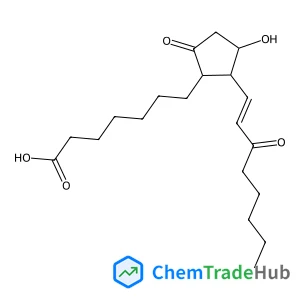
(11alpha,13E)-11-Hydroxy-9,15-dioxoprost-13-en-1-oic acid
CAS Number:
22973-19-9
Molecular Formula:
C20H32O5
Recommended Suppliers





Disclaimer
This page provides academic journal information for reference and research purposes only. We are not affiliated with any journal publishers and do not handle publication submissions. For publication-related inquiries, please contact the respective journal publishers directly.
If you notice any inaccuracies in the information displayed, please contact us at support@chemtradehub.com. We will promptly review and address your concerns.