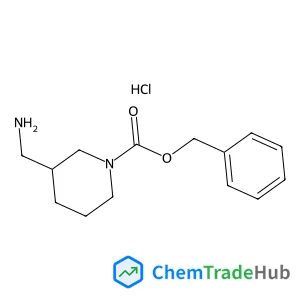
Benzyl 3-(aminomethyl)piperidine-1-carboxylate hydrochloride
CAS Number:
1186663-23-9
Molecular Formula:
C14H21ClN2O2
Angus Gray-Weale, James K. Beattie
The claim that the behaviour of the fluoride ion at aqueous hydrophobic interfaces contradicts the fluctuation force model described in our paper is dismissed on four grounds. (1) The dielectric decrement of NaF solutions remains uncertain. (2) Even if it were as large as that of NaOH, this would not disprove our theory (as explained in our paper), partly because there is no reason to assume that it interacts with surrounding water molecules in the same way as does the hydroxide ion, despite their having similar ionic radii. In fact, experimental evidence shows the solvation structures around the two ions are quite different, a difference not captured by simulations of the type used by Vácha et al. (3) There is no experimental evidence that fluoride is not adsorbed at the interface at millimolar concentrations. (4) The models and methods of calculation used by Vácha et al. in their comment appear to be flawed, and this casts some doubt on the rather firm conclusions drawn from similar simulations in previous works.
Urška Jug, Janez Mavri, Jernej Stare
DOI: 10.1039/C7CP07069A
I. León, I. Peña, C. Cabezas, E. R. Alonso, J. L. Alonso
DOI: 10.1039/C8CP01734D
Fen Li
DOI: 10.1039/C7CP07113B
D. ChangMo Yang, Jenica Marie L. Madridejos, Amir Hajibabaei, Chunggi Baig, Kwang S. Kim
DOI: 10.1039/C8CP00457A
Lukas Jackalin, Boris B. Kharkov, Andrei V. Komolkin
DOI: 10.1039/C8CP04161J
Yonghui Zhang, Zhen Li, Chun Chan, Jiale Ma, Chunyi Zhi, Xiaolin Cheng
DOI: 10.1039/C7CP07136A
Yun Jin, Danyi Guo, Bo Li, Shouping Xu, Jiang Cheng, Li Li, Xiufang Wen, Pihui Pi
DOI: 10.1039/C7CP06020C
Sung Man Park, Hong Lae Kim, Chan Ho Kwon
DOI: 10.1039/C8CP05577G
6-(3-Fluorophenyl)picolinic acid is generally considered safe for laboratory use...
(3R)-3-Pyrrolidinol is used in the pharmaceutical industry as a precursor for dr...
When handling (4R,5R)-4,5-Diethoxycarbonyl-2,2-dimethyldioxolane (CAS: 59779-75-...
1-(6-Chloroimidazo[1,2-b]pyridazin-3-yl)ethanone is often synthesized via a mult...
The market for N-Ethyl-3,4-dimethylbenzylamine (CAS: 39180-83-1) remains steady,...
Tert-butyl 3-(pyrrolidin-1-yl)azetidine-1-carboxylate is a chemical compound wit...
1-Bromo-3-chloro-2,4-dimethoxybenzene (CAS: 1228956-93-1) falls under the classi...
The safety of 8-Bromo-2-methyl-3,4-dihydroisoquinolin-1(2H)-one (CAS: 1368622-07...
Benzyl [(3S)-2,6-dioxo-3-piperidinyl]carbamate is generally safe when handled wi...
1-{[4-(4,4,5,5-Tetramethyl-1,3,2-dioxaborolan-2-yl)phenyl]sulfonyl}pyrrolidine s...

Physical Chemistry Chemical Physics (PCCP) is an international journal co-owned by 19 physical chemistry and physics societies from around the world. This journal publishes original, cutting-edge research in physical chemistry, chemical physics and biophysical chemistry. To be suitable for publication in PCCP, articles must include significant innovation and/or insight into physical chemistry; this is the most important criterion that reviewers and Editors will judge against when evaluating submissions. The journal has a broad scope and welcomes contributions spanning experiment, theory, computation and data science. Topical coverage includes spectroscopy, dynamics, kinetics, statistical mechanics, thermodynamics, electrochemistry, catalysis, surface science, quantum mechanics, quantum computing and machine learning. Interdisciplinary research areas such as polymers and soft matter, materials, nanoscience, energy, surfaces/interfaces, and biophysical chemistry are welcomed if they demonstrate significant innovation and/or insight into physical chemistry. Joined experimental/theoretical studies are particularly appreciated when complementary and based on up-to-date approaches.