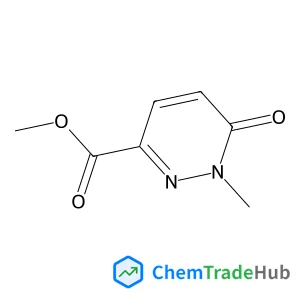
Methyl 1-methyl-6-oxo-1,6-dihydro-3-pyridazinecarboxylate
CAS Number:
74173-58-3
Molecular Formula:
C7H8N2O3
The first page of this article is displayed as the abstract.
A-Reza Nekoei, Morteza Vatanparast
DOI: 10.1039/C8CP07003B
Changming Zhao, Yifeng Duan, Jie Gao, Wenjie Liu, Haiming Dong, Huafeng Dong, Dekun Zhang
DOI: 10.1039/C8CP04222E
Yafei Luo, Zhongzhu Chen, Jianping Hu, Zhigang Xu, Qingxi Meng, Dianyong Tang
DOI: 10.1039/C8CP06804F
Bianka M. D. Puscher, Ali Asghar Katbab, Ievgen Levchuk, Negar Kazerouni, Nicola Gasparini, Nadia Camaioni, Andres Osvet, Miroslaw Batentschuk, Rainer H. Fink, Dirk M. Guldi
DOI: 10.1039/C8CP03743D
Grzegorz Nawrocki, Alp Karaboga
DOI: 10.1039/C8CP06142D
Sujeet Dutta, S. Krishna Prasad
DOI: 10.1039/C8CP03603A
Riccardo Checchetto, Paolo Bettotti, Gianfranco Carotenuto, Werner Egger, Christoph Hugenschmidt, Antonio Miotello
DOI: 10.1039/C8CP03879A
Helena Jablonowski, Ansgar Schmidt-Bleker, Klaus-Dieter Weltmann, Thomas von Woedtke, Kristian Wende
DOI: 10.1039/C8CP02412J
Xiaolin Guo, Zhihuan Qiu, Jianxin Mao, Renxian Zhou
DOI: 10.1039/C8CP03696A
Shun-ichi Ishiuchi, Yuta Sasaki, Masaaki Fujii
DOI: 10.1039/C8CP05839C
3-(2-Bromoimidazo[2,1-b]thiazol-6-yl)propanoic acid hydrochloride is typically s...
2-Isopropyl-1,3-dioxane-5-carboxylic acid is typically synthesized by the carbox...
Alisporivir (CAS: 254435-95-5) is an antiviral medication used in the treatment ...
[1,2,4]triazolo[3,4-a]phthalazine (CAS: 234-80-0) is a crystalline compound with...
Regulatory guidelines for (2S)-5-Hydroxy-2-(4-hydroxyphenyl)-4-oxo-3,4-dihydro-2...
2,2-Difluorocyclohexanamine hydrochloride is generally safe when handled under p...
3-Nitro-2-phenylthiophene is primarily used in the synthesis of other organic co...
1-(Trifluoroacetyl)-4-piperidinecarbonitrile (CAS: 77940-79-5) is a colorless to...
Research and market trends for 1,3,6,8-Tetranitro-9H-carbazole (CAS: 4543-33-3) ...
Waste containing Dibenzo[b,d]thiophen-1-ylboronic acid (CAS: 1245943-60-5) shoul...

Physical Chemistry Chemical Physics (PCCP) is an international journal co-owned by 19 physical chemistry and physics societies from around the world. This journal publishes original, cutting-edge research in physical chemistry, chemical physics and biophysical chemistry. To be suitable for publication in PCCP, articles must include significant innovation and/or insight into physical chemistry; this is the most important criterion that reviewers and Editors will judge against when evaluating submissions. The journal has a broad scope and welcomes contributions spanning experiment, theory, computation and data science. Topical coverage includes spectroscopy, dynamics, kinetics, statistical mechanics, thermodynamics, electrochemistry, catalysis, surface science, quantum mechanics, quantum computing and machine learning. Interdisciplinary research areas such as polymers and soft matter, materials, nanoscience, energy, surfaces/interfaces, and biophysical chemistry are welcomed if they demonstrate significant innovation and/or insight into physical chemistry. Joined experimental/theoretical studies are particularly appreciated when complementary and based on up-to-date approaches.