


Improved charge carrier dynamics in polymer/perovskite nanocrystal based hybrid ternary solar cells
Literature Information
Publication Date
2018-09-01
DOI
10.1039/C8CP03743D
Impact Factor
3.676
Authors
Bianka M. D. Puscher, Ali Asghar Katbab, Ievgen Levchuk, Negar Kazerouni, Nicola Gasparini, Nadia Camaioni, Andres Osvet, Miroslaw Batentschuk, Rainer H. Fink, Dirk M. Guldi
View Original
Abstract
Here, brand new ternary hybrid solar cells comprising perovskite nanocrystals (NCs) with a complementary absorption profile of the organic host matrix are reported. In particular, NH2CHNH2PbI3 (FAPbI3) perovskite NCs are implemented in bulk heterojunction organic solar cells based on the pDPP5T-2 electron donating polymer and a [6,6]-phenyl-C61-butyric acid methyl ester (PC61BM) acceptor at various loading amounts and the fabricated hybrid photovoltaics are thoroughly studied by employing different optoelectrical characterization methods. Current–voltage measurements and photoinduced charge carrier extraction by linear increasing voltage (photo-CELIV) reveal improved charge generation and charge transport properties upon incorporation of perovskite NCs into the photo-active layer of the hybrid solar cell. The power conversion efficiency (PCE) of the hybrid solar cell comprising 5% perovskite NCs is 10% enhanced compared to the organic reference, mainly due to the enlarged light harvesting and increased short circuit current density (Jsc). However, results suggest that introducing a higher amount of perovskite content induces bimolecular and trap-assisted recombination in the ternary devices. We perform a comprehensive transient absorption study of the charge transfer/transport mechanisms by employing femto-second pump–probe transient absorption spectroscopy (fs-TAS). fs-TAS measurements demonstrate a slower charge carrier recombination rate due to the introduction of perovskite NCs into the photoactive layer. Results reveal that DPP injects electrons from the singlet excited state into the perovskite NCs, which causes the desired cascading charge carrier transfer. In ternary blends, a small amount of FAPbI3 NCs provides an additional pathway in favor of the charge-separated state via the NCs, which, despite accelerating the depopulation of DPP's singlet excited state slightly slows down the charge-separation process between DPP and PC61BM. Interestingly, the loss processes are slowed down; an effect that is more important and, hence, explains the improved solar cell efficiency.
Recommended Journals

Russian Chemical Bulletin

Russian Journal of General Chemistry

Journal of Peptide Science

Russian Journal of Organic Chemistry

Current Opinion in Colloid & Interface Science

Russian Journal of Bioorganic Chemistry

Russian Journal of Applied Chemistry

Journal of Natural Medicines

Chemistry Education Research and Practice

Saudi Pharmaceutical Journal
Related Literature
Thin V2O5 films synthesized by plasma-enhanced atomic layer deposition for memristive applications
Vladimir A. Seleznev, Nadezhda A. Nebogatikova, Artem I. Ivanov, Bogdan V. Voloshin, Irina I. Kurkina
2023-11-13
Paper
DOI: 10.1039/D3CP03761D
Correction: Understanding the charge transfer dynamics of the Cu2WS4–CNT–FeOOH ternary composite for photo-electrochemical studies
Preeti Dagar, Nandan Ghorai, Manisha Bungla, Hirendra N. Ghosh
2023-11-27
Correction
DOI: 10.1039/D3CP90230G
Near-infrared spectroscopy in the pharmaceutical industry . Critical Review
Paper
DOI: 10.1039/A802531B
Comment on “Cumulant mapping as the basis of multi-dimensional spectrometry” by Leszek J. Frasinski, Phys. Chem. Chem. Phys., 2022, 24, 20776–20787
2023-11-22
Comment
DOI: 10.1039/D3CP02525J
Formation of superoxide and ozone-like species on Cu doped CeO2(111) and their CO oxidation reactivity: a DFT study
Hao Wang, Yuan Li, Jiao Han, Caishun Zhang, Honghao Wang, Daosheng Liu, Xiaoning Hou, Lei Zhang, Zhixian Gao
2023-11-24
Paper
DOI: 10.1039/D3CP03885H
Interrogating the nature of aggregates formed in a model azine based ESIPT coupled AIE active probe: stark differences in photodynamics in the solid state and aggregates in water
Arghyadeep Bhattacharyya, Akash Das, Nikhil Guchhait
2023-11-03
Paper
DOI: 10.1039/D3CP03603K
Role of electron and hole doping in the NdNi1−xVxO3 nanostructure
Raktima Basu, Reshma Kumawat, Mrinmay Sahu, Abu Bakkar Miah, Partha Mitra, Goutam Dev Mukherjee
2023-11-03
Paper
DOI: 10.1039/D3CP01409F
Co-aggregation of α-synuclein with amyloid-β stabilizes β-sheet-rich oligomers and enhances the formation of β-barrels
Fengjuan Huang, Yuying Liu, Ying Wang, Jia Xu, Jiangfang Lian, Yu Zou, Chuang Wang, Feng Ding
2023-11-02
Paper
DOI: 10.1039/D3CP04138G
You might also like
Compound Q&A
Are there alternatives to 1-(4-Chlorophenyl)-N-hydroxymethanimine (CAS: 3848-36-0) in synthesis?
When considering alternatives to 1-(4-Chlorophenyl)-N-hydroxymethanimine (CAS: 3...
3848-36-01-(4-Chlorophenyl)-N...
Compound Q&A
How should (1R,9S,10S,12S,14E,16S,19R,20R,21S,22R)-3,9,21-Trihydroxy-5,10,12,14,16,20,22-heptamethyl-23,24-dioxatetracyclo[17.3.1.1~6,9~.0~2,7~]tetracosa-2,5,7,14-tetraen-4-one (CAS: 183202-73-5) be stored?
This compound should be stored in a cool, dry place away from direct sunlight. I...
183202-73-5(1R,9S,10S,12S,14E,1...
Compound Q&A
How is 3-(4-Bromophenyl)-5-(2-fluorophenyl)-1,2,4-oxadiazole (CAS: 419553-16-5) typically synthesized?
3-(4-Bromophenyl)-5-(2-fluorophenyl)-1,2,4-oxadiazole is synthesized through a m...
419553-16-53-(4-Bromophenyl)-5-...
Compound Q&A
How is 5-Chloro-2-(4-chlorophenyl)-4-methyl-6-[3-(1-piperidinyl)propoxy]pyrimidine (CAS: 1639220-19-1) typically synthesized?
5-Chloro-2-(4-chlorophenyl)-4-methyl-6-[3-(1-piperidinyl)propoxy]pyrimidine (CAS...
1639220-19-15-Chloro-2-(4-chloro...
Compound Q&A
What industries use 2-Chloro-4-(difluoromethoxy)pyridine (CAS: 1206978-15-5)?
2-Chloro-4-(difluoromethoxy)pyridine is used in the pharmaceutical industry for ...
1206978-15-52-Chloro-4-(difluoro...
Compound Q&A
What regulatory guidelines apply to 3-Chloro-6-methylpyridazine (CAS: 1121-79-5)?
3-Chloro-6-methylpyridazine (CAS: 1121-79-5) is classified under the Globally Ha...
1121-79-53-Chloro-6-methylpyr...
Compound Q&A
Are there alternatives to Methyl 4,5-dimethyl-2-nitrobenzoate in synthesis?
Several alternatives can be used in the synthesis of Methyl 4,5-dimethyl-2-nitro...
90922-74-0Methyl 4,5-dimethyl-...
Compound Q&A
Are there alternatives to (2E,2'E)-3,3'-(1,4-Phenylene)bisacrylaldehyde in synthesis?
Alternatives to (2E,2'E)-3,3'-(1,4-Phenylene)bisacrylaldehyde include other acry...
63405-68-5(2E,2'E)-3,3'-(1,4-P...
Compound Q&A
What is 3-Amino-5-chloropyridin-2-ol hydrochloride (CAS: 1261906-29-9)?
3-Amino-5-chloropyridin-2-ol hydrochloride is an organic compound with the CAS n...
1261906-29-93-Amino-5-chloropyri...
Compound Q&A
What precautions should be taken when handling 6,7-Difluoro-2,3-dihydro-4H-chromen-4-one (CAS: 1092349-93-3)?
When handling 6,7-Difluoro-2,3-dihydro-4H-chromen-4-one, it is essential to wear...
1092349-93-36,7-Difluoro-2,3-dih...
Source Journal
Physical Chemistry Chemical Physics

CiteScore:
5.5
Self-citation Rate:
10.3%
Articles per Year:
3036
Physical Chemistry Chemical Physics (PCCP) is an international journal co-owned by 19 physical chemistry and physics societies from around the world. This journal publishes original, cutting-edge research in physical chemistry, chemical physics and biophysical chemistry. To be suitable for publication in PCCP, articles must include significant innovation and/or insight into physical chemistry; this is the most important criterion that reviewers and Editors will judge against when evaluating submissions. The journal has a broad scope and welcomes contributions spanning experiment, theory, computation and data science. Topical coverage includes spectroscopy, dynamics, kinetics, statistical mechanics, thermodynamics, electrochemistry, catalysis, surface science, quantum mechanics, quantum computing and machine learning. Interdisciplinary research areas such as polymers and soft matter, materials, nanoscience, energy, surfaces/interfaces, and biophysical chemistry are welcomed if they demonstrate significant innovation and/or insight into physical chemistry. Joined experimental/theoretical studies are particularly appreciated when complementary and based on up-to-date approaches.
Recommended Compounds
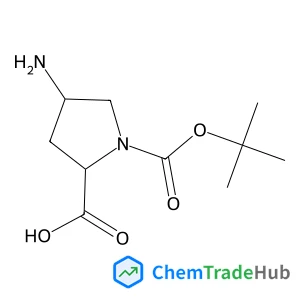
(2R,4R)-1-Boc-4-Aminopyrrolidine-2-carboxylic acid
CAS Number:
132622-98-1
Molecular Formula:
C10H18N2O4
Recommended Suppliers





Disclaimer
This page provides academic journal information for reference and research purposes only. We are not affiliated with any journal publishers and do not handle publication submissions. For publication-related inquiries, please contact the respective journal publishers directly.
If you notice any inaccuracies in the information displayed, please contact us at support@chemtradehub.com. We will promptly review and address your concerns.