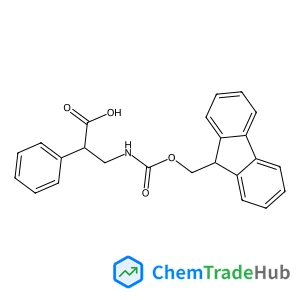
(S)-3-((((9H-Fluoren-9-yl)methoxy)carbonyl)amino)-2-phenylpropanoic acid
CAS Number:
1217663-60-9
Molecular Formula:
C24H21NO4
Grzegorz Nawrocki, Alp Karaboga
The rotational diffusion of a protein in the presence of protein crowder molecules was analyzed via computer simulations. Cluster formation as a result of transient intermolecular contacts was identified as the dominant effect for reduced rotational diffusion upon crowding. The slow-down in diffusion was primarily correlated with direct protein–protein contacts rather than indirect interactions via shared hydration layers. But increased solvent viscosity due to crowding contributed to a lesser extent. Key protein–protein contacts correlated with a slow-down in diffusion involve largely interactions between charged and polar groups suggesting that the surface composition of a given protein and the resulting propensity for forming interactions with surrounding proteins in a crowded cellular environment may be the major determinant of its diffusive properties.

Russian Journal of Bioorganic Chemistry

Chemical Communications

Nature Medicine

Russian Journal of Organic Chemistry

Russian Journal of General Chemistry

Journal of Natural Medicines

Drug Discovery Today

Russian Journal of Coordination Chemistry

New Journal of Chemistry

Chemistry Education Research and Practice
DOI: 10.1039/A800776D
Branislav Milovanović, Milena Petković
DOI: 10.1039/D3CP03991A
Wei Zhang, Xin Guo, Junqiang Ren, Junchen Li, Hongtao Xue, Fuling Tang, Peiqing La, Xuefeng Lu
DOI: 10.1039/D3CP03613H
Preeti Dagar, Nandan Ghorai, Manisha Bungla, Hirendra N. Ghosh
DOI: 10.1039/D3CP90230G
Jia-Ben Song, Yun-Hao Zhang, Yu-Feng Li, Jia-Cheng Zhang, Xu Liang, Zhen-Dong Sha
DOI: 10.1039/D3CP04280D
Sabine N. Neal, Dario Stacchiola, Samuel A. Tenney
DOI: 10.1039/D3CP03958G
Cong Hu
DOI: 10.1039/D3CP00061C
DOI: 10.1039/D3CP04092E
When considering alternatives to 1-(4-Chlorophenyl)-N-hydroxymethanimine (CAS: 3...
This compound should be stored in a cool, dry place away from direct sunlight. I...
3-(4-Bromophenyl)-5-(2-fluorophenyl)-1,2,4-oxadiazole is synthesized through a m...
5-Chloro-2-(4-chlorophenyl)-4-methyl-6-[3-(1-piperidinyl)propoxy]pyrimidine (CAS...
2-Chloro-4-(difluoromethoxy)pyridine is used in the pharmaceutical industry for ...
3-Chloro-6-methylpyridazine (CAS: 1121-79-5) is classified under the Globally Ha...
Several alternatives can be used in the synthesis of Methyl 4,5-dimethyl-2-nitro...
Alternatives to (2E,2'E)-3,3'-(1,4-Phenylene)bisacrylaldehyde include other acry...
3-Amino-5-chloropyridin-2-ol hydrochloride is an organic compound with the CAS n...
When handling 6,7-Difluoro-2,3-dihydro-4H-chromen-4-one, it is essential to wear...

Physical Chemistry Chemical Physics (PCCP) is an international journal co-owned by 19 physical chemistry and physics societies from around the world. This journal publishes original, cutting-edge research in physical chemistry, chemical physics and biophysical chemistry. To be suitable for publication in PCCP, articles must include significant innovation and/or insight into physical chemistry; this is the most important criterion that reviewers and Editors will judge against when evaluating submissions. The journal has a broad scope and welcomes contributions spanning experiment, theory, computation and data science. Topical coverage includes spectroscopy, dynamics, kinetics, statistical mechanics, thermodynamics, electrochemistry, catalysis, surface science, quantum mechanics, quantum computing and machine learning. Interdisciplinary research areas such as polymers and soft matter, materials, nanoscience, energy, surfaces/interfaces, and biophysical chemistry are welcomed if they demonstrate significant innovation and/or insight into physical chemistry. Joined experimental/theoretical studies are particularly appreciated when complementary and based on up-to-date approaches.