












π-Hydrogen bonding and aromaticity: a systematic interplay study
Literature Information
Publication Date
2018-12-01
DOI
10.1039/C8CP07003B
Impact Factor
3.676
Authors
A-Reza Nekoei, Morteza Vatanparast
View Original
Abstract
Quantum DFT calculations, corrected for long-range interactions, have been carried out on complex models formed between HF as a proton donor and 2-methylene-2H-indene derivatives as proton acceptors. Using various exocyclic X substitutions, mutual effects of the aromaticity and the strength of the resulting π-hydrogen bond (after its evaluation by AIM methodology) have been investigated. The results show that the aromaticity of 6-membered rings and the hydrogen bond strength increase upon increasing the electron-donating character of the X-substituents. Based on some aromaticity indices (HOMA, FLU, SA and NICS(1)zz), it has been shown that the formation of a π-hydrogen bond causes an increase of aromaticity of the 6-membered ring. Also, the strength of the resulting π-hydrogen bond (with an energy of about 4.0 to 7.0 kcal mol−1) depends on the aromaticity of the 6-membered ring and increases with an increase in the aromaticity. In addition, a linear relationship was found between the most negative value of the molecular electrostatic potential (Vmin) and the HOMA, which confirms that the Vmin in the region of the studied ring could be used as a new index to estimate the amount of aromaticity. The electronic properties of the complexes have also been evaluated by means of the molecular electrostatic potential (MEP), the atoms in molecules (AIM) and the natural bond orbital (NBO) analyses.
Related Literature
Ultrafast multiexponential electron injection dynamics at a dye and ZnO QD interface: a combined spectroscopic and first principles study
Pushpendra Kumar, Suman Kalyan Pal
2016-09-30
Paper
DOI: 10.1039/C6CP04610J
Correction: Ion collision cross section analyses in quadrupole ion traps using the filter diagonalization method: a theoretical study
Ting Jiang, Muyi He, Dan Guo, Yanbing Zhai
2016-10-18
Correction
DOI: 10.1039/C6CP90248K
A DFT kinetic study on 1,3-dipolar cycloaddition reactions in solution
Shi-Jun Li, De-Cai Fang
2016-10-18
Paper
DOI: 10.1039/C6CP05190A
Origin of the catalytic activity of face-centered-cubic ruthenium nanoparticles determined from an atomic-scale structure
L. S. R. Kumara, Anli Yang, Chulho Song, Kohei Kusada, Hirokazu Kobayashi
2016-10-11
Paper
DOI: 10.1039/C6CP04088H
125Te NMR provides evidence of autoassociation of organo-ditellurides in solution
P. J. W. Elder, I. Vargas-Baca
2016-10-13
Paper
DOI: 10.1039/C6CP05892B
Confinement effects on the properties of Janus dimers
Leandro B. Krott
2016-09-14
Paper
DOI: 10.1039/C6CP05821C
A comparison of the experimental and theoretical charge density distributions in two polymorphic modifications of piroxicam
Felcia Lai, Jonathan J. Du, Linda Váradi, Daniel Baker, Paul W. Groundwater, Jacob Overgaard, James A. Platts, David E. Hibbs
2016-10-10
Paper
DOI: 10.1039/C6CP02690G
Precise determination of water exchanges on a mineral surface
Andrew G. Stack, Jose M. Borreguero, Timothy R. Prisk, Eugene Mamontov, Hsiu-Wen Wang, Lukas Vlcek, David J. Wesolowski
2016-10-03
Paper
DOI: 10.1039/C6CP05836A
Rationalising pKa shifts in Bacillus circulans xylanase with computational studies
Kela Xiao
2016-07-27
Paper
DOI: 10.1039/C6CP02526A
Revisiting the F + HCl → HF + Cl reaction using a multireference coupled-cluster method
Yuri Alexandre Aoto, Andreas Köhn
2016-09-21
Paper
DOI: 10.1039/C6CP05782A
You might also like
Compound Q&A
Are there alternatives to 1-(4-Chlorophenyl)-N-hydroxymethanimine (CAS: 3848-36-0) in synthesis?
When considering alternatives to 1-(4-Chlorophenyl)-N-hydroxymethanimine (CAS: 3...
3848-36-01-(4-Chlorophenyl)-N...
Compound Q&A
How should (1R,9S,10S,12S,14E,16S,19R,20R,21S,22R)-3,9,21-Trihydroxy-5,10,12,14,16,20,22-heptamethyl-23,24-dioxatetracyclo[17.3.1.1~6,9~.0~2,7~]tetracosa-2,5,7,14-tetraen-4-one (CAS: 183202-73-5) be stored?
This compound should be stored in a cool, dry place away from direct sunlight. I...
183202-73-5(1R,9S,10S,12S,14E,1...
Compound Q&A
How is 3-(4-Bromophenyl)-5-(2-fluorophenyl)-1,2,4-oxadiazole (CAS: 419553-16-5) typically synthesized?
3-(4-Bromophenyl)-5-(2-fluorophenyl)-1,2,4-oxadiazole is synthesized through a m...
419553-16-53-(4-Bromophenyl)-5-...
Compound Q&A
How is 5-Chloro-2-(4-chlorophenyl)-4-methyl-6-[3-(1-piperidinyl)propoxy]pyrimidine (CAS: 1639220-19-1) typically synthesized?
5-Chloro-2-(4-chlorophenyl)-4-methyl-6-[3-(1-piperidinyl)propoxy]pyrimidine (CAS...
1639220-19-15-Chloro-2-(4-chloro...
Compound Q&A
What industries use 2-Chloro-4-(difluoromethoxy)pyridine (CAS: 1206978-15-5)?
2-Chloro-4-(difluoromethoxy)pyridine is used in the pharmaceutical industry for ...
1206978-15-52-Chloro-4-(difluoro...
Compound Q&A
What regulatory guidelines apply to 3-Chloro-6-methylpyridazine (CAS: 1121-79-5)?
3-Chloro-6-methylpyridazine (CAS: 1121-79-5) is classified under the Globally Ha...
1121-79-53-Chloro-6-methylpyr...
Compound Q&A
Are there alternatives to Methyl 4,5-dimethyl-2-nitrobenzoate in synthesis?
Several alternatives can be used in the synthesis of Methyl 4,5-dimethyl-2-nitro...
90922-74-0Methyl 4,5-dimethyl-...
Compound Q&A
Are there alternatives to (2E,2'E)-3,3'-(1,4-Phenylene)bisacrylaldehyde in synthesis?
Alternatives to (2E,2'E)-3,3'-(1,4-Phenylene)bisacrylaldehyde include other acry...
63405-68-5(2E,2'E)-3,3'-(1,4-P...
Compound Q&A
What is 3-Amino-5-chloropyridin-2-ol hydrochloride (CAS: 1261906-29-9)?
3-Amino-5-chloropyridin-2-ol hydrochloride is an organic compound with the CAS n...
1261906-29-93-Amino-5-chloropyri...
Compound Q&A
What precautions should be taken when handling 6,7-Difluoro-2,3-dihydro-4H-chromen-4-one (CAS: 1092349-93-3)?
When handling 6,7-Difluoro-2,3-dihydro-4H-chromen-4-one, it is essential to wear...
1092349-93-36,7-Difluoro-2,3-dih...
Source Journal
Physical Chemistry Chemical Physics

CiteScore:
5.5
Self-citation Rate:
10.3%
Articles per Year:
3036
Physical Chemistry Chemical Physics (PCCP) is an international journal co-owned by 19 physical chemistry and physics societies from around the world. This journal publishes original, cutting-edge research in physical chemistry, chemical physics and biophysical chemistry. To be suitable for publication in PCCP, articles must include significant innovation and/or insight into physical chemistry; this is the most important criterion that reviewers and Editors will judge against when evaluating submissions. The journal has a broad scope and welcomes contributions spanning experiment, theory, computation and data science. Topical coverage includes spectroscopy, dynamics, kinetics, statistical mechanics, thermodynamics, electrochemistry, catalysis, surface science, quantum mechanics, quantum computing and machine learning. Interdisciplinary research areas such as polymers and soft matter, materials, nanoscience, energy, surfaces/interfaces, and biophysical chemistry are welcomed if they demonstrate significant innovation and/or insight into physical chemistry. Joined experimental/theoretical studies are particularly appreciated when complementary and based on up-to-date approaches.
Recommended Compounds
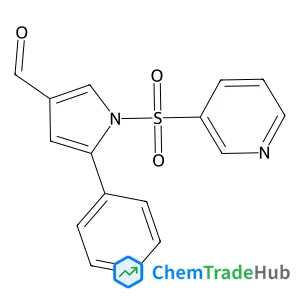
5-Phenyl-1-(pyridin-3-ylsulfonyl)-1H-pyrrole-3-carbaldehyde
CAS Number:
881676-90-0
Molecular Formula:
C16H12N2O3S
Recommended Suppliers





Disclaimer
This page provides academic journal information for reference and research purposes only. We are not affiliated with any journal publishers and do not handle publication submissions. For publication-related inquiries, please contact the respective journal publishers directly.
If you notice any inaccuracies in the information displayed, please contact us at support@chemtradehub.com. We will promptly review and address your concerns.