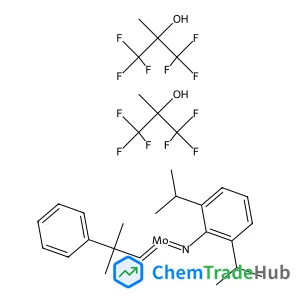
2,6-Diisopropylphenylimidoneophylidene molybdenum(VI) bis(hexafluoro-t-butoxide)
CAS Number:
139220-25-0
Molecular Formula:
C30H37F12MoNO2
The first page of this article is displayed as the abstract.
Akram Mirehi, Ebrahim Heidari-Semiromi
DOI: 10.1039/C8CP05041D
Hang Zhai, Zhen Qin, Dan Sun, Jianyun Wang, Chang Liu, Nan Min, Quan Li
DOI: 10.1039/C8CP04271C
Shun-ichi Ishiuchi, Yuta Sasaki, Masaaki Fujii
DOI: 10.1039/C8CP05839C
Melody L. Kessler, Hannah E. Starr, Robin R. Knauf, Kelley J. Rountree, Jillian L. Dempsey
DOI: 10.1039/C8CP04275F
Qinye Li, Siyao Qiu, Lizhong He, Xiwang Zhang
DOI: 10.1039/C8CP04474K
Shovan Dan, S. Mukherjee, Chandan Mazumdar, R. Ranganathan
DOI: 10.1039/C8CP06222F
Yue-Jie Shi, Rong-Jun Zhang, Xin Chen, Lei Wang, Lei Chen, Qing-Hua Huang, Da-Hai Li, Yu-Xiang Zheng, Song-You Wang, Ning Dai, Liang-Yao Chen
DOI: 10.1039/C8CP04942D
Lars Wiehemeier, Oliver Wrede, Julian Oberdisse, Thomas Hellweg, Tilman Kottke
DOI: 10.1039/C8CP05911J
Changming Zhao, Yifeng Duan, Jie Gao, Wenjie Liu, Haiming Dong, Huafeng Dong, Dekun Zhang
DOI: 10.1039/C8CP04222E
Tianwei He, Sri Kasi Matta, Aijun Du
DOI: 10.1039/C8CP06978F
3-(2-Bromoimidazo[2,1-b]thiazol-6-yl)propanoic acid hydrochloride is typically s...
2-Isopropyl-1,3-dioxane-5-carboxylic acid is typically synthesized by the carbox...
Alisporivir (CAS: 254435-95-5) is an antiviral medication used in the treatment ...
[1,2,4]triazolo[3,4-a]phthalazine (CAS: 234-80-0) is a crystalline compound with...
Regulatory guidelines for (2S)-5-Hydroxy-2-(4-hydroxyphenyl)-4-oxo-3,4-dihydro-2...
2,2-Difluorocyclohexanamine hydrochloride is generally safe when handled under p...
3-Nitro-2-phenylthiophene is primarily used in the synthesis of other organic co...
1-(Trifluoroacetyl)-4-piperidinecarbonitrile (CAS: 77940-79-5) is a colorless to...
Research and market trends for 1,3,6,8-Tetranitro-9H-carbazole (CAS: 4543-33-3) ...
Waste containing Dibenzo[b,d]thiophen-1-ylboronic acid (CAS: 1245943-60-5) shoul...

Physical Chemistry Chemical Physics (PCCP) is an international journal co-owned by 19 physical chemistry and physics societies from around the world. This journal publishes original, cutting-edge research in physical chemistry, chemical physics and biophysical chemistry. To be suitable for publication in PCCP, articles must include significant innovation and/or insight into physical chemistry; this is the most important criterion that reviewers and Editors will judge against when evaluating submissions. The journal has a broad scope and welcomes contributions spanning experiment, theory, computation and data science. Topical coverage includes spectroscopy, dynamics, kinetics, statistical mechanics, thermodynamics, electrochemistry, catalysis, surface science, quantum mechanics, quantum computing and machine learning. Interdisciplinary research areas such as polymers and soft matter, materials, nanoscience, energy, surfaces/interfaces, and biophysical chemistry are welcomed if they demonstrate significant innovation and/or insight into physical chemistry. Joined experimental/theoretical studies are particularly appreciated when complementary and based on up-to-date approaches.