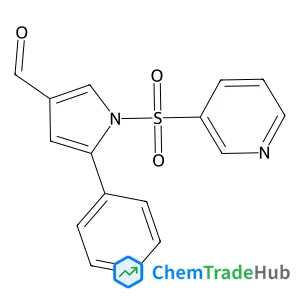
5-Phenyl-1-(pyridin-3-ylsulfonyl)-1H-pyrrole-3-carbaldehyde
CAS Number:
881676-90-0
Molecular Formula:
C16H12N2O3S
Tianwei He, Sri Kasi Matta, Aijun Du
Electrochemical reduction of dinitrogen molecules (N2) to value-added ammonia by using renewable electricity under mild conditions is regarded as a sustainable and promising strategy for N2 fixation. However, the lack of efficient, robust and inexpensive electrocatalysts for such electrochemical reduction has prevented its wide application. Herein, we report a novel single-atom catalyst, i.e., a single tungsten (W) atom anchored on N-doped graphyne (W@N-doped graphyne) as a highly efficient and low-cost electrocatalyst for the N2 reduction reaction. The inert NN triple bond can be sufficiently activated when an N2 molecule is adsorbed on the W atom. A single atom of W coordinated with one N atom (doping into an sp-hybridized carbon atom) exhibits the highest catalytic performance with ultra-low onset potential of 0.29 V for N2 reduction reactions. The ‘distal mechanism’ is identified as the most favourable catalytic pathway. Moreover, the improved electrical conductivity of W@N-doped graphyne compared to that of pristine graphyne can ensure better electron transfer efficiency during the reduction processes. Our study provides a novel electrocatalyst with excellent catalytic performance for electrochemical reduction of N2 to NH3 under ambient conditions.
DOI: 10.1039/D3CP04879A
Wei Zhang, Xin Guo, Junqiang Ren, Junchen Li, Hongtao Xue, Fuling Tang, Peiqing La, Xuefeng Lu
DOI: 10.1039/D3CP03613H
M. Boström, I. Brevik, O. I. Malyi
DOI: 10.1039/D3CP04157C
Mingna Zheng, Yanwei Li, Qingzhu Zhang, Wenxing Wang
DOI: 10.1039/D3CP04519F
When considering alternatives to 1-(4-Chlorophenyl)-N-hydroxymethanimine (CAS: 3...
This compound should be stored in a cool, dry place away from direct sunlight. I...
3-(4-Bromophenyl)-5-(2-fluorophenyl)-1,2,4-oxadiazole is synthesized through a m...
5-Chloro-2-(4-chlorophenyl)-4-methyl-6-[3-(1-piperidinyl)propoxy]pyrimidine (CAS...
2-Chloro-4-(difluoromethoxy)pyridine is used in the pharmaceutical industry for ...
3-Chloro-6-methylpyridazine (CAS: 1121-79-5) is classified under the Globally Ha...
Several alternatives can be used in the synthesis of Methyl 4,5-dimethyl-2-nitro...
Alternatives to (2E,2'E)-3,3'-(1,4-Phenylene)bisacrylaldehyde include other acry...
3-Amino-5-chloropyridin-2-ol hydrochloride is an organic compound with the CAS n...
When handling 6,7-Difluoro-2,3-dihydro-4H-chromen-4-one, it is essential to wear...

Physical Chemistry Chemical Physics (PCCP) is an international journal co-owned by 19 physical chemistry and physics societies from around the world. This journal publishes original, cutting-edge research in physical chemistry, chemical physics and biophysical chemistry. To be suitable for publication in PCCP, articles must include significant innovation and/or insight into physical chemistry; this is the most important criterion that reviewers and Editors will judge against when evaluating submissions. The journal has a broad scope and welcomes contributions spanning experiment, theory, computation and data science. Topical coverage includes spectroscopy, dynamics, kinetics, statistical mechanics, thermodynamics, electrochemistry, catalysis, surface science, quantum mechanics, quantum computing and machine learning. Interdisciplinary research areas such as polymers and soft matter, materials, nanoscience, energy, surfaces/interfaces, and biophysical chemistry are welcomed if they demonstrate significant innovation and/or insight into physical chemistry. Joined experimental/theoretical studies are particularly appreciated when complementary and based on up-to-date approaches.
![6-Bromo-2,3-dihydro-1H-pyrido[2,3-b][1,4]oxazine structure](https://static.chemtradehub.com/structs/120/1203499-17-5-b4d1.webp "6-Bromo-2,3-dihydro-1H-pyrido[2,3-b][1,4]oxazine structure")