


Swelling behaviour of core–shell microgels in H2O, analysed by temperature-dependent FTIR spectroscopy
Literature Information
Publication Date
2018-12-03
DOI
10.1039/C8CP05911J
Impact Factor
3.676
Authors
Lars Wiehemeier, Oliver Wrede, Julian Oberdisse, Thomas Hellweg, Tilman Kottke
View Original
Abstract
Stimuli-responsive microgels are colloidal particles and promising candidates for applications such as targeted drug delivery, matrices for catalysts, nanoactuators and smart surface coatings. To tailor the response, the architecture of microgels is of paramount importance with respect to these applications. Statistical copolymer microgels based on N-isopropylmethacrylamide (NiPMAM) and N-n-propylacrylamide (NnPAM) show a cooperative phase transition leading to a collapse at a specific temperature. Interestingly, some core–shell microgel particles reveal a linear response of the hydrodynamic radius with temperature. Such observations were made by photon correlation spectroscopy (PCS), which is limited to the diffusion properties dominated by the particle shell. In this work we investigate the molecular hydration within the network of microgels in H2O by temperature-dependent FTIR spectroscopy. The phase transition temperature was determined by the shift in frequency of the NH bending vibration in homopolymer and statistical copolymer microgels and the results are in accordance with those from PCS. In contrast, experiments on core–shell particles show a broadening and shift of the respective phase transition temperatures of the core and shell indicating an interaction of the core and shell polymers on a molecular level that extends far into the core. In conclusion, temperature-dependent FTIR spectroscopy is a convenient approach to elucidate the internal architecture of complex microgel particles in H2O.
Recommended Journals

Journal of Natural Medicines

Drug Discovery Today

Crystallography Reports

Current Opinion in Colloid & Interface Science

Current Opinion in Solid State & Materials Science

Chemical Communications

Chemistry Education Research and Practice

Acta Materialia

Saudi Pharmaceutical Journal

Journal of Peptide Science
Related Literature
Spatially resolved multimodal vibrational spectroscopy under high pressures
Sabine N. Neal, Dario Stacchiola, Samuel A. Tenney
2023-11-10
Communication
DOI: 10.1039/D3CP03958G
A highly efficient Mn4+ activated Nb-based oxyfluoride red fluorescent material with excellent water stability: preparation and performance analysis
Wenjie Shi
2023-11-14
Paper
DOI: 10.1039/D3CP04631A
High-pressure structural studies and pressure-induced sensitisation of 3,4,5-trinitro-1H-pyrazole
Jack Hemingway, Xiaojiao Liu, Adam A. L. Michalchuk, Carole A. Morrison, Colin R. Pulham
2023-11-09
Paper
DOI: 10.1039/D3CP04526A
Prediction of 2D group-11 chalcogenides: insights into novel auxetic M2X (M = Cu, Ag, Au; X = S, Se, Te) monolayers
Yufei Xue, Weina Ren, Xuxia Shai, Tingting Wei, Chunhua Zeng, Hua Wang
2023-11-17
Communication
DOI: 10.1039/D3CP04397E
You might also like
Compound Q&A
Are there alternatives to 1-(4-Chlorophenyl)-N-hydroxymethanimine (CAS: 3848-36-0) in synthesis?
When considering alternatives to 1-(4-Chlorophenyl)-N-hydroxymethanimine (CAS: 3...
3848-36-01-(4-Chlorophenyl)-N...
Compound Q&A
How should (1R,9S,10S,12S,14E,16S,19R,20R,21S,22R)-3,9,21-Trihydroxy-5,10,12,14,16,20,22-heptamethyl-23,24-dioxatetracyclo[17.3.1.1~6,9~.0~2,7~]tetracosa-2,5,7,14-tetraen-4-one (CAS: 183202-73-5) be stored?
This compound should be stored in a cool, dry place away from direct sunlight. I...
183202-73-5(1R,9S,10S,12S,14E,1...
Compound Q&A
How is 3-(4-Bromophenyl)-5-(2-fluorophenyl)-1,2,4-oxadiazole (CAS: 419553-16-5) typically synthesized?
3-(4-Bromophenyl)-5-(2-fluorophenyl)-1,2,4-oxadiazole is synthesized through a m...
419553-16-53-(4-Bromophenyl)-5-...
Compound Q&A
How is 5-Chloro-2-(4-chlorophenyl)-4-methyl-6-[3-(1-piperidinyl)propoxy]pyrimidine (CAS: 1639220-19-1) typically synthesized?
5-Chloro-2-(4-chlorophenyl)-4-methyl-6-[3-(1-piperidinyl)propoxy]pyrimidine (CAS...
1639220-19-15-Chloro-2-(4-chloro...
Compound Q&A
What industries use 2-Chloro-4-(difluoromethoxy)pyridine (CAS: 1206978-15-5)?
2-Chloro-4-(difluoromethoxy)pyridine is used in the pharmaceutical industry for ...
1206978-15-52-Chloro-4-(difluoro...
Compound Q&A
What regulatory guidelines apply to 3-Chloro-6-methylpyridazine (CAS: 1121-79-5)?
3-Chloro-6-methylpyridazine (CAS: 1121-79-5) is classified under the Globally Ha...
1121-79-53-Chloro-6-methylpyr...
Compound Q&A
Are there alternatives to Methyl 4,5-dimethyl-2-nitrobenzoate in synthesis?
Several alternatives can be used in the synthesis of Methyl 4,5-dimethyl-2-nitro...
90922-74-0Methyl 4,5-dimethyl-...
Compound Q&A
Are there alternatives to (2E,2'E)-3,3'-(1,4-Phenylene)bisacrylaldehyde in synthesis?
Alternatives to (2E,2'E)-3,3'-(1,4-Phenylene)bisacrylaldehyde include other acry...
63405-68-5(2E,2'E)-3,3'-(1,4-P...
Compound Q&A
What is 3-Amino-5-chloropyridin-2-ol hydrochloride (CAS: 1261906-29-9)?
3-Amino-5-chloropyridin-2-ol hydrochloride is an organic compound with the CAS n...
1261906-29-93-Amino-5-chloropyri...
Compound Q&A
What precautions should be taken when handling 6,7-Difluoro-2,3-dihydro-4H-chromen-4-one (CAS: 1092349-93-3)?
When handling 6,7-Difluoro-2,3-dihydro-4H-chromen-4-one, it is essential to wear...
1092349-93-36,7-Difluoro-2,3-dih...
Source Journal
Physical Chemistry Chemical Physics

CiteScore:
5.5
Self-citation Rate:
10.3%
Articles per Year:
3036
Physical Chemistry Chemical Physics (PCCP) is an international journal co-owned by 19 physical chemistry and physics societies from around the world. This journal publishes original, cutting-edge research in physical chemistry, chemical physics and biophysical chemistry. To be suitable for publication in PCCP, articles must include significant innovation and/or insight into physical chemistry; this is the most important criterion that reviewers and Editors will judge against when evaluating submissions. The journal has a broad scope and welcomes contributions spanning experiment, theory, computation and data science. Topical coverage includes spectroscopy, dynamics, kinetics, statistical mechanics, thermodynamics, electrochemistry, catalysis, surface science, quantum mechanics, quantum computing and machine learning. Interdisciplinary research areas such as polymers and soft matter, materials, nanoscience, energy, surfaces/interfaces, and biophysical chemistry are welcomed if they demonstrate significant innovation and/or insight into physical chemistry. Joined experimental/theoretical studies are particularly appreciated when complementary and based on up-to-date approaches.
Recommended Compounds

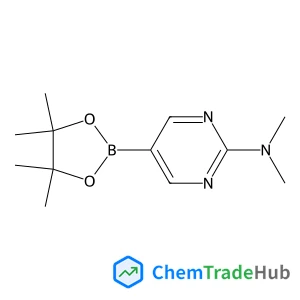
N,N-Dimethyl-5-(4,4,5,5-tetramethyl-1,3,2-dioxaborolan-2-yl)-2-pyrimidinamine
CAS Number:
1032759-30-0
Molecular Formula:
C12H20BN3O2
Recommended Suppliers






Disclaimer
This page provides academic journal information for reference and research purposes only. We are not affiliated with any journal publishers and do not handle publication submissions. For publication-related inquiries, please contact the respective journal publishers directly.
If you notice any inaccuracies in the information displayed, please contact us at support@chemtradehub.com. We will promptly review and address your concerns.