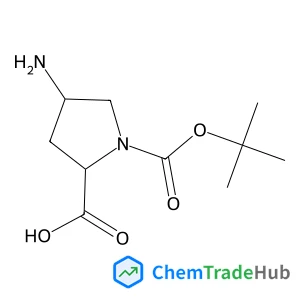
(2R,4R)-1-Boc-4-Aminopyrrolidine-2-carboxylic acid
CAS Number:
132622-98-1
Molecular Formula:
C10H18N2O4
Qinye Li, Siyao Qiu, Lizhong He, Xiwang Zhang
Transition metal molybdenum (Mo) exhibits a strong capacity to adsorb nitrogen (N2), but the Mo–N2 interaction is too strong and thus it is difficult for ammonia (NH3) to be released from the catalyst surface. Bonding with nonmetals with strong electronegativity is helpful to weaken the Mo–N2 interaction, while the effect of hydrogen termination on catalyst surfaces needs to be evaluated given that the hydrogen evolution reaction (HER) is a key side reaction. This computational work aims to explore α-molybdenum carbide (Mo2C, orthorhombic phase) as an electrochemical catalyst for the full nitrogen reduction reaction (NRR). Our density functional theory (DFT) calculations focus on a (100) surface and demonstrate that (i) surface molybdenum and carbon can be terminated by hydrogen via the Volmer step and (ii) the NRR can occur on H-terminated Mo2C(100) with an energy requirement of 1.0–1.4 eV, depending on H-coverage. Although C–Mo bonding can remarkably reduce difficulty in NH3 release from a Mo-site, H-terminals result in performance deterioration. These results provide new insights into the development of NRR catalysts.

Acta Materialia

Saudi Pharmaceutical Journal

Nature Medicine

Chemistry Education Research and Practice

Russian Journal of Organic Chemistry

Current Opinion in Solid State & Materials Science

Organic Process Research & Development

Russian Chemical Bulletin

Russian Journal of Applied Chemistry

Drug Discovery Today
DOI: 10.1039/A802531B
Cong Hu
DOI: 10.1039/D3CP00061C
Chaoqun Zhang, Phelan Yu, Chandler J. Conn, Nicholas R. Hutzler, Lan Cheng
DOI: 10.1039/D3CP04040B
Fengjuan Huang, Yuying Liu, Ying Wang, Jia Xu, Jiangfang Lian, Yu Zou, Chuang Wang, Feng Ding
DOI: 10.1039/D3CP04138G
Mingna Zheng, Yanwei Li, Qingzhu Zhang, Wenxing Wang
DOI: 10.1039/D3CP04519F
Vladimir A. Seleznev, Nadezhda A. Nebogatikova, Artem I. Ivanov, Bogdan V. Voloshin, Irina I. Kurkina
DOI: 10.1039/D3CP03761D
Bich Ngoc Nguyen Thi, Chu Viet Ha, Nghiem Thi Ha Lien, J. Guerrero-Sanchez
DOI: 10.1039/D3CP02115G
Wenhao Pan, Changjiang Yang, Lei Zhou, Xiaolan Cai, Yankun Wang, Junhao Tan, Jun Chang
DOI: 10.1039/D3CP03677D
Xiao Xiao, Tong Mu, Andrey A. Sukhanov, Yihang Zhou, Peiran Yu, Fabiao Yu, Ayhan Elmali, Jianzhang Zhao, Ahmet Karatay, Violeta K. Voronkova
DOI: 10.1039/D3CP04891H
When considering alternatives to 1-(4-Chlorophenyl)-N-hydroxymethanimine (CAS: 3...
This compound should be stored in a cool, dry place away from direct sunlight. I...
3-(4-Bromophenyl)-5-(2-fluorophenyl)-1,2,4-oxadiazole is synthesized through a m...
5-Chloro-2-(4-chlorophenyl)-4-methyl-6-[3-(1-piperidinyl)propoxy]pyrimidine (CAS...
2-Chloro-4-(difluoromethoxy)pyridine is used in the pharmaceutical industry for ...
3-Chloro-6-methylpyridazine (CAS: 1121-79-5) is classified under the Globally Ha...
Several alternatives can be used in the synthesis of Methyl 4,5-dimethyl-2-nitro...
Alternatives to (2E,2'E)-3,3'-(1,4-Phenylene)bisacrylaldehyde include other acry...
3-Amino-5-chloropyridin-2-ol hydrochloride is an organic compound with the CAS n...
When handling 6,7-Difluoro-2,3-dihydro-4H-chromen-4-one, it is essential to wear...

Physical Chemistry Chemical Physics (PCCP) is an international journal co-owned by 19 physical chemistry and physics societies from around the world. This journal publishes original, cutting-edge research in physical chemistry, chemical physics and biophysical chemistry. To be suitable for publication in PCCP, articles must include significant innovation and/or insight into physical chemistry; this is the most important criterion that reviewers and Editors will judge against when evaluating submissions. The journal has a broad scope and welcomes contributions spanning experiment, theory, computation and data science. Topical coverage includes spectroscopy, dynamics, kinetics, statistical mechanics, thermodynamics, electrochemistry, catalysis, surface science, quantum mechanics, quantum computing and machine learning. Interdisciplinary research areas such as polymers and soft matter, materials, nanoscience, energy, surfaces/interfaces, and biophysical chemistry are welcomed if they demonstrate significant innovation and/or insight into physical chemistry. Joined experimental/theoretical studies are particularly appreciated when complementary and based on up-to-date approaches.
![[4-(Isobutyrylamino)phenyl]boronic acid structure](https://static.chemtradehub.com/structs/874/874219-50-8-6ab5.webp "[4-(Isobutyrylamino)phenyl]boronic acid structure")