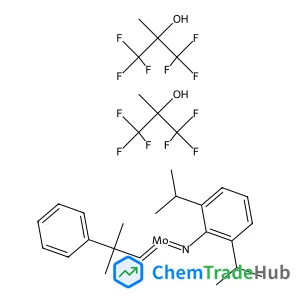
2,6-Diisopropylphenylimidoneophylidene molybdenum(VI) bis(hexafluoro-t-butoxide)
CAS Number:
139220-25-0
Molecular Formula:
C30H37F12MoNO2
Sandra Monti, Ilse Manet, Francesco Manoli, Giancarlo Marconi
In the present contribution we address the study of the interaction of a flavonoid-derivative licochalcone A (LA) with human serum albumin (HSA). The application of circular dichroism, UV-Vis absorption, fluorescence and laser flash photolysis combined with molecular mechanics, molecular dynamics and quantum mechanical calculations of rotational strength afforded a clear picture of the modes of association of the LA neutral molecule to HSA, evidencing specific interactions with protein amino acids and their photophysical consequences. The drug is primarily associated in subdomain IIA where a strong interaction with Trp214 is established. At least two different positions of LA with respect to tryptophan are possible, one with the phenolic ring of the drug facing the aromatic ring of Trp214 and the other with the methoxyphenolic ring of LA in proximity to Trp214. In both cases LA is at ca. 4 Å from Trp214. This vicinity does not affect much the S1 singlet state deactivation of the bound drug, which exhibits a slightly higher fluorescence quantum yield and fluorescence lifetime on the order of that of the free molecule. The LA triplet lifetime appears to be somewhat shortened in this site. The secondary binding site is in subdomain IIIA. Here, the carbonyl group of LA experiences a strong H-bond with the OH-phenolic substituent of Tyr411. This interaction reduces substantially the LA molecular degrees of freedom, thereby determining a decrease of both radiative and nonradiative rate constants for decay of the singlet. The overall rigidity of the structure causes a lengthening of the triplet lifetime.
Jiaqing Huang, Yijie Mo, Yao Yao
DOI: 10.1039/C8CP06467A
Yue-Jie Shi, Rong-Jun Zhang, Xin Chen, Lei Wang, Lei Chen, Qing-Hua Huang, Da-Hai Li, Yu-Xiang Zheng, Song-You Wang, Ning Dai, Liang-Yao Chen
DOI: 10.1039/C8CP04942D
Yingmin Wang, Wenhui Kong, Lifeng Wang, Jin Zhong Zhang, Yan Li, Xiaoguang Liu, Yong Li
DOI: 10.1039/C8CP06768F
Zhen Li, Siyu Han, Yuanchun Pan, Jian Zhou, Huibin Xu
DOI: 10.1039/C8CP06534A
DOI: 10.1039/C8CP06087H
Grzegorz Nawrocki, Alp Karaboga
DOI: 10.1039/C8CP06142D
Gustavo Cuba-Supanta, Rafael Gutierrez, Justo Rojas-Tapia
DOI: 10.1039/C8CP05592K
Yina Huang, Baolin Wang, Qiangqiang Meng, Lele Fan, Qinfang Zhang
DOI: 10.1039/C8CP04541K
3-(2-Bromoimidazo[2,1-b]thiazol-6-yl)propanoic acid hydrochloride is typically s...
2-Isopropyl-1,3-dioxane-5-carboxylic acid is typically synthesized by the carbox...
Alisporivir (CAS: 254435-95-5) is an antiviral medication used in the treatment ...
[1,2,4]triazolo[3,4-a]phthalazine (CAS: 234-80-0) is a crystalline compound with...
Regulatory guidelines for (2S)-5-Hydroxy-2-(4-hydroxyphenyl)-4-oxo-3,4-dihydro-2...
2,2-Difluorocyclohexanamine hydrochloride is generally safe when handled under p...
3-Nitro-2-phenylthiophene is primarily used in the synthesis of other organic co...
1-(Trifluoroacetyl)-4-piperidinecarbonitrile (CAS: 77940-79-5) is a colorless to...
Research and market trends for 1,3,6,8-Tetranitro-9H-carbazole (CAS: 4543-33-3) ...
Waste containing Dibenzo[b,d]thiophen-1-ylboronic acid (CAS: 1245943-60-5) shoul...

Physical Chemistry Chemical Physics (PCCP) is an international journal co-owned by 19 physical chemistry and physics societies from around the world. This journal publishes original, cutting-edge research in physical chemistry, chemical physics and biophysical chemistry. To be suitable for publication in PCCP, articles must include significant innovation and/or insight into physical chemistry; this is the most important criterion that reviewers and Editors will judge against when evaluating submissions. The journal has a broad scope and welcomes contributions spanning experiment, theory, computation and data science. Topical coverage includes spectroscopy, dynamics, kinetics, statistical mechanics, thermodynamics, electrochemistry, catalysis, surface science, quantum mechanics, quantum computing and machine learning. Interdisciplinary research areas such as polymers and soft matter, materials, nanoscience, energy, surfaces/interfaces, and biophysical chemistry are welcomed if they demonstrate significant innovation and/or insight into physical chemistry. Joined experimental/theoretical studies are particularly appreciated when complementary and based on up-to-date approaches.