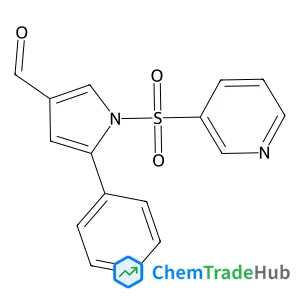
5-Phenyl-1-(pyridin-3-ylsulfonyl)-1H-pyrrole-3-carbaldehyde
CAS Number:
881676-90-0
Molecular Formula:
C16H12N2O3S
Yingmin Wang, Wenhui Kong, Lifeng Wang, Jin Zhong Zhang, Yan Li, Xiaoguang Liu, Yong Li
The development of new antioxidants with quick absorbance of free radicals and excellent biocompatibility has drawn intensive attention in recent years. Graphene quantum dots (GQDs) seemed to be one of the most promising antioxidants because of their appropriate antioxidant activity, unique structure, excellent biocompatibility, and low toxicity. However, the relatively low antioxidant activity in comparison with inorganic semiconductor materials and unclear antioxidant mechanism limited their application in cells. In this paper, we further explored their antioxidant mechanism by focusing on the relationship between antioxidant activity and surface oxygen functional groups. The total oxygen fraction was controlled by post-preparation reduction using NaBH4 and the type of oxygen functional groups was adjusted by free radicals during the preparation of GQDs. The degree of reduction and content of surface oxygen groups were determined by X-ray photoelectron spectroscopy (XPS), and the antioxidant activity was obtained by scavenging of 1,1-diphenyl-2-picryl-hydrazyl (DPPH˙) and hydroxyl (˙OH) free radicals. Based on the analysis of XPS, Raman, and Fourier-transform infrared (FT-IR) spectra, the relationship between antioxidant activity and the surface oxygen groups of GQDs was obtained, and the antioxidant mechanism of GQDs was revealed with a particular specification of each oxygen group in the antioxidant activity of GQDs, meanwhile, the biocompatibility of GQDs has been demonstrated by cytotoxicity tests. We hope that our results will provide a new insight into a complete antioxidant mechanism of GQDs.

Saudi Pharmaceutical Journal

Chemical Communications

New Journal of Chemistry

Drug Discovery Today

Acta Materialia

Current Opinion in Solid State & Materials Science

Current Opinion in Colloid & Interface Science

Journal of Saudi Chemical Society

Chemistry Education Research and Practice

Russian Journal of Coordination Chemistry
Chaoqun Zhang, Phelan Yu, Chandler J. Conn, Nicholas R. Hutzler, Lan Cheng
DOI: 10.1039/D3CP04040B
Christina Kjær, Emil Vogt, Jeppe Langeland, Nanna Falk Christensen, Thomas Toft Lindkvist, Henrik G. Kjaergaard, Steen Brøndsted Nielsen
DOI: 10.1039/D3CP04615J
Liying Yang, Tingyu Liu, Jinsong Jiang, Wenqi Song
DOI: 10.1039/D3CP04600A
DOI: 10.1039/D3CP90213G
Kanhu Charan Behera, Mangalampalli Ravikanth
DOI: 10.1039/D3CP04234K
Yang Sun, Renhai Wang, Yimei Fang, Shunqing Wu, Qiubao Lin, Kai-Ming Ho
DOI: 10.1039/D3CP03844K
When considering alternatives to 1-(4-Chlorophenyl)-N-hydroxymethanimine (CAS: 3...
This compound should be stored in a cool, dry place away from direct sunlight. I...
3-(4-Bromophenyl)-5-(2-fluorophenyl)-1,2,4-oxadiazole is synthesized through a m...
5-Chloro-2-(4-chlorophenyl)-4-methyl-6-[3-(1-piperidinyl)propoxy]pyrimidine (CAS...
2-Chloro-4-(difluoromethoxy)pyridine is used in the pharmaceutical industry for ...
3-Chloro-6-methylpyridazine (CAS: 1121-79-5) is classified under the Globally Ha...
Several alternatives can be used in the synthesis of Methyl 4,5-dimethyl-2-nitro...
Alternatives to (2E,2'E)-3,3'-(1,4-Phenylene)bisacrylaldehyde include other acry...
3-Amino-5-chloropyridin-2-ol hydrochloride is an organic compound with the CAS n...
When handling 6,7-Difluoro-2,3-dihydro-4H-chromen-4-one, it is essential to wear...

Physical Chemistry Chemical Physics (PCCP) is an international journal co-owned by 19 physical chemistry and physics societies from around the world. This journal publishes original, cutting-edge research in physical chemistry, chemical physics and biophysical chemistry. To be suitable for publication in PCCP, articles must include significant innovation and/or insight into physical chemistry; this is the most important criterion that reviewers and Editors will judge against when evaluating submissions. The journal has a broad scope and welcomes contributions spanning experiment, theory, computation and data science. Topical coverage includes spectroscopy, dynamics, kinetics, statistical mechanics, thermodynamics, electrochemistry, catalysis, surface science, quantum mechanics, quantum computing and machine learning. Interdisciplinary research areas such as polymers and soft matter, materials, nanoscience, energy, surfaces/interfaces, and biophysical chemistry are welcomed if they demonstrate significant innovation and/or insight into physical chemistry. Joined experimental/theoretical studies are particularly appreciated when complementary and based on up-to-date approaches.