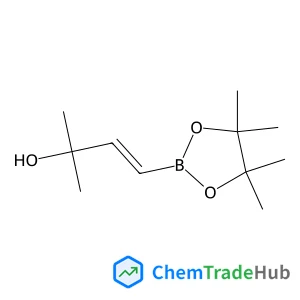
(E)-2-methyl-4-(4,4,5,5-tetramethyl-1,3,2-dioxaborolan-2-yl)but-3-en-2-ol
CAS Number:
581802-26-8
Molecular Formula:
C11H21BO3
Jiaqing Huang, Yijie Mo, Yao Yao
All-polymer solar cells have made substantial achievements in recent years, offering numerous unsettled subjects for mechanical researchers. In order to quantitatively study the influence of the molecular electrostatic potential on the charge generation proposed by the experimenter, we simulate the ultrafast dynamics of the charge-transfer (CT) state at the interface between two polymer chains, which are respectively regarded as the donor and acceptor in all-polymer solar cells. The formation of a stable CT state is found to be sensitive to the distance between two oppositely charged polarons and the relevant critical electrostatic potential is thus quantified, which is in good agreement with experiments. In order to get insight into the dependence of the dissociation of the CT state on the width of the interfacial layer, two quantities are calculated: one is the Coulomb capture radius between the two polarons and the other is the quantum trace distance which serves as the fingerprint of the quantum coherence between them. The dissociation of the CT state is found to take place within an ultrafast timescale for an optimum interfacial width. The classical spatial distance and the quantum trace distance manifest a converging trend, suggesting a decoherence scenario for the charge separation in all-polymer solar cells.
J. Ulises Reveles, Khaled M. Saoud, M. Samy El-Shall
DOI: 10.1039/C6CP05431E
Suresh Kondati Natarajan, Jörg Behler
DOI: 10.1039/C6CP05711J
Pablo Rivero
DOI: 10.1039/C6CP06191E
Eleanor I. Gillette, Nam Kim, Gary W. Rubloff, Sang Bok Lee
DOI: 10.1039/C6CP05640G
Abhishek Mishra, Mayank Shrivastava
DOI: 10.1039/C6CP04497B
Bernhard Frick, Johannes Elbert, Markus Gallei, Bernd Stühn
DOI: 10.1039/C6CP05156A
DOI: 10.1039/C6CP05557E
When considering alternatives to 1-(4-Chlorophenyl)-N-hydroxymethanimine (CAS: 3...
This compound should be stored in a cool, dry place away from direct sunlight. I...
3-(4-Bromophenyl)-5-(2-fluorophenyl)-1,2,4-oxadiazole is synthesized through a m...
5-Chloro-2-(4-chlorophenyl)-4-methyl-6-[3-(1-piperidinyl)propoxy]pyrimidine (CAS...
2-Chloro-4-(difluoromethoxy)pyridine is used in the pharmaceutical industry for ...
3-Chloro-6-methylpyridazine (CAS: 1121-79-5) is classified under the Globally Ha...
Several alternatives can be used in the synthesis of Methyl 4,5-dimethyl-2-nitro...
Alternatives to (2E,2'E)-3,3'-(1,4-Phenylene)bisacrylaldehyde include other acry...
3-Amino-5-chloropyridin-2-ol hydrochloride is an organic compound with the CAS n...
When handling 6,7-Difluoro-2,3-dihydro-4H-chromen-4-one, it is essential to wear...

Physical Chemistry Chemical Physics (PCCP) is an international journal co-owned by 19 physical chemistry and physics societies from around the world. This journal publishes original, cutting-edge research in physical chemistry, chemical physics and biophysical chemistry. To be suitable for publication in PCCP, articles must include significant innovation and/or insight into physical chemistry; this is the most important criterion that reviewers and Editors will judge against when evaluating submissions. The journal has a broad scope and welcomes contributions spanning experiment, theory, computation and data science. Topical coverage includes spectroscopy, dynamics, kinetics, statistical mechanics, thermodynamics, electrochemistry, catalysis, surface science, quantum mechanics, quantum computing and machine learning. Interdisciplinary research areas such as polymers and soft matter, materials, nanoscience, energy, surfaces/interfaces, and biophysical chemistry are welcomed if they demonstrate significant innovation and/or insight into physical chemistry. Joined experimental/theoretical studies are particularly appreciated when complementary and based on up-to-date approaches.