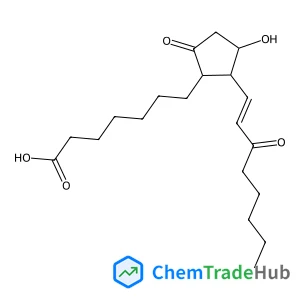
(11alpha,13E)-11-Hydroxy-9,15-dioxoprost-13-en-1-oic acid
CAS Number:
22973-19-9
Molecular Formula:
C20H32O5
Ken-ichi Shimizu, Yoshihiro Tsuji, Tsuyoshi Hatamachi, Kenji Toda, Tatsuya Kodama, Mineo Sato, Yoshie Kitayama
A series of layered perovskite tantalates, A2SrTa2O7 (A = H, Li, K, and Rb), were prepared as novel photocatalysts for photocatalytic water splitting into H2 and O2 under UV irradiation. The layered perovskite tantalates with hydrated interlayer space, A2SrTa2O7·nH2O (A = H, K, and Rb), showed higher H2 formation rate than anhydrous layered tantalate, Li2SrTa2O7, and anhydrous perovskite tantalate, KTaO3. H2SrTa2O7·nH2O and K2SrTa2O7·nH2O showed high activity for overall splitting of water without loading co-catalysts. The reaction over H2SrTa2O7·nH2O proceeded steadily more than 70 h, demonstrating a high durability of the catalyst. Effects of hydrated interlayer space on the catalytic activity were discussed on the basis of the results of photoluminescence spectra and the hydrogen evolution from aqueous solution of n-butylamine as a test reaction. The results indicate that the availability of interlayer space of layered tantalate as reaction sites is an important factor to improve the photocatalytic activity of Ta-based semiconductor materials.
Daniel T. Gryko, Beata Koszarna
DOI: 10.1039/B208950E
Franco Cozzi, Rita Annunziata, Maurizio Benaglia, Mauro Cinquini, Laura Raimondi, Kim K. Baldridge, Jay S. Siegel
DOI: 10.1039/B208871A
Gennaro Pescitelli, Nina Berova, Tom L. Xiao, Roman V. Rozhkov, Richard C. Larock, Daniel W. Armstrong
DOI: 10.1039/B207652G
Ji Liu, Qing-Yun Liu, Xing-Xiao Fang, Gong-Qing Liu, Yong Ling
DOI: 10.1039/C8OB02161A
Kuo-Hsin Chen, Yi-Jung Chiang, Jia-Liang Zhu
DOI: 10.1039/C8OB01489B
Xianwei Li, Tianzhang Wang, Yu-Jing Lu, Shaomin Ji, Yanping Huo, Bifu Liu
DOI: 10.1039/C8OB01532E
Yu Wang, Chenlong Wei, Ruyun Tang, Haosheng Zhan, Jing Lin, Zhenhua Liu, Weihua Tao, Zhongxue Fang
DOI: 10.1039/C8OB01749B
Yun Lu, Yixing Zhao, Kishan L. Handoo, Vernon D. Parker
DOI: 10.1039/B208186E
Michael Harding, Robert Hodgson, Tahir Majid, Kenneth J. McDowall
DOI: 10.1039/B208781B
Jennifer Frommer, Beatrice Karg, Klaus Weisz, Sabine Müller
DOI: 10.1039/C8OB02246A
6-(3-Fluorophenyl)picolinic acid is generally considered safe for laboratory use...
(3R)-3-Pyrrolidinol is used in the pharmaceutical industry as a precursor for dr...
When handling (4R,5R)-4,5-Diethoxycarbonyl-2,2-dimethyldioxolane (CAS: 59779-75-...
1-(6-Chloroimidazo[1,2-b]pyridazin-3-yl)ethanone is often synthesized via a mult...
The market for N-Ethyl-3,4-dimethylbenzylamine (CAS: 39180-83-1) remains steady,...
Tert-butyl 3-(pyrrolidin-1-yl)azetidine-1-carboxylate is a chemical compound wit...
1-Bromo-3-chloro-2,4-dimethoxybenzene (CAS: 1228956-93-1) falls under the classi...
The safety of 8-Bromo-2-methyl-3,4-dihydroisoquinolin-1(2H)-one (CAS: 1368622-07...
Benzyl [(3S)-2,6-dioxo-3-piperidinyl]carbamate is generally safe when handled wi...
1-{[4-(4,4,5,5-Tetramethyl-1,3,2-dioxaborolan-2-yl)phenyl]sulfonyl}pyrrolidine s...

Physical Chemistry Chemical Physics (PCCP) is an international journal co-owned by 19 physical chemistry and physics societies from around the world. This journal publishes original, cutting-edge research in physical chemistry, chemical physics and biophysical chemistry. To be suitable for publication in PCCP, articles must include significant innovation and/or insight into physical chemistry; this is the most important criterion that reviewers and Editors will judge against when evaluating submissions. The journal has a broad scope and welcomes contributions spanning experiment, theory, computation and data science. Topical coverage includes spectroscopy, dynamics, kinetics, statistical mechanics, thermodynamics, electrochemistry, catalysis, surface science, quantum mechanics, quantum computing and machine learning. Interdisciplinary research areas such as polymers and soft matter, materials, nanoscience, energy, surfaces/interfaces, and biophysical chemistry are welcomed if they demonstrate significant innovation and/or insight into physical chemistry. Joined experimental/theoretical studies are particularly appreciated when complementary and based on up-to-date approaches.
![2-Methyl-2-propanyl [(2S)-1-hydroxy-3-(4-hydroxyphenyl)-2-propanyl]carbamate structure](https://static.chemtradehub.com/structs/833/83345-46-4-eec2.webp "2-Methyl-2-propanyl [(2S)-1-hydroxy-3-(4-hydroxyphenyl)-2-propanyl]carbamate structure")
![4-[(2,4-Dihydroxyphenyl)diazenyl]-5-hydroxy-2,7-naphthalenedisulfonic acid structure](https://static.chemtradehub.com/structs/362/3627-01-8-79ac.webp "4-[(2,4-Dihydroxyphenyl)diazenyl]-5-hydroxy-2,7-naphthalenedisulfonic acid structure")