


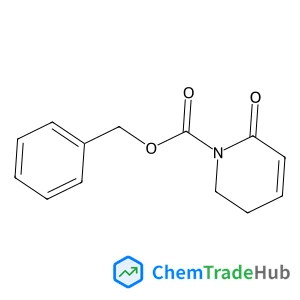
Benzyl 6-oxo-3,6-dihydro-1(2H)-pyridinecarboxylate
CAS Number:
725746-35-0
Molecular Formula:
C13H13NO3
Michael Harding, Robert Hodgson, Tahir Majid, Kenneth J. McDowall
Dipyranones, such as 1,2-bis[(2R,3S,6S)-3-hydroxy-6-methoxy-3-oxo-6H-pyran-2-yl]ethane, were exploited as templates for the synthesis of some novel C-linked disaccharide analogues. Efficient methods, such as stereoselective reduction and dihydroxylation, were developed for two-directional functionalisation of these templates. Peracetylated derivatives of ten stereoisomeric disaccharide analogues {acetic acid 4,5-diacetoxy-6-methoxy-[(3′,4′,5′-triacetoxy-6′-methoxytetrahydropyran-2′-yl)ethyl]tetrahydropyran-3-yl esters} were synthesised from a virtual library of 136 compounds; furthermore, an additional eight stereoisomers could have been synthesised simply by using the enantiomeric ligand in the enantioselective step. The ability of (2S,3S,4R,5R,6R)- 6-methoxy-2-[2′-((2′R,3′R,4′S,5′R,6′S)-3′,4′,5′-trihydroxy-6′-methoxytetrahydropyran-2′-yl)ethyl]tetrahydropyran-3,4,5-triol to bind to the repressor protein, LacI, was estimated to be similar to that of isopropyl-β-thiogalactoside. The disaccharide mimetics were concluded to be a new and interesting class of C-linked disaccharide mimetics with promising, though largely unstudied, biological activity.

Critical Reviews in Solid State and Materials Sciences

Heteroatom Chemistry

Topics in Catalysis

Chinese Journal of Chemistry

Cellulose

Bioorganic & Medicinal Chemistry Letters

Atomization and Sprays

Acta Metallurgica Sinica-English Letters

Journal of the Indian Institute of Science

Herald of the Russian Academy of Sciences
Werner Fudickar, Torsten Linker
DOI: 10.1039/B719637G
Szymon W. Przybylak, Floriana Tuna, Simon J. Teat, Richard E. P. Winpenny
DOI: 10.1039/B717277J
Pierangelo Metrangolo, Frank Meyer, Tullio Pilati, Giancarlo Terraneo
DOI: 10.1039/B716879A
Johanna Niesel, Antonio Pinto, Harmel W. Peindy N'Dongo, Klaus Merz, Ingo Ott, Ronald Gust, Ulrich Schatzschneider
DOI: 10.1039/B719075A
Junwon Kim, Hye-Young Park, Jaeseung Kim, Jiyoung Ryu, Do Yoon Kwon, Regis Grailhe, Rita Song
DOI: 10.1039/B719434J
Sankar Muniappan, Sophia Lipstman, Israel Goldberg
DOI: 10.1039/B719625C
Jian Zhang, Xianhui Bu
DOI: 10.1039/B719368H
Ali Abou Hassan, Olivier Sandre, Valérie Cabuil, Patrick Tabeling
DOI: 10.1039/B719550H
N-(4-Methoxybenzyl)-2-pyridinamine (CAS: 52818-63-0) is increasingly being used ...
When handling Ethyl 4-(2-chlorophenyl)-1,3-thiazole-2-carboxylate, appropriate p...
Diethyldiselane (CAS: 628-39-7) is classified under the Globally Harmonized Syst...
The market for oxocopper (CAS: 12053-18-8) is primarily driven by its use in cat...
The market for 5-{[(2-Methyl-2-propanyl)oxy]carbonyl}-5-azaspiro[2.4]heptane-7-c...
2-(1-Pyrrolidinyl)-4-pyridinamine is a chemical compound with the CAS number 359...
2-(3-Pyridinyl)-1-azabicyclo[2.2.2]octane (CAS: 91556-75-1) is a crystalline sol...
(S)-Alpha-allyl-proline hydrochloride is usually synthesized via a Wittig reacti...
3-Methyl-1,2-oxazole-5-carboxylic acid (CAS: 4857-42-5) is an organic compound w...
Lys-SMCC-DM1 is synthesized via a multi-step process involving the coupling of S...

Organic & Biomolecular Chemistry (OBC) publishes original and high impact research and reviews in organic chemistry. We welcome research that shows new or significantly improved protocols or methodologies in total synthesis, synthetic methodology or physical and theoretical organic chemistry as well as research that shows a significant advance in the organic chemistry or molecular design aspects of chemical biology, catalysis, supramolecular and macromolecular chemistry, theoretical chemistry, mechanism-oriented physical organic chemistry, medicinal chemistry or natural products. Articles published in the journal should report new work which makes a highly-significant impact in the field. Routine and incremental work is generally not suitable for publication in the journal. More details about key areas of our scope are below. In all cases authors should include in their article clear rationale for why their research has been carried out.

![1-(1-Benzyl-1,2,3,6-tetrahydropyridin-4-yl)-1H-benzo[d]imidazol-2(3H)-one structure](https://static.chemtradehub.com/structs/603/60373-71-9-7dfb.webp "1-(1-Benzyl-1,2,3,6-tetrahydropyridin-4-yl)-1H-benzo[d]imidazol-2(3H)-one structure")





