












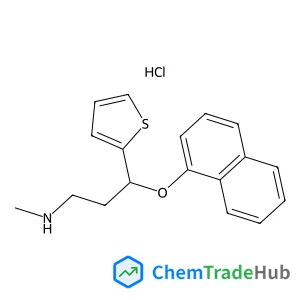
N-Methyl-3-(1-naphthyloxy)-3-(2-thienyl)-1-propanamine hydrochloride (1:1)
CAS Number:
1188266-11-6
Molecular Formula:
C18H20ClNOS
Xiangming Fu, Yanqiu Wang, Liang Xu, Atsushi Narumi, Shin-ichiro Sato, Xiaoran Yang
Poly(N,N-bis(2-ethoxyethyl)acrylamide) (PEOEAm), a new thermoresponsive polyacrylamide, has been studied from the perspectives of synthesis and thermal phase transition. PEOEAm without any initiator residue at the chain end was synthesized via hydrosilylation-promoted group transfer polymerization (GTP) to exclude the effect of polymer end groups on the thermoresponsive properties of the polymer. To extend thermoresponsive PEOEAm to its copolymer systems, the GTP tendency of EOEAm was evaluated and compared with that of N,N-dimethylacrylamide (DMAm). There exists a significant difference between the polymerization reactivities of EOEAm and DMAm, and this difference was applied to realize the random group transfer copolymerization (GTcoP) of EOEAm (“A” unit) and DMAm (“B” unit) for the one-pot synthesis of a BA-block copolymer. A series of block copolymer architectures, such as AB-, ABA-, BAB-, and BABA-block copolymers, were similarly prepared. The thermoresponsive properties of the block copolymers were evaluated by measuring the cloud-point temperature and hydrodynamic radius of their aqueous solutions.
DOI: 10.1039/JA9860100293
Shan Huang, Yuexin Song, Zhimei He, Jian-Rong Zhang, Jun-Jie Zhu
DOI: 10.1039/D1AN00077B
Hangtian Zhu, Jun Luo, Huaizhou Zhao, Jingkui Liang
DOI: 10.1039/C5TA01266J
Yue-Ming Yu, Yuan-Yuan Niu, Ling-Yang Wang, Zhi-Yong Wu, Cui-Wei Yan
DOI: 10.1039/D1AN00171J
Ya-Xin Wang, Dong-Xia Wang, Jia-Yi Ma, Jing Wang, Yi-Chen Du, De-Ming Kong
DOI: 10.1039/D1AN00275A
Ionut Tranca, Xin Zhou, Can Li
DOI: 10.1039/C5TA02193F
Roli Verma, Banshi D. Gupta
DOI: 10.1039/C3AN01098H
DOI: 10.1039/D0AN02400G
N-(4-Methoxybenzyl)-2-pyridinamine (CAS: 52818-63-0) is increasingly being used ...
When handling Ethyl 4-(2-chlorophenyl)-1,3-thiazole-2-carboxylate, appropriate p...
Diethyldiselane (CAS: 628-39-7) is classified under the Globally Harmonized Syst...
The market for oxocopper (CAS: 12053-18-8) is primarily driven by its use in cat...
The market for 5-{[(2-Methyl-2-propanyl)oxy]carbonyl}-5-azaspiro[2.4]heptane-7-c...
2-(1-Pyrrolidinyl)-4-pyridinamine is a chemical compound with the CAS number 359...
2-(3-Pyridinyl)-1-azabicyclo[2.2.2]octane (CAS: 91556-75-1) is a crystalline sol...
(S)-Alpha-allyl-proline hydrochloride is usually synthesized via a Wittig reacti...
3-Methyl-1,2-oxazole-5-carboxylic acid (CAS: 4857-42-5) is an organic compound w...
Lys-SMCC-DM1 is synthesized via a multi-step process involving the coupling of S...

Polymer Chemistry welcomes submissions in all areas of polymer science that have a strong focus on macromolecular chemistry. Manuscripts may cover a broad range of fields, yet no direct application focus is required.
![5'-Fluoro-[2,3'-biindolinylidene]-2',3-dione structure](https://static.chemtradehub.com/structs/251/251903-00-1-9cb1.webp "5'-Fluoro-[2,3'-biindolinylidene]-2',3-dione structure")





