













Supramolecular self-assembly and perfected in vitro/vivo property of 5-fluorouracil and ferulic acid on the strength of double optimized strategy: the first 5-fluorouracial-phenolic acid nutraceutical cocrystal with synergistic antitumor efficacy
Literature Information
Publication Date
2021-03-10
DOI
10.1039/D1AN00171J
Impact Factor
4.616
Authors
Yue-Ming Yu, Yuan-Yuan Niu, Ling-Yang Wang, Zhi-Yong Wu, Cui-Wei Yan
View Original
Abstract
For highlighting the predominance of phenolic acid nutraceutical ferulic acid (FR) in regulating the in vivo/vitro performances of anticancer drug 5-fluorouracil (Flu) and strengthening their cooperativity in antitumor effect, thus achieving a major breakthrough in the development of drug-nutraceutical cocrystal with synergistic antitumor action, a cocrystallization strategy of dual optimization is created, in which both the in vivo and vitro natures of Flu are improved by exploiting the FR's excellent physicochemical property. Moreover, Flu's anticancer effects were promoted by exerting the assistant antitumor peculiarity of FR. Such dual optimization of FR for Flu in physicochemical properties and anticancer activities is beneficial for realizing synergistic augmentation effect by taking the benefit of the cooperativeness of Flu and FR in the anticancer ability. Based on this idea, a novel cocrystal of Flu and FR, namely, Flu-FR-H2O, is successfully assembled as the first 5-fluorouracil-nutraceutical cocrystal with synergistic antitumor effect and its explicit structure is resolved. The single-crystal X-ray diffraction demonstrates that Flu and FR have a ratio of 1 : 1 with one equivalent of solvent water in the cocrystal, where one-dimensional hydrogen-bonding helices and FR-Flu hydrogen-bonding pairs, together construct a three-dimensional supramolecular network. By combining experimental evaluation with theoretical analysis, in vitro/vivo pharmaceutical properties are scientifically investigated. Results show that the permeability and aqueous solubility of Flu are respectively elevated by 5.08 and 1.64 folds, which has brought about ameliorated pharmacokinetics, thus providing prolonged retention time and increased oral bioavailability. More interestingly, the cocrystal shows synergistic inhibition ability of Flu and FR against tested tumor cell strains, hence laying the groundwork for reducing the dosage and even the toxic side effects of Flu. As a result of this, the present research not only provides a new strategy for Flu to optimize its physicochemical properties and antitumor activities simultaneously but also offers some opinions for the development of synergistic antitumor pharmaceutical cocrystals.
Related Literature
Heteropoly acid as a novel nitrene transfer agent: a facile and practical aziridination of olefins with Chloramine-T
G. D. Kishore Kumar, Sundarababu Baskaran
2004-03-23
Communication
DOI: 10.1039/B402371D
On-chip separation of peptides prepared within a micro reactor
Vinod George, Paul Watts, Stephen J. Haswell, Esteban Pombo-Villar
2003-10-22
Communication
DOI: 10.1039/B310744B
Remarkable enhancement of reactivity of carbonyl compounds for polymerizations with non-activated aromatic hydrocarbons
Mikhail Zolotukhin, Serguei Fomine, Roberto Salcedo, Leonard Khalilov
2004-03-25
Communication
DOI: 10.1039/B317108F
Synthetic studies towards congeners of phomactin A. Re-examination of the structure of Sch 49028
John W. C. Cheing, William P. D. Goldring, Gerald Pattenden
2003-10-11
Communication
DOI: 10.1039/B310753A
Peptide-coated CdS quantum dots for the optical detection of copper(ii) and silver(i)‡
Kerim M. Gattás-Asfura, Roger M. Leblanc
2003-09-25
Communication
DOI: 10.1039/B308991F
First in-situSAXS studies of the mesostructuration of spherical silica and titania particles during spray-drying process
C. Boissiere, D. Grosso, H. Amenitsch, A. Gibaud, A. Coupé, N. Baccile, C. Sanchez
2003-10-14
Communication
DOI: 10.1039/B308694A
The generation and trapping of organozinc carbenoids from N-diethoxymethyl amides: a new amidocyclopropanation reaction
Guillaume Bégis, David Cladingboel, William B. Motherwell
2003-10-03
Communication
DOI: 10.1039/B309887G
Synthetic studies on ecteinascidin 743: rapid access to the fully functionalized tetrahydroisoquinoline with a bridged 10-membered sulfur containing macrocycle
Michaël De Paolis, Angèle Chiaroni, Jieping Zhu
2003-10-20
Communication
DOI: 10.1039/B309824A
The enhancement of photoswitching in a diarylethene derivative by the incorporation of cyanobiphenyl groups
Michel Frigoli, Georg H. Mehl
2004-02-23
Communication
DOI: 10.1039/B316146C
Rapid synthesis of oligosaccharides using an anomeric fluorous silyl protecting group
Leonardo Manzoni
2003-10-29
Communication
DOI: 10.1039/B311448A
You might also like
Compound Q&A
What is the market or research trend for N-(4-Methoxybenzyl)-2-pyridinamine (CAS: 52818-63-0)?
N-(4-Methoxybenzyl)-2-pyridinamine (CAS: 52818-63-0) is increasingly being used ...
52818-63-0N-(4-Methoxybenzyl)-...
Compound Q&A
What precautions should be taken when handling Ethyl 4-(2-chlorophenyl)-1,3-thiazole-2-carboxylate (CAS: 1050507-06-6)?
When handling Ethyl 4-(2-chlorophenyl)-1,3-thiazole-2-carboxylate, appropriate p...
1050507-06-6Ethyl 4-(2-chlorophe...
Compound Q&A
What regulatory guidelines apply to diethyldiselane (CAS: 628-39-7)?
Diethyldiselane (CAS: 628-39-7) is classified under the Globally Harmonized Syst...
628-39-7Diethyldiselane
Compound Q&A
What is the market or research trend for oxocopper (CAS: 12053-18-8)?
The market for oxocopper (CAS: 12053-18-8) is primarily driven by its use in cat...
12053-18-8oxocopper; oxo-(oxoc...
Compound Q&A
What is the market or research trend for 5-{[(2-Methyl-2-propanyl)oxy]carbonyl}-5-azaspiro[2.4]heptane-7-carboxylic acid?
The market for 5-{[(2-Methyl-2-propanyl)oxy]carbonyl}-5-azaspiro[2.4]heptane-7-c...
1268519-54-55-{[(2-Methyl-2-prop...
Compound Q&A
What is 2-(1-Pyrrolidinyl)-4-pyridinamine (CAS: 35981-63-6)?
2-(1-Pyrrolidinyl)-4-pyridinamine is a chemical compound with the CAS number 359...
35981-63-62-(1-Pyrrolidinyl)-4...
Compound Q&A
What are the physical and chemical properties of 2-(3-Pyridinyl)-1-azabicyclo[2.2.2]octane (CAS: 91556-75-1)?
2-(3-Pyridinyl)-1-azabicyclo[2.2.2]octane (CAS: 91556-75-1) is a crystalline sol...
91556-75-12-(3-Pyridinyl)-1-az...
Compound Q&A
How is (S)-Alpha-allyl-proline hydrochloride (CAS: 129704-91-2) typically synthesized?
(S)-Alpha-allyl-proline hydrochloride is usually synthesized via a Wittig reacti...
129704-91-2(S)-Alpha-allyl-prol...
Compound Q&A
What is 3-Methyl-1,2-oxazole-5-carboxylic acid (CAS: 4857-42-5)?
3-Methyl-1,2-oxazole-5-carboxylic acid (CAS: 4857-42-5) is an organic compound w...
4857-42-53-Methyl-1,2-oxazole...
Compound Q&A
How is Lys-SMCC-DM1 (CAS: 1281816-04-3) typically synthesized?
Lys-SMCC-DM1 is synthesized via a multi-step process involving the coupling of S...
1281816-04-3Lys-SMCC-DM1
Source Journal
Analyst

CiteScore:
7.8
Self-citation Rate:
5.6%
Articles per Year:
653
Analyst publishes analytical and bioanalytical research that reports premier fundamental discoveries and inventions, and the applications of those discoveries, unconfined by traditional discipline barriers.
Recommended Compounds
![1-{3-[4-Amino-3-(4-phenoxyphenyl)-1H-pyrazolo[3,4-d]pyrimidin-1-yl]-1-piperidinyl}-2,3-dihydroxy-1-propanone structure](https://static.chemtradehub.com/structs/122/1226872-27-0-e037.webp "1-{3-[4-Amino-3-(4-phenoxyphenyl)-1H-pyrazolo[3,4-d]pyrimidin-1-yl]-1-piperidinyl}-2,3-dihydroxy-1-propanone structure")
1-{3-[4-Amino-3-(4-phenoxyphenyl)-1H-pyrazolo[3,4-d]pyrimidin-1-yl]-1-piperidinyl}-2,3-dihydroxy-1-propanone
CAS Number:
1226872-27-0
Molecular Formula:
C25H26N6O4
![1-(1-Benzyl-1,2,3,6-tetrahydropyridin-4-yl)-1H-benzo[d]imidazol-2(3H)-one structure](https://static.chemtradehub.com/structs/603/60373-71-9-7dfb.webp "1-(1-Benzyl-1,2,3,6-tetrahydropyridin-4-yl)-1H-benzo[d]imidazol-2(3H)-one structure")
1-(1-Benzyl-1,2,3,6-tetrahydropyridin-4-yl)-1H-benzo[d]imidazol-2(3H)-one
CAS Number:
60373-71-9
Molecular Formula:
C19H19N3O
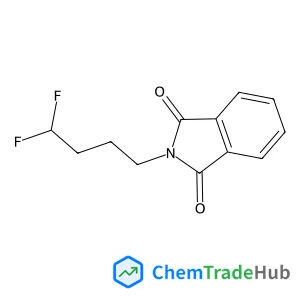
2-(4,4-Difluorobutyl)-1H-isoindole-1,3(2H)-dione
CAS Number:
1265341-14-7
Molecular Formula:
C12H11F2NO2
Recommended Suppliers






Disclaimer
This page provides academic journal information for reference and research purposes only. We are not affiliated with any journal publishers and do not handle publication submissions. For publication-related inquiries, please contact the respective journal publishers directly.
If you notice any inaccuracies in the information displayed, please contact us at support@chemtradehub.com. We will promptly review and address your concerns.