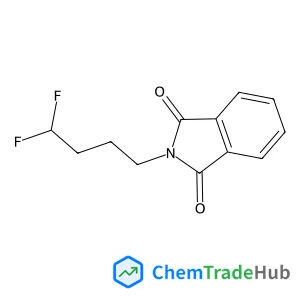
2-(4,4-Difluorobutyl)-1H-isoindole-1,3(2H)-dione
CAS Number:
1265341-14-7
Molecular Formula:
C12H11F2NO2
Ionic alkyllead compounds are extracted from water into carbon tetrachloride by complexation with sodium diethyldithiocarbamate while inorganic lead is effectively removed through the application of EDTA. Evaporation of the organic solvent followed by digestion of the organolead complexes with nitric acid allows the determination of the sum of the ionic alkyllead compounds by graphite furnace atomic absorption spectrometry with an over-all recovery of 85 ± 6% and a detection limit of a few ng l–1.

Helvetica Chimica Acta

Israel Journal of Chemistry

Pure and Applied Chemistry

Proceedings of the National Academy of Sciences of the United States of America

Science Progress

Fibre Chemistry

Journal of Catalysis

Molecular Pharmacology

Organic Preparations and Procedures International

Journal of Organometallic Chemistry
Lin-Ping Zhang, Thomas C. W. Mak
DOI: 10.1039/B307604K
Catherine Dendrinou-Samara, Curtis M. Zaleski, Andri Evagorou, Jeff W. Kampf, Vincent L. Pecoraro, Dimitris P. Kessissoglou
DOI: 10.1039/B309439A
G. D. Kishore Kumar, Sundarababu Baskaran
DOI: 10.1039/B402371D
Craig R. Stewart, Jonathan M. Goodman
DOI: 10.1039/B309488J
Yitong Li, Chi Ming Yang
DOI: 10.1039/B310543A
Hideki Amii, Yutaka Ichihara, Takashi Nakagawa, Takeshi Kobayashi, Kenji Uneyama
DOI: 10.1039/B309696C
Sheila N. Baker, T. Mark McCleskey, Siddharth Pandey, Gary A. Baker
DOI: 10.1039/B401304M
Kerim M. Gattás-Asfura, Roger M. Leblanc
DOI: 10.1039/B308991F
Chi-Keung Lam, Thomas C. W. Mak
DOI: 10.1039/B306649E
John D. Harvey, Christopher J. Ziegler
DOI: 10.1039/B310522A
N-(4-Methoxybenzyl)-2-pyridinamine (CAS: 52818-63-0) is increasingly being used ...
When handling Ethyl 4-(2-chlorophenyl)-1,3-thiazole-2-carboxylate, appropriate p...
Diethyldiselane (CAS: 628-39-7) is classified under the Globally Harmonized Syst...
The market for oxocopper (CAS: 12053-18-8) is primarily driven by its use in cat...
The market for 5-{[(2-Methyl-2-propanyl)oxy]carbonyl}-5-azaspiro[2.4]heptane-7-c...
2-(1-Pyrrolidinyl)-4-pyridinamine is a chemical compound with the CAS number 359...
2-(3-Pyridinyl)-1-azabicyclo[2.2.2]octane (CAS: 91556-75-1) is a crystalline sol...
(S)-Alpha-allyl-proline hydrochloride is usually synthesized via a Wittig reacti...
3-Methyl-1,2-oxazole-5-carboxylic acid (CAS: 4857-42-5) is an organic compound w...
Lys-SMCC-DM1 is synthesized via a multi-step process involving the coupling of S...

The Journal of Analytical Atomic Spectrometry (JAAS) is the central journal for publishing innovative research on fundamentals, instrumentation, and methods in the determination, speciation and isotopic analysis of (trace) elements within all fields of application. This includes, but is not restricted to, the most recent progress, developments and achievements in all forms of atomic and elemental detection, isotope ratio determination, molecular analysis, plasma-based analysis and X-ray techniques. The journal welcomes full papers, communications, technical notes, critical and tutorial review articles, editorials, and comments, in addition to the Atomic Spectrometry Updates (ASU) literature reviews that are prepared by an expert panel. Submissions are welcome in the following areas, but note this list reflects the current scope and authors are strongly encouraged to contact the Editorial team if they believe that their work offers potentially new and emerging research relevant to the journal remit: Fundamental studies in the following. New and existing sources for atomic emission, absorption, fluorescence and mass spectrometry and those that provide both atomic and molecular information Sample introduction techniques for solids, liquids, gases Improvements in sensitivity, selectivity, precision, accuracy and/or robustness Isotope ratio measurements, including techniques for improving precision and mass bias correction Single channel and multichannel simultaneous detection systems Chemometrics, statistics, calibration techniques and internal standardisation Theoretical and numerical modelling of fundamental processes related to all of the above methodologies Novel or improved methodologies in areas of application including, but not limited to the following. Biosciences, including elemental, speciation and isotopic analysis in biological systems, immunoassays based on metal-labeled antibodies, bio-imaging, and nanoparticle toxicology Geochemistry Environmental science Materials science, including engineered nanoparticles and quantum dots Metrology, including reference materials Forensic analysis Food and agricultural sciences Energy Archaeometry Molecular analysis. Molecular sources for elemental and isotopic analysis Atomic sources for molecular analysis Atomic and molecular techniques simultaneously used for complementary chemical information All contributions are judged on originality and quality of scientific content, and appropriateness of length to content of new science.
![1-[6-(1H-Imidazol-1-yl)-3-pyridinyl]methanamine structure](https://static.chemtradehub.com/structs/914/914637-08-4-8825.webp "1-[6-(1H-Imidazol-1-yl)-3-pyridinyl]methanamine structure")