












Silver-integrated cobalt hydroxide hybrid nanostructured materials for improved electrocatalytic oxygen evolution reaction
Literature Information
Publication Date
2023-12-21
DOI
10.1039/D3NJ05268K
Impact Factor
3.591
Authors
Gunasekaran Arunkumar, Pandi Muthukumar, Govindan Deviga, Mariappan Mariappan, Savarimuthu Philip Anthony
View Original
Abstract
Cobalt hydroxide Co(OH)2 is considered to be a potential material for electrocatalyst, especially for oxygen evolution reaction (OER), owing to the earth's abundance, environmentally benign nature, and redox-active properties of cobalt. Herein, we report the fabrication of pristine Co(OH)2 and AgNP-integrated Co(OH)2 (Ag–Co(OH)2) by simple wet chemical methods and explore the electrocatalytic OER activity in the alkaline medium. High-resolution transmission electro-microscopic (HR-TEM) analysis revealed featureless nanostructures for Co(OH)2 with coexisting amorphous and crystalline phases, as well as the inclusion of crystalline AgNPs in Ag–Co(OH)2. X-ray photoelectron spectroscopic (XPS) analysis confirmed the inclusion of metallic AgNPs and the presence of Co at a mixed oxidation state. Electrocatalytic OER studies indicated that pristine Co(OH)2 required the overpotential of 299 mV to achieve a geometric current density of 10 mA cm−2. The integration of AgNPs in Co(OH)2 (Ag–Co(OH)2) showed a gradual improvement in the OER activity. The optimized sample, Ag–Co(OH)2-5, required the overpotential of 253 mV to produce 10 mA cm−2 current density. Tafel slope analysis revealed a lower value upon AgNP integration and electrochemical impedance showed lower charge transfer resistance. The lower Tafel value and charge transfer resistance of Ag–Co(OH)2-5 indicated good chemical coupling and faster reaction kinetics at the electrode surface. AgNPs incorporation with Co(OH)2 also showed enhanced turn-over frequency, electrochemical active surface area, and double-layer capacitance. The fabricated hybrid Ag–Co(OH)2-5 catalyst also exhibited good stability over 60 h. Thus, the electrocatalytic activity of low-cost Co(OH)2 was improved by fabricating coexisting amorphous and crystalline phases and integrating noble silver nanoparticles.
Related Literature
High molecular weight acrylonitrile–butadiene architectures via a combination of RAFT polymerization and orthogonal copper mediated azide–alkyne cycloaddition
Christoph J. Dürr, Sebastian G. J. Emmerling, Paul Lederhose, Andreas Kaiser, Sven Brandau, Michael Klimpel, Christopher Barner-Kowollik
2012-02-07
Paper
DOI: 10.1039/C2PY00547F
Light-emitting poly(N-naphthyl-2,7-carbazole)
Takeshi Mori, Toshinobu Shinnai
2011-10-10
Paper
DOI: 10.1039/C1PY00286D
Two dimensional size controlled confinement of poly(vinyl pyrrolidone) in the interlayer space of swelling clay mineral
Minoru Sohmiya, Shingo Omata
2012-02-10
Paper
DOI: 10.1039/C2PY00465H
Boron-containing polymers as versatile building blocks for functional nanostructured materials
Fei Cheng, Frieder Jäkle
2011-05-18
Review Article
DOI: 10.1039/C1PY00123J
Synthesis of microporous polymers by Friedel–Crafts reaction of 1-bromoadamantane with aromatic compounds and their surface modification
Ho Lim, Min Chul Cha, Ji Young Chang
2012-02-16
Communication
DOI: 10.1039/C2PY00511E
A click chemistry approach to the efficient synthesis of polyoxometalate–polymer hybrids with well-defined structures
Min-Biao Hu, Nan Xia, Wei Yu, Chi Ma, Jing Tang, Zhan-Yao Hou, Ping Zheng, Wei Wang
2012-01-18
Communication
DOI: 10.1039/C2PY00546H
Bioactive and electroactive response of flexible polythiophene:polyester nanomembranes for tissue engineering
Luis J. del Valle
2012-02-01
Paper
DOI: 10.1039/C2PY00584K
An isoindigo and dithieno[3,2-b:2′,3′-d]silole copolymer for polymer solar cells
Romain Stalder, Caroline Grand, Jegadesan Subbiah, Franky So, John R. Reynolds
2011-10-27
Communication
DOI: 10.1039/C1PY00402F
Random introduction of degradable linkages into functional vinyl polymers by radical ring-opening polymerization, tailored for soft tissue engineering
Jenny Undin, Teresa Illanes, Anna Finne-Wistrand, Ann-Christine Albertsson
2012-03-19
Paper
DOI: 10.1039/C2PY20034A
Individual graphene oxide platelets through direct molecular exfoliation with globular amphiphilic hyperbranched polymers
Shi-Min Shau, Tzong-Yuan Juang, Han-Sheng Lin, Cheng-Liang Huang, Chi-Fa Hsieh, Jeng-Yue Wu, Ru-Jong Jeng
2012-03-14
Paper
DOI: 10.1039/C2PY00006G
You might also like
Compound Q&A
What industries use 4-(4-tert-Butylphenyl)-1H-pyrazol-3-amine (CAS: 1015845-73-4)?
4-(4-tert-Butylphenyl)-1H-pyrazol-3-amine finds applications in various industri...
1015845-73-44-(4-tert-Butylpheny...
Compound Q&A
What industries use H3TATAB (CAS: 63557-10-8)?
H3TATAB is used in the pharmaceutical industry for the synthesis of certain orga...
63557-10-8H3TATAB
Compound Q&A
What are the main uses of 1-Ethyl-3-fluorobenzene (CAS: 696-39-9)?
1-Ethyl-3-fluorobenzene (CAS: 696-39-9) is primarily used as a precursor in the ...
696-39-91-Ethyl-3-fluorobenz...
Compound Q&A
What are the main uses of 1-(tert-Butoxycarbonyl)-4-(4-methoxyphenyl)pyrrolidine-3-carboxylic acid (CAS: 851484-94-1)?
1-(tert-Butoxycarbonyl)-4-(4-methoxyphenyl)pyrrolidine-3-carboxylic acid is prim...
851484-94-11-(tert-Butoxycarbon...
Compound Q&A
What are the physical and chemical properties of 1-Cyclobutyl-4-piperidinone (CAS: 359880-05-0)?
1-Cyclobutyl-4-piperidinone (CAS: 359880-05-0) is a colorless or white crystalli...
359880-05-01-Cyclobutyl-4-piper...
Compound Q&A
What is Pyridine-2,6-dicarboxylic acid mono-tert-butyl ester (CAS: 575433-76-0)?
Pyridine-2,6-dicarboxylic acid mono-tert-butyl ester (CAS: 575433-76-0) is a che...
575433-76-0Pyridine-2,6-dicarbo...
Compound Q&A
What is the market or research trend for 2,3-Difluorophenylalanine (CAS: 236754-62-4)?
The market for 2,3-Difluorophenylalanine (CAS: 236754-62-4) is growing with incr...
236754-62-42,3-Difluorophenylal...
Compound Q&A
How is (2-Hydroxy-1-naphthyl)boronic acid (CAS: 898257-48-2) typically synthesized?
(2-Hydroxy-1-naphthyl)boronic acid can be synthesized through the reduction of 2...
898257-48-2(2-Hydroxy-1-naphthy...
Compound Q&A
What are the physical and chemical properties of tert-Butyl (5-bromo-6-methyl-3-(4,4,5,5-tetramethyl-1,3,2-dioxaborolan-2-yl)pyridin-2-yl)carbamate (CAS: 1315351-28-0)?
This compound is a crystalline solid with a molecular weight of approximately 52...
1315351-28-0tert-Butyl (5-bromo-...
Compound Q&A
Are there alternatives to 5,7-Dihydroxy-4-oxo-2-(3,4,5-trihydroxyphenyl)-4H-chromen-3-yl beta-D-glucopyranoside (CAS: 19833-12-6) in synthesis?
While 5,7-Dihydroxy-4-oxo-2-(3,4,5-trihydroxyphenyl)-4H-chromen-3-yl beta-D-gluc...
19833-12-65,7-Dihydroxy-4-oxo-...
Source Journal
New Journal of Chemistry

CiteScore:
5.3
Self-citation Rate:
3.7%
Articles per Year:
2153
NJC (New Journal of Chemistry) is a broad-based primary journal encompassing all branches of chemistry and its sub-disciplines. It contains full research articles, communications, perspectives and focus articles. This well-established journal, owned by the Centre National de la Recherche Scientifique (CNRS) of France, has been co-published with the Royal Society of Chemistry since January 1998. NJC is the forum for the publication of high-quality, original and significant work that opens new directions in chemistry or other scientific disciplines. In addition to having a significant chemical component, work published in NJC must demonstrate that it will have an impact on areas of research other than that of the reported work.
Recommended Compounds
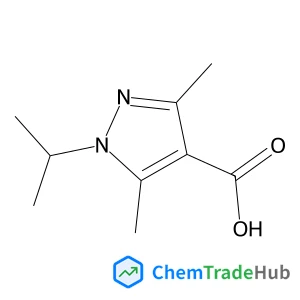
1-isopropyl-3,5-dimethyl-1H-pyrazole-4-carboxylic acid
CAS Number:
1007542-01-9
Molecular Formula:
C9H14N2O2
![4-[2-(3,4-Dihydro-2H-chromen-6-yl)-1,3-oxazol-5-yl]-1-(3-{[(2,5-dioxo-1-pyrrolidinyl)oxy]carbonyl}benzyl)pyridinium bromide structure](https://static.chemtradehub.com/structs/155/155863-03-9-8183.webp "4-[2-(3,4-Dihydro-2H-chromen-6-yl)-1,3-oxazol-5-yl]-1-(3-{[(2,5-dioxo-1-pyrrolidinyl)oxy]carbonyl}benzyl)pyridinium bromide structure")
4-[2-(3,4-Dihydro-2H-chromen-6-yl)-1,3-oxazol-5-yl]-1-(3-{[(2,5-dioxo-1-pyrrolidinyl)oxy]carbonyl}benzyl)pyridinium bromide
CAS Number:
155863-03-9
Molecular Formula:
C29H24BrN3O6
Recommended Suppliers



Disclaimer
This page provides academic journal information for reference and research purposes only. We are not affiliated with any journal publishers and do not handle publication submissions. For publication-related inquiries, please contact the respective journal publishers directly.
If you notice any inaccuracies in the information displayed, please contact us at support@chemtradehub.com. We will promptly review and address your concerns.