












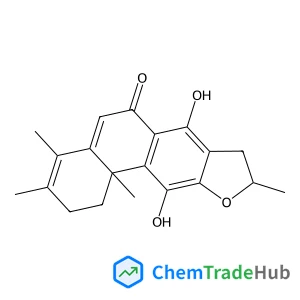
Phenanthro(3,2-b)furan-6(2H)-one, 1,8,9,11b-tetrahydro-7,11-dihydroxy-3,4,9,11b-tetramethyl-, cis-
CAS Number:
99624-92-7
Molecular Formula:
C20H22O4
Shi-Min Shau, Tzong-Yuan Juang, Han-Sheng Lin, Cheng-Liang Huang, Chi-Fa Hsieh, Jeng-Yue Wu, Ru-Jong Jeng
In this study, we used a solution process, involving direct molecular exfoliation of graphite oxide (GO) stacked layers, to obtain individual graphene oxide platelets (GOPs) through amphiphilic hyperbranched polymers (HPs). The HPs, based on poly(amic acid) and polyimide with terminal amino functionalities, were obtained through a facile “A2 + B3” synthesis; gel permeation chromatography of the HPs revealed molecular weights of 5000–8200 g mol−1 with a distribution of polydispersity between 2.0 and 4.2. Next, we inserted these globular HPs into the interlayer spaces of GO to prepare a series of GO/HP nanohybrids possessing intercalated and exfoliated morphologies. The intercalation processes featured a critical transition point at which a dramatic enlargement occurred to the interlayer spacing, depending on the content of the bulky embedded HPs. From transmission electron microscopy images, we observed transparent folding of the GOPs; powder X-ray diffraction analysis revealed individual nanosheets with well-defined diffraction patterns. Incorporating the bulky three-dimensional globular structure into the layered GO significantly influenced the solution exfoliation, allowing us to examine the intercalating behavior of GO intergallery. This solution-phase methodology, through direct HP molecular exfoliation, provides the way toward obtaining individual nanosheets, opening up opportunities for platelet-like nanographene oxide materials in many technological applications.
Samuel L. Smith, Alex W. Chin
DOI: 10.1039/C4CP01791A
Mei Wang, Liming Cheng, Quanbao Li, Zhiwen Chen, Shilong Wang
DOI: 10.1039/C4CP03407D
Mohammad Mahdi Abolhasani, Minoo Naebe, Qipeng Guo
DOI: 10.1039/C4CP00031E
Yunxia Li, Yanyan Zhu, Wenjing Zhang, Donghui Wei, Yingying Ran, Qilin Zhao, Mingsheng Tang
DOI: 10.1039/C4CP02186J
Arnab Shit, Shreyam Chatterjee, Arun K. Nandi
DOI: 10.1039/C4CP02175D
Daungruthai Jarukanont, João T. S. Coimbra, Bernd Bauerhenne, Pedro A. Fernandes, Shekhar Patel, Maria J. Ramos, Martin E. Garcia
DOI: 10.1039/C4CP02289K
Pierangelo Fabbrizzi, Luisa Lascialfari, Stefano Cicchi, Malgorzata Biczysko, Fabrizio Santoro
DOI: 10.1039/C3CP54609H
Keita Kanda, Dock-Chil Che
DOI: 10.1039/C3CP54475C
Kensaku Nagasawa, Shinobu Takao, Kotaro Higashi, Shin-ichi Nagamatsu, Gabor Samjeské, Yoshiaki Imaizumi, Oki Sekizawa, Takashi Yamamoto
DOI: 10.1039/C3CP54457E
Teresa Fornaro, Malgorzata Biczysko, Vincenzo Barone
DOI: 10.1039/C3CP54724H
4-(4-tert-Butylphenyl)-1H-pyrazol-3-amine finds applications in various industri...
H3TATAB is used in the pharmaceutical industry for the synthesis of certain orga...
1-Ethyl-3-fluorobenzene (CAS: 696-39-9) is primarily used as a precursor in the ...
1-(tert-Butoxycarbonyl)-4-(4-methoxyphenyl)pyrrolidine-3-carboxylic acid is prim...
1-Cyclobutyl-4-piperidinone (CAS: 359880-05-0) is a colorless or white crystalli...
Pyridine-2,6-dicarboxylic acid mono-tert-butyl ester (CAS: 575433-76-0) is a che...
The market for 2,3-Difluorophenylalanine (CAS: 236754-62-4) is growing with incr...
(2-Hydroxy-1-naphthyl)boronic acid can be synthesized through the reduction of 2...
This compound is a crystalline solid with a molecular weight of approximately 52...
While 5,7-Dihydroxy-4-oxo-2-(3,4,5-trihydroxyphenyl)-4H-chromen-3-yl beta-D-gluc...

Polymer Chemistry welcomes submissions in all areas of polymer science that have a strong focus on macromolecular chemistry. Manuscripts may cover a broad range of fields, yet no direct application focus is required.
![(3aR,7R,7aR)-2,2-Diethyl-3a,6,7,7a-tetrahydro-7-[(methylsulfonyl)oxy]-1,3-benzodioxole-5-carboxylic Acid Ethyl Ester structure](https://static.chemtradehub.com/structs/204/204254-90-0-7172.webp "(3aR,7R,7aR)-2,2-Diethyl-3a,6,7,7a-tetrahydro-7-[(methylsulfonyl)oxy]-1,3-benzodioxole-5-carboxylic Acid Ethyl Ester structure")




