












High molecular weight acrylonitrile–butadiene architectures via a combination of RAFT polymerization and orthogonal copper mediated azide–alkyne cycloaddition
Literature Information
Publication Date
2012-02-07
DOI
10.1039/C2PY00547F
Impact Factor
5.582
Authors
Christoph J. Dürr, Sebastian G. J. Emmerling, Paul Lederhose, Andreas Kaiser, Sven Brandau, Michael Klimpel, Christopher Barner-Kowollik
View Original
Abstract
α-Functional nitrile butadiene rubber (NBR) building blocks were employed in the copper mediated 1,3-dipolar Huisgen coupling upon addition of 1,4-bis(azidomethyl)benzene (4). Polymer–polymer coupling afforded linear polymers with molecular weights ranging from 2500 g mol−1 to 97 000 g mol−1 and polydispersities from 1.1 to 1.6. The α-functional NBR building blocks were obtained via the reversible addition–fragmentation chain transfer (RAFT) copolymerization of acrylonitrile (AN) and 1,3-butadiene (BD) at 100 °C, utilizing the high temperature azo initiator 1,1′-azobis(cyclohexane-1-carbonitrile) and chlorobenzene or acetone as solvents. A novel alkyne-functional trithiocarbonate 2 was synthesized in 64% yield via the N,N′-dicyclohexylcarbodiimide mediated coupling of 2-((dodecylsulfanyl)carbono-thioyl)sulfanyl propanoic acid (DoPAT, 1) and propargyl alcohol. 2 was shown to be an efficient controlling agent for the controlled/living radical copolymerization of acrylonitrile and 1,3-butadiene. The use of copper mediated azide–alkyne cycloaddition was extended towards the side-chain modification of acrylonitrile–butadiene rubbers as well as applied in the synthesis of branched and cross-linked NBR structures. For this purpose an acrylonitrile-1,3-butadiene–propargyl methacrylate (PMA) terpolymer of 3900 g mol−1 with a PDI of 1.3 was synthesized by a DoPAT-mediated RAFT polymerization. Herein, monomers were employed in the ratio of 56 : 35 : 9 (BD : AN : PMA). The ability of the terpolymer to undergo side-chain modification was demonstrated upon addition of 1-undecane azide. Cross-links were established via addition of 1,4-bis(azidomethyl)benzene. The current study provides the first successful approach to employ an orthogonal conjugation technique on this technically important class of synthetic rubbers.
Recommended Journals
Related Literature
Large-scale first principles configuration interaction calculations of optical absorption in aluminum clusters
Ravindra Shinde, Alok Shukla
2014-08-12
Paper
DOI: 10.1039/C4CP02232G
Morphological effect of gold nanoparticles on the adsorption of bovine serum albumin
Abhishek Chaudhary, Abhishek Gupta, Syamantak Khan, Chayan Kanti Nandi
2014-08-12
Paper
DOI: 10.1039/C4CP01515K
Nanoporous molybdenum carbide wires as an active electrocatalyst towards the oxygen reduction reaction
Xiaojun Bian, Jingjing Xiao, Baohong Liu, Micheál D. Scanlon, Hubert H. Girault
2014-02-12
Paper
DOI: 10.1039/C3CP54754J
Optimization of thermoelectric efficiency in SnTe: the case for the light band
Zachary M. Gibbs, Heng Wang, Yemao Han, Caini Xin, Laifeng Li
2014-08-14
Paper
DOI: 10.1039/C4CP02091J
Directions of chemical change: experimental characterization of the stereodynamics of photodissociation and reactive processes
Dock-Chil Che, Michio Okada, Federico Palazzetti, Vincenzo Aquilanti
2014-04-14
Perspective
DOI: 10.1039/C4CP00464G
Resonant Raman spectra of molecules with diradical character: multiconfigurational wavefunction investigation of neutral viologens
Julia Romanova, Vincent Liégeois, Benoît Champagne
2014-08-28
Paper
DOI: 10.1039/C4CP02977A
Size dependence of the upconverted luminescence of NaYF4:Er,Yb microspheres for use in ratiometric thermometry
Bin Dong, Rui N. Hua, Bao S. Cao, Zhi P. Li, Yang Y. He, Zhen Y. Zhang, Otto S. Wolfbeis
2014-08-04
Paper
DOI: 10.1039/C4CP01966K
One-pot fabrication of novel cuboctahedral Cu2O crystals enclosed by anisotropic surfaces with enhancing catalytic performance
Shaodong Sun, Hongjia Zhang, LinLi Tang, Xiaozhe Zhang, Zhimao Yang
2014-08-20
Communication
DOI: 10.1039/C4CP03381G
Ultrafast charge separation and nongeminate electron–hole recombination in organic photovoltaics
Samuel L. Smith, Alex W. Chin
2014-06-03
Communication
DOI: 10.1039/C4CP01791A
You might also like
Compound Q&A
What industries use 4-(4-tert-Butylphenyl)-1H-pyrazol-3-amine (CAS: 1015845-73-4)?
4-(4-tert-Butylphenyl)-1H-pyrazol-3-amine finds applications in various industri...
1015845-73-44-(4-tert-Butylpheny...
Compound Q&A
What industries use H3TATAB (CAS: 63557-10-8)?
H3TATAB is used in the pharmaceutical industry for the synthesis of certain orga...
63557-10-8H3TATAB
Compound Q&A
What are the main uses of 1-Ethyl-3-fluorobenzene (CAS: 696-39-9)?
1-Ethyl-3-fluorobenzene (CAS: 696-39-9) is primarily used as a precursor in the ...
696-39-91-Ethyl-3-fluorobenz...
Compound Q&A
What are the main uses of 1-(tert-Butoxycarbonyl)-4-(4-methoxyphenyl)pyrrolidine-3-carboxylic acid (CAS: 851484-94-1)?
1-(tert-Butoxycarbonyl)-4-(4-methoxyphenyl)pyrrolidine-3-carboxylic acid is prim...
851484-94-11-(tert-Butoxycarbon...
Compound Q&A
What are the physical and chemical properties of 1-Cyclobutyl-4-piperidinone (CAS: 359880-05-0)?
1-Cyclobutyl-4-piperidinone (CAS: 359880-05-0) is a colorless or white crystalli...
359880-05-01-Cyclobutyl-4-piper...
Compound Q&A
What is Pyridine-2,6-dicarboxylic acid mono-tert-butyl ester (CAS: 575433-76-0)?
Pyridine-2,6-dicarboxylic acid mono-tert-butyl ester (CAS: 575433-76-0) is a che...
575433-76-0Pyridine-2,6-dicarbo...
Compound Q&A
What is the market or research trend for 2,3-Difluorophenylalanine (CAS: 236754-62-4)?
The market for 2,3-Difluorophenylalanine (CAS: 236754-62-4) is growing with incr...
236754-62-42,3-Difluorophenylal...
Compound Q&A
How is (2-Hydroxy-1-naphthyl)boronic acid (CAS: 898257-48-2) typically synthesized?
(2-Hydroxy-1-naphthyl)boronic acid can be synthesized through the reduction of 2...
898257-48-2(2-Hydroxy-1-naphthy...
Compound Q&A
What are the physical and chemical properties of tert-Butyl (5-bromo-6-methyl-3-(4,4,5,5-tetramethyl-1,3,2-dioxaborolan-2-yl)pyridin-2-yl)carbamate (CAS: 1315351-28-0)?
This compound is a crystalline solid with a molecular weight of approximately 52...
1315351-28-0tert-Butyl (5-bromo-...
Compound Q&A
Are there alternatives to 5,7-Dihydroxy-4-oxo-2-(3,4,5-trihydroxyphenyl)-4H-chromen-3-yl beta-D-glucopyranoside (CAS: 19833-12-6) in synthesis?
While 5,7-Dihydroxy-4-oxo-2-(3,4,5-trihydroxyphenyl)-4H-chromen-3-yl beta-D-gluc...
19833-12-65,7-Dihydroxy-4-oxo-...
Source Journal
Polymer Chemistry

CiteScore:
8.6
Self-citation Rate:
7.3%
Articles per Year:
457
Polymer Chemistry welcomes submissions in all areas of polymer science that have a strong focus on macromolecular chemistry. Manuscripts may cover a broad range of fields, yet no direct application focus is required.
Recommended Compounds
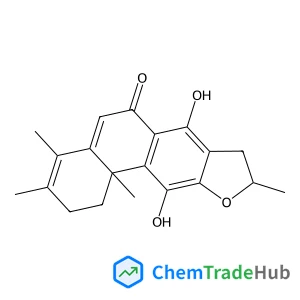
Phenanthro(3,2-b)furan-6(2H)-one, 1,8,9,11b-tetrahydro-7,11-dihydroxy-3,4,9,11b-tetramethyl-, cis-
CAS Number:
99624-92-7
Molecular Formula:
C20H22O4
Recommended Suppliers







Disclaimer
This page provides academic journal information for reference and research purposes only. We are not affiliated with any journal publishers and do not handle publication submissions. For publication-related inquiries, please contact the respective journal publishers directly.
If you notice any inaccuracies in the information displayed, please contact us at support@chemtradehub.com. We will promptly review and address your concerns.