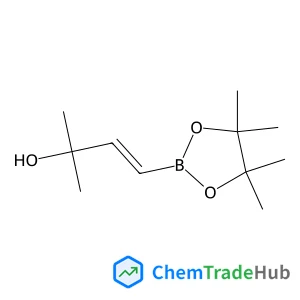
(E)-2-methyl-4-(4,4,5,5-tetramethyl-1,3,2-dioxaborolan-2-yl)but-3-en-2-ol
CAS Number:
581802-26-8
Molecular Formula:
C11H21BO3
Nadya Amalia, Fiki T. Akbar, Hadi T. Yudistira, Nadhratun N. Mobarak
Pyrolyzed Fe–N–C-based catalysts, particularly FeN4, are reported to show enhanced catalytic activity for some chemical reactions, particularly for the oxygen reduction reaction (ORR). Here, we present a computational study to investigate another pyrolyzed Fe–N–C-based catalyst, i.e. Fe2N6, adsorbed on graphene with special emphasis on the edges of graphene nanoribbons (both zig-zag and armchair configurations) as a candidate for Fe dual-atom catalysts (Fe-DACs). Utilizing density functional theory calculations along with microkinetic simulations, we investigate the influence of graphitic edges on the stability and ORR activity of Fe-DAC active sites. Our findings indicate that the presence of graphitic edges, particularly the zig-zag configuration, significantly lowers the formation energy of Fe-DAC active sites, making them more likely to form at the edges. Furthermore, several Fe-DAC active sites at graphitic edges exhibit exceptional ORR performance, surpassing the commonly employed FeN4 active site in SAC systems and even exceeding the benchmark Pt(111) surface. Notably, the (Fe2N6)o@z1 active site demonstrates outstanding performance in both associative and dissociative mechanisms. These results highlight the role of graphitic nanopores in enhancing the catalytic behavior of Fe-DAC active sites, providing valuable insights for designing efficient non-precious metal catalysts for ORR applications.
Adebayo A. Adeleke, Yansun Yao
DOI: 10.1039/C8CP07288D
Sreejith P. Babu, Perumal Elumalai
DOI: 10.1039/C8CP07500J
Kit McColl, Furio Corà
DOI: 10.1039/C9CP00170K
Juan P. Aranguren-Abrate, Claude Dedonder-Lardeux, Christophe Jouvet
DOI: 10.1039/C8CP07162D
Mauro Boero
DOI: 10.1039/C8CP07467D
Jiawei Wu, Dongxu Dai, Maodu Chen, Xueming Yang
DOI: 10.1039/C9CP00441F
DOI: 10.1039/C9CP00257J
Pablo Pinacho, Susana Blanco, Juan Carlos López
DOI: 10.1039/C8CP06959J
Angela Patti, Sonia Pedotti, Giuseppe Mazzeo, Giovanna Longhi, Sergio Abbate, Lorenzo Paoloni, Sergio Rampino, Vincenzo Barone
DOI: 10.1039/C9CP00437H
Olaf W. Morawski, Andrzej L. Sobolewski, Daniel T. Gryko
DOI: 10.1039/C9CP00978G
When considering alternatives to 1-(4-Chlorophenyl)-N-hydroxymethanimine (CAS: 3...
This compound should be stored in a cool, dry place away from direct sunlight. I...
3-(4-Bromophenyl)-5-(2-fluorophenyl)-1,2,4-oxadiazole is synthesized through a m...
5-Chloro-2-(4-chlorophenyl)-4-methyl-6-[3-(1-piperidinyl)propoxy]pyrimidine (CAS...
2-Chloro-4-(difluoromethoxy)pyridine is used in the pharmaceutical industry for ...
3-Chloro-6-methylpyridazine (CAS: 1121-79-5) is classified under the Globally Ha...
Several alternatives can be used in the synthesis of Methyl 4,5-dimethyl-2-nitro...
Alternatives to (2E,2'E)-3,3'-(1,4-Phenylene)bisacrylaldehyde include other acry...
3-Amino-5-chloropyridin-2-ol hydrochloride is an organic compound with the CAS n...
When handling 6,7-Difluoro-2,3-dihydro-4H-chromen-4-one, it is essential to wear...

Physical Chemistry Chemical Physics (PCCP) is an international journal co-owned by 19 physical chemistry and physics societies from around the world. This journal publishes original, cutting-edge research in physical chemistry, chemical physics and biophysical chemistry. To be suitable for publication in PCCP, articles must include significant innovation and/or insight into physical chemistry; this is the most important criterion that reviewers and Editors will judge against when evaluating submissions. The journal has a broad scope and welcomes contributions spanning experiment, theory, computation and data science. Topical coverage includes spectroscopy, dynamics, kinetics, statistical mechanics, thermodynamics, electrochemistry, catalysis, surface science, quantum mechanics, quantum computing and machine learning. Interdisciplinary research areas such as polymers and soft matter, materials, nanoscience, energy, surfaces/interfaces, and biophysical chemistry are welcomed if they demonstrate significant innovation and/or insight into physical chemistry. Joined experimental/theoretical studies are particularly appreciated when complementary and based on up-to-date approaches.