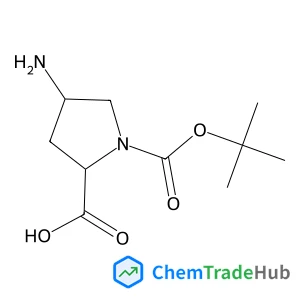
(2R,4R)-1-Boc-4-Aminopyrrolidine-2-carboxylic acid
CAS Number:
132622-98-1
Molecular Formula:
C10H18N2O4
Mauro Boero
Diffusion and storage of hydrogen molecules in metal–organic frameworks are crucial for the development of next-generation energy storage devices. By resorting to the first principles modeling, we compute the diffusion coefficient of molecular hydrogen in these systems in a range of temperatures where MOF-based devices are expected to operate. The explicit inclusion of the electronic structure shows that diffusivities are one order of magnitude smaller than those reported by classical simulations, evidencing the insufficiency of the empirical force fields used so far. We show that hydrogen is mainly rolled up around the metal oxide nodes both in MOF-5 and IRMOF-6, and partly around the carbon atoms in the case of IRMOF-6, where charged linkers are present. Metal ions embedded in the junction sites exert an electrostatic attraction toward hydrogen and the resulting distribution shows some ordering around these same sites at low temperature, whereas this tendency vanishes at room temperature. The induced polarization of hydrogen molecules generates an electrostatic interaction with charged atoms inside these nano-scaffolds and this is a key factor for the enhancement in hydrogen storage both in MOF-5 and IRMOF-6. The mechanism discussed hereby provides a novel understanding of metal–organic frameworks and acts as a guide to tune their efficiency for hydrogen storage. Moreover it paves the way to a computer-aided design of effective MOFs indicating that a fine control of the distribution of electrostatic charges inside the hydrogen hosting structure is crucial.
Jennifer A. Moore, Kalyan Vasudevan, Nicholas J. Hill, Gregor Reeske, Alan H. Cowley
DOI: 10.1039/B606390J
Craig P. Butts, Michael Green, Thomas N. Hooper, Richard J. Kilby, John E. McGrady, Dimitrios A. Pantazis, Christopher A. Russell
DOI: 10.1039/B717204D
Hang-Beom Bu, Günther Götz, Egon Reinold, Astrid Vogt, Sylvia Schmid, Raúl Blanco, Jose L. Segura, Peter Bäuerle
DOI: 10.1039/B718077B
Tianming Zuo, Kenneth Walker, Marilyn M. Olmstead, Frederic Melin, Brian C. Holloway, Luis Echegoyen, Harry C. Dorn, Manuel N. Chaur, Christopher J. Chancellor, Christine M. Beavers, Alan L. Balch, Andreas J. Athans
DOI: 10.1039/B716037B
Ayyappanpillai Ajayaghosh, Parayalil Chithra, Reji Varghese, Kizhumuri P. Divya
DOI: 10.1039/B718054C
Stephen G. Davies, A. Christopher Garner, Euan C. Goddard, Dennis Kruchinin, Paul M. Roberts, Humberto Rodriguez-Solla, Andrew D. Smith
DOI: 10.1039/B604835H
Gaojian Chen, Peter M. Wright, Jin Geng, Giuseppe Mantovani, David M. Haddleton
DOI: 10.1039/B718112D
Li Liu, Nan Zhao, Oren A. Scherman
DOI: 10.1039/B716889F
Weibin Cui, Yubo Wu, Hongkun Tian, Yanhou Geng, Fosong Wang
DOI: 10.1039/B713463K
Tadashi Ema, Daisuke Tanida, Tatsuya Matsukawa, Takashi Sakai
DOI: 10.1039/B718763G
When considering alternatives to 1-(4-Chlorophenyl)-N-hydroxymethanimine (CAS: 3...
This compound should be stored in a cool, dry place away from direct sunlight. I...
3-(4-Bromophenyl)-5-(2-fluorophenyl)-1,2,4-oxadiazole is synthesized through a m...
5-Chloro-2-(4-chlorophenyl)-4-methyl-6-[3-(1-piperidinyl)propoxy]pyrimidine (CAS...
2-Chloro-4-(difluoromethoxy)pyridine is used in the pharmaceutical industry for ...
3-Chloro-6-methylpyridazine (CAS: 1121-79-5) is classified under the Globally Ha...
Several alternatives can be used in the synthesis of Methyl 4,5-dimethyl-2-nitro...
Alternatives to (2E,2'E)-3,3'-(1,4-Phenylene)bisacrylaldehyde include other acry...
3-Amino-5-chloropyridin-2-ol hydrochloride is an organic compound with the CAS n...
When handling 6,7-Difluoro-2,3-dihydro-4H-chromen-4-one, it is essential to wear...

Physical Chemistry Chemical Physics (PCCP) is an international journal co-owned by 19 physical chemistry and physics societies from around the world. This journal publishes original, cutting-edge research in physical chemistry, chemical physics and biophysical chemistry. To be suitable for publication in PCCP, articles must include significant innovation and/or insight into physical chemistry; this is the most important criterion that reviewers and Editors will judge against when evaluating submissions. The journal has a broad scope and welcomes contributions spanning experiment, theory, computation and data science. Topical coverage includes spectroscopy, dynamics, kinetics, statistical mechanics, thermodynamics, electrochemistry, catalysis, surface science, quantum mechanics, quantum computing and machine learning. Interdisciplinary research areas such as polymers and soft matter, materials, nanoscience, energy, surfaces/interfaces, and biophysical chemistry are welcomed if they demonstrate significant innovation and/or insight into physical chemistry. Joined experimental/theoretical studies are particularly appreciated when complementary and based on up-to-date approaches.
![(2S)-2-{[(9H-Fluoren-9-ylmethoxy)carbonyl]amino}-4-(methylselanyl)butanoic acid structure](https://static.chemtradehub.com/structs/121/1217852-49-7-f252.webp "(2S)-2-{[(9H-Fluoren-9-ylmethoxy)carbonyl]amino}-4-(methylselanyl)butanoic acid structure")