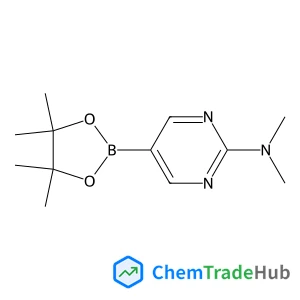
N,N-Dimethyl-5-(4,4,5,5-tetramethyl-1,3,2-dioxaborolan-2-yl)-2-pyrimidinamine
CAS Number:
1032759-30-0
Molecular Formula:
C12H20BN3O2
Olaf W. Morawski, Andrzej L. Sobolewski, Daniel T. Gryko
A structurally unique cyclic tris-coumarin possessing three identical coumarin units bridged by amide linkers as well as two linear analogs has been synthesized. There is a remarkable agreement between crystallographic data, 1H NMR and results of calculations for the cyclic tris-coumarin, showing in all cases a non-symmetric arrangement of identical coumarin moieties. Weak polarization of the coumarin subunits, resulting from the presence of only CONH– groups as electron-donors, results in a hypsochromic shift of both absorption and emission in this dye. We have proven that in non-cyclic, head-to-tail linked tris-coumarins, the photophysics is controlled not only by the substituents but also by the conformation of the molecule, which in turn depends on the nature of the linker's interactions. These can be controlled by the presence/absence of an amide-type hydrogen atom responsible for the formation of intramolecular hydrogen bonds. The presence of a hydrogen bond favors a stretched trans conformation of the dye, while in its absence, folding of the molecule occurs leading to a more compact conformation. Although, the increased number of covalently linked coumarin units does not drastically change the preferred conformation, the fluorescence quantum yields of tris-coumarins are significantly lower than for analogous bis-coumarins composed of the same units.
Wensheng Fu, Hideaki Kaneda, Norio Teramae
DOI: 10.1039/B717094G
Qi Zeng, Ping Cai, Zhen Li, Jingui Qin, Ben Zhong Tang
DOI: 10.1039/B717764J
Dominik Kurzydłowski
DOI: 10.1039/B716705A
Ezequiel Perez-Inestrosa, Jose-María Montenegro, Daniel Collado, Rafael Suau
DOI: 10.1039/B717690B
Junhui Xu
DOI: 10.1039/B606429A
Othman Bouloussa
DOI: 10.1039/B716026G
Sensuke Ogoshi, Tomoya Arai, Masato Ohashi, Hideo Kurosawa
DOI: 10.1039/B717261C
Hang-Beom Bu, Günther Götz, Egon Reinold, Astrid Vogt, Sylvia Schmid, Raúl Blanco, Jose L. Segura, Peter Bäuerle
DOI: 10.1039/B718077B
Miki Ishifuji, Masaya Mitsuishi, Tokuji Miyashita
DOI: 10.1039/B714832A
Manolis J. Manos, Joon I. Jang, John B. Ketterson, Mercouri G. Kanatzidis
DOI: 10.1039/B712732D
When considering alternatives to 1-(4-Chlorophenyl)-N-hydroxymethanimine (CAS: 3...
This compound should be stored in a cool, dry place away from direct sunlight. I...
3-(4-Bromophenyl)-5-(2-fluorophenyl)-1,2,4-oxadiazole is synthesized through a m...
5-Chloro-2-(4-chlorophenyl)-4-methyl-6-[3-(1-piperidinyl)propoxy]pyrimidine (CAS...
2-Chloro-4-(difluoromethoxy)pyridine is used in the pharmaceutical industry for ...
3-Chloro-6-methylpyridazine (CAS: 1121-79-5) is classified under the Globally Ha...
Several alternatives can be used in the synthesis of Methyl 4,5-dimethyl-2-nitro...
Alternatives to (2E,2'E)-3,3'-(1,4-Phenylene)bisacrylaldehyde include other acry...
3-Amino-5-chloropyridin-2-ol hydrochloride is an organic compound with the CAS n...
When handling 6,7-Difluoro-2,3-dihydro-4H-chromen-4-one, it is essential to wear...

Physical Chemistry Chemical Physics (PCCP) is an international journal co-owned by 19 physical chemistry and physics societies from around the world. This journal publishes original, cutting-edge research in physical chemistry, chemical physics and biophysical chemistry. To be suitable for publication in PCCP, articles must include significant innovation and/or insight into physical chemistry; this is the most important criterion that reviewers and Editors will judge against when evaluating submissions. The journal has a broad scope and welcomes contributions spanning experiment, theory, computation and data science. Topical coverage includes spectroscopy, dynamics, kinetics, statistical mechanics, thermodynamics, electrochemistry, catalysis, surface science, quantum mechanics, quantum computing and machine learning. Interdisciplinary research areas such as polymers and soft matter, materials, nanoscience, energy, surfaces/interfaces, and biophysical chemistry are welcomed if they demonstrate significant innovation and/or insight into physical chemistry. Joined experimental/theoretical studies are particularly appreciated when complementary and based on up-to-date approaches.