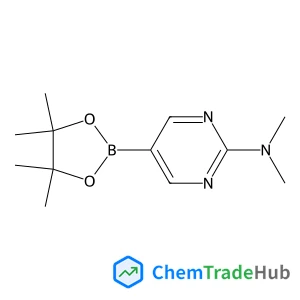
N,N-Dimethyl-5-(4,4,5,5-tetramethyl-1,3,2-dioxaborolan-2-yl)-2-pyrimidinamine
CAS Number:
1032759-30-0
Molecular Formula:
C12H20BN3O2
Sreejith P. Babu, Perumal Elumalai
This study presents the influence of the Au content on the catalytic activity of Pd100−xAux catalysts for ethanol electrooxidation in alkaline media. Potentiostatic electrochemical synthesis of the catalysts is adopted to reduce the resistance at the catalyst support interface and ensure minimal precursor wastage. Characterization of the Pd100−xAux bimetallic catalysts has been done using field-emission scanning electron microscopy (FESEM), energy dispersive X-ray analysis (EDAX), EDAX elemental mapping, high-resolution transmission electron microscopy (HR-TEM) and selected area electron diffraction (SAED) studies. Cyclic voltammetry and chronoamperometry studies imply superior electrocatalytic activity of the Pd100−xAux compositions with at least 50% Au to Pd. The Pd70Au30 bimetallic demonstrates the lowest onset potential of 0.475 V vs. RHE and highest mass activity with excellent stability. The combined effects of increased hydroxyl coverage on the Au and a d-band center shift, due to the induced compressive strain, are correlated with the excellent catalytic activity of the Pd70Au30 bimetallic catalyst. This claim is verified by evaluating the catalytic activity and the d-band centers of the Pd100−xAux catalysts obtained from their valence band spectra. On the basis of experimental UPS data, the authors report a downward shift of the d-band center for the Pd70Au30 bimetallic, which ensures ‘optimal chemisorption’, leading to enhanced oxidation.
Anupama Ranganathan, Abdelkrim El-Ghayoury, Cécile Mézière, Etienne Harté, Rodolphe Clérac, Patrick Batail
DOI: 10.1039/B600159A
Christopher J. C. Whitehouse, Stephen G. Bell, Henry G. Tufton, Richard J. P. Kenny, Lydia C. I. Ogilvie, Luet-Lok Wong
DOI: 10.1039/B718124H
Ashima Sah, Robert Kreiter, Dave H. A. Blank, Jaap F. Vente, Johan E. ten Elshof
DOI: 10.1039/B718082A
DOI: 10.1039/B605075A
Tadashi Ema, Daisuke Tanida, Tatsuya Matsukawa, Takashi Sakai
DOI: 10.1039/B718763G
Philippe C. Gros, Abdelatif Doudouh, Christopher Woltermann
DOI: 10.1039/B605170G
Susan E. Gibson, Jacob T. Rendell
DOI: 10.1039/B712298E
Sébastien Goeb, Aaron A. Rachford, Felix N. Castellano
DOI: 10.1039/B713285A
Chen-Hsiung Hung, Gao-Fong Chang, Anil Kumar, Geng-Fong Lin, Wei-Min Ching, Eric Wei-Guang Diau
DOI: 10.1039/B714412A
Dominik Kurzydłowski
DOI: 10.1039/B716705A
When considering alternatives to 1-(4-Chlorophenyl)-N-hydroxymethanimine (CAS: 3...
This compound should be stored in a cool, dry place away from direct sunlight. I...
3-(4-Bromophenyl)-5-(2-fluorophenyl)-1,2,4-oxadiazole is synthesized through a m...
5-Chloro-2-(4-chlorophenyl)-4-methyl-6-[3-(1-piperidinyl)propoxy]pyrimidine (CAS...
2-Chloro-4-(difluoromethoxy)pyridine is used in the pharmaceutical industry for ...
3-Chloro-6-methylpyridazine (CAS: 1121-79-5) is classified under the Globally Ha...
Several alternatives can be used in the synthesis of Methyl 4,5-dimethyl-2-nitro...
Alternatives to (2E,2'E)-3,3'-(1,4-Phenylene)bisacrylaldehyde include other acry...
3-Amino-5-chloropyridin-2-ol hydrochloride is an organic compound with the CAS n...
When handling 6,7-Difluoro-2,3-dihydro-4H-chromen-4-one, it is essential to wear...

Physical Chemistry Chemical Physics (PCCP) is an international journal co-owned by 19 physical chemistry and physics societies from around the world. This journal publishes original, cutting-edge research in physical chemistry, chemical physics and biophysical chemistry. To be suitable for publication in PCCP, articles must include significant innovation and/or insight into physical chemistry; this is the most important criterion that reviewers and Editors will judge against when evaluating submissions. The journal has a broad scope and welcomes contributions spanning experiment, theory, computation and data science. Topical coverage includes spectroscopy, dynamics, kinetics, statistical mechanics, thermodynamics, electrochemistry, catalysis, surface science, quantum mechanics, quantum computing and machine learning. Interdisciplinary research areas such as polymers and soft matter, materials, nanoscience, energy, surfaces/interfaces, and biophysical chemistry are welcomed if they demonstrate significant innovation and/or insight into physical chemistry. Joined experimental/theoretical studies are particularly appreciated when complementary and based on up-to-date approaches.