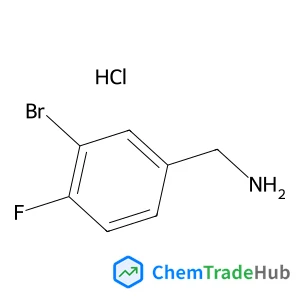
1-(3-Bromo-4-fluorophenyl)methanamine hydrochloride (1:1)
CAS Number:
202865-68-7
Molecular Formula:
C7H8BrClFN
Jiawei Wu, Dongxu Dai, Maodu Chen, Xueming Yang
The adsorption and polymerization of acetaldehyde (CH3CHO) have been investigated on clean and CO pre-covered Co(0001) surfaces using the temperature programmed desorption (TPD) method. On the clean Co(0001) surface, CH3CHO molecules can polymerize to produce paraldehyde with very low efficiency. With pre-dosed CO molecules on Co(0001), the decomposition of CH3CHO is greatly inhibited. When the coverage of pre-dosed CO is <0.33 ML, no enhancement of CH3CHO polymerization is observed. However, when the pre-dosed CO coverage is >0.33 ML, the polymerization of CH3CHO is significantly enhanced during the TPD process. Further results suggest that CO molecules adsorbed at the bridge/hollow sites may initialize the polymerization by nucleophilic attack of CH3CHO molecules with their O atoms. Moreover, the polymerization product induced by CO molecules is not paraldehyde, but linear polymer chains of CH3CHO at low CH3CHO coverages and probably three dimensional polymer structures at high CH3CHO coverages.
Masanari Kimura, Masahiko Mori, Nahoko Mukai, Keisuke Kojima, Yoshinao Tamaru
DOI: 10.1039/B605728D
Qi Zeng, Ping Cai, Zhen Li, Jingui Qin, Ben Zhong Tang
DOI: 10.1039/B717764J
Jun-ichi Matsuo, Yumi Tanaki, Aimi Kido, Hiroyuki Ishibashi
DOI: 10.1039/B605882E
Anupama Ranganathan, Abdelkrim El-Ghayoury, Cécile Mézière, Etienne Harté, Rodolphe Clérac, Patrick Batail
DOI: 10.1039/B600159A
Philippe C. Gros, Abdelatif Doudouh, Christopher Woltermann
DOI: 10.1039/B605170G
Jye-Shane Yang, Guan-Jhih Huang, Yi-Hung Liu, Shie-Ming Peng
DOI: 10.1039/B717714C
Darryl J. Morrison, Susanne D. Riegel, Warren E. Piers, Masood Parvez, Robert McDonald
DOI: 10.1039/B605716K
Jack A. Brown, Stephanie Irvine, Alan R. Kennedy, William J. Kerr, Shalini Andersson, Göran N. Nilsson
DOI: 10.1039/B715938B
Zhian Liang, Xiaoyu Wu
DOI: 10.1039/B606154K
Jian Jin, Yukihiro Sugiyama, Keita Mitsui, Hideo Arakawa, Izumi Ichinose
DOI: 10.1039/B717485C
When considering alternatives to 1-(4-Chlorophenyl)-N-hydroxymethanimine (CAS: 3...
This compound should be stored in a cool, dry place away from direct sunlight. I...
3-(4-Bromophenyl)-5-(2-fluorophenyl)-1,2,4-oxadiazole is synthesized through a m...
5-Chloro-2-(4-chlorophenyl)-4-methyl-6-[3-(1-piperidinyl)propoxy]pyrimidine (CAS...
2-Chloro-4-(difluoromethoxy)pyridine is used in the pharmaceutical industry for ...
3-Chloro-6-methylpyridazine (CAS: 1121-79-5) is classified under the Globally Ha...
Several alternatives can be used in the synthesis of Methyl 4,5-dimethyl-2-nitro...
Alternatives to (2E,2'E)-3,3'-(1,4-Phenylene)bisacrylaldehyde include other acry...
3-Amino-5-chloropyridin-2-ol hydrochloride is an organic compound with the CAS n...
When handling 6,7-Difluoro-2,3-dihydro-4H-chromen-4-one, it is essential to wear...

Physical Chemistry Chemical Physics (PCCP) is an international journal co-owned by 19 physical chemistry and physics societies from around the world. This journal publishes original, cutting-edge research in physical chemistry, chemical physics and biophysical chemistry. To be suitable for publication in PCCP, articles must include significant innovation and/or insight into physical chemistry; this is the most important criterion that reviewers and Editors will judge against when evaluating submissions. The journal has a broad scope and welcomes contributions spanning experiment, theory, computation and data science. Topical coverage includes spectroscopy, dynamics, kinetics, statistical mechanics, thermodynamics, electrochemistry, catalysis, surface science, quantum mechanics, quantum computing and machine learning. Interdisciplinary research areas such as polymers and soft matter, materials, nanoscience, energy, surfaces/interfaces, and biophysical chemistry are welcomed if they demonstrate significant innovation and/or insight into physical chemistry. Joined experimental/theoretical studies are particularly appreciated when complementary and based on up-to-date approaches.