












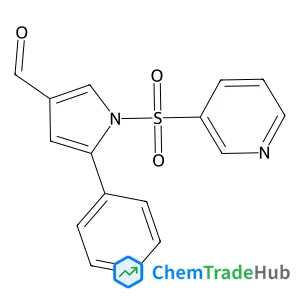
5-Phenyl-1-(pyridin-3-ylsulfonyl)-1H-pyrrole-3-carbaldehyde
CAS Number:
881676-90-0
Molecular Formula:
C16H12N2O3S
Pablo Pinacho, Susana Blanco, Juan Carlos López
The microsolvated complexes of formanilide, generated in a supersonic expansion, have been observed by Fourier transform microwave spectroscopy. Three 1 : 1 and one 1 : 2 formanilide–water adducts have been observed and their structures characterized by the measurement of isotopologue rotational spectra. In one of the monohydrated complexes and in the dihydrated complex, formanilide adopts a cis-configuration. In these species water closes sequential cycles with the cis amino and carbonyl groups through a network of N–H⋯O and O–H⋯O hydrogen bonds. Furthermore, in these complexes cis-formanilide has almost the same non planar configuration observed in the monomer. In the two monohydrated complexes detected with trans-formanilide, a planar skeleton is detected with water interacting solely with either the amino (N–H··O bond) or the carbonyl group (O–H⋯OC bond). The observed tunnelling splittings show a rich intermolecular dynamics in those complexes. The results seem to indicate that complexation with water switches the configuration of formanilide from trans, which is more stable for the bare monomer, to cis, which is more stable for the hydrated complexes.
Jennifer A. Moore, Kalyan Vasudevan, Nicholas J. Hill, Gregor Reeske, Alan H. Cowley
DOI: 10.1039/B606390J
Hang-Beom Bu, Günther Götz, Egon Reinold, Astrid Vogt, Sylvia Schmid, Raúl Blanco, Jose L. Segura, Peter Bäuerle
DOI: 10.1039/B718077B
Hongxia Wang, Jian Fang, Tong Cheng, Jie Ding, Liangti Qu, Liming Dai, Xungai Wang, Tong Lin
DOI: 10.1039/B714352D
Koichi Tanaka, Shinji Oda, Motoo Shiro
DOI: 10.1039/B714083E
Dominik Kurzydłowski
DOI: 10.1039/B716705A
Darryl J. Morrison, Susanne D. Riegel, Warren E. Piers, Masood Parvez, Robert McDonald
DOI: 10.1039/B605716K
Paul V. Santacroce, Oluyomi A. Okunola, Peter Y. Zavalij, Jeffery T. Davis
DOI: 10.1039/B607221F
Chang-Cheng You, Rochelle R. Arvizo, Vincent M. Rotello
DOI: 10.1039/B605508G
Shau-Hua Ueng, Sheng-Yao Hsueh, Chien-Chen Lai, Yi-Hung Liu, Shie-Ming Peng, Sheng-Hsien Chiu
DOI: 10.1039/B716331B
When considering alternatives to 1-(4-Chlorophenyl)-N-hydroxymethanimine (CAS: 3...
This compound should be stored in a cool, dry place away from direct sunlight. I...
3-(4-Bromophenyl)-5-(2-fluorophenyl)-1,2,4-oxadiazole is synthesized through a m...
5-Chloro-2-(4-chlorophenyl)-4-methyl-6-[3-(1-piperidinyl)propoxy]pyrimidine (CAS...
2-Chloro-4-(difluoromethoxy)pyridine is used in the pharmaceutical industry for ...
3-Chloro-6-methylpyridazine (CAS: 1121-79-5) is classified under the Globally Ha...
Several alternatives can be used in the synthesis of Methyl 4,5-dimethyl-2-nitro...
Alternatives to (2E,2'E)-3,3'-(1,4-Phenylene)bisacrylaldehyde include other acry...
3-Amino-5-chloropyridin-2-ol hydrochloride is an organic compound with the CAS n...
When handling 6,7-Difluoro-2,3-dihydro-4H-chromen-4-one, it is essential to wear...

Physical Chemistry Chemical Physics (PCCP) is an international journal co-owned by 19 physical chemistry and physics societies from around the world. This journal publishes original, cutting-edge research in physical chemistry, chemical physics and biophysical chemistry. To be suitable for publication in PCCP, articles must include significant innovation and/or insight into physical chemistry; this is the most important criterion that reviewers and Editors will judge against when evaluating submissions. The journal has a broad scope and welcomes contributions spanning experiment, theory, computation and data science. Topical coverage includes spectroscopy, dynamics, kinetics, statistical mechanics, thermodynamics, electrochemistry, catalysis, surface science, quantum mechanics, quantum computing and machine learning. Interdisciplinary research areas such as polymers and soft matter, materials, nanoscience, energy, surfaces/interfaces, and biophysical chemistry are welcomed if they demonstrate significant innovation and/or insight into physical chemistry. Joined experimental/theoretical studies are particularly appreciated when complementary and based on up-to-date approaches.
![4-[(3-Chloro-2-fluorophenyl)amino]-7-methoxy-6-quinazolinyl acetate structure](https://static.chemtradehub.com/structs/740/740081-22-5-f58f.webp "4-[(3-Chloro-2-fluorophenyl)amino]-7-methoxy-6-quinazolinyl acetate structure")







