












![1-[6-(1H-Imidazol-1-yl)-3-pyridinyl]methanamine structure](https://static.chemtradehub.com/structs/914/914637-08-4-8825.webp "1-[6-(1H-Imidazol-1-yl)-3-pyridinyl]methanamine structure")
Front cover
Literature Information
Publication Date
2023-12-12
DOI
10.1039/D3CC90400H
Impact Factor
6.222
Authors
View Original
Abstract
A graphical abstract is available for this content
Related Literature
Electric quadrupole moment of graphene and its effect on intermolecular interactions
Mikuláš Kocman, Martin Pykal, Petr Jurečka
2013-12-06
Paper
DOI: 10.1039/C3CP54701A
Self-aggregation mechanisms of N-alkyl derivatives of urea and thiourea
Monika Obrzud, Maria Rospenk, Aleksander Koll
2013-12-16
Paper
DOI: 10.1039/C3CP53582G
A new approach to determine vapour pressures and hygroscopicities of aqueous aerosols containing semi-volatile organic compounds
D. J. Stewart, T. C. Preston, J. S. Walker, Y.-H. Zhang, J. P. Reid
2014-01-02
Paper
DOI: 10.1039/C3CP54948H
Single bubble perturbation in cavitation proximity of solid glass: hot spot versus distance
Helmuth Möhwald, Kenneth Suslick
2013-08-21
Paper
DOI: 10.1039/C3CP52850B
Photoelectrochemical scanning droplet cell microscopy for localized photovoltaic investigations on organic semiconductors
Jacek Gasiorowski, Jan Philipp Kollender, Kurt Hingerl, Niyazi Serdar Sariciftci, Andrei Ionut Mardare
2013-11-18
Paper
DOI: 10.1039/C3CP53851F
The benzoic acid–water complex: a potential atmospheric nucleation precursor studied using microwave spectroscopy and ab initio calculations
Elijah G. Schnitzler, Wolfgang Jäger
2013-11-28
Paper
DOI: 10.1039/C3CP54486A
Photochemistry of a 1 : 1 hydrogen-bonded CH3CN : HCOOH complex under astrochemically-relevant conditions
2013-11-01
Paper
DOI: 10.1039/C3CP54041C
Initial stages of Cu3Au(111) oxidation: oxygen induced Cu segregation and the protective Au layer profile
Kohei Oka, M. Hashinokuchi, Akitaka Yoshigoe, Yuden Teraoka
2013-12-23
Paper
DOI: 10.1039/C3CP54709D
Emission ellipsometry used to probe aggregation of the luminescent 2,1,3-benzothiadiazole dyes and ordering in an E7 liquid crystal matrix
Paulo Alliprandini Filho, Gustavo G. Dalkiranis, Raigna A. S. Z. Armond, Eralci M. Therézio, Ivan H. Bechtold, André A. Vieira, Rodrigo Cristiano, Hugo Gallardo, Osvaldo N. Oliveira, Jr.
2013-11-26
Paper
DOI: 10.1039/C3CP53803F
You might also like
Compound Q&A
What is the market or research trend for N-(4-Methoxybenzyl)-2-pyridinamine (CAS: 52818-63-0)?
N-(4-Methoxybenzyl)-2-pyridinamine (CAS: 52818-63-0) is increasingly being used ...
52818-63-0N-(4-Methoxybenzyl)-...
Compound Q&A
What precautions should be taken when handling Ethyl 4-(2-chlorophenyl)-1,3-thiazole-2-carboxylate (CAS: 1050507-06-6)?
When handling Ethyl 4-(2-chlorophenyl)-1,3-thiazole-2-carboxylate, appropriate p...
1050507-06-6Ethyl 4-(2-chlorophe...
Compound Q&A
What regulatory guidelines apply to diethyldiselane (CAS: 628-39-7)?
Diethyldiselane (CAS: 628-39-7) is classified under the Globally Harmonized Syst...
628-39-7Diethyldiselane
Compound Q&A
What is the market or research trend for oxocopper (CAS: 12053-18-8)?
The market for oxocopper (CAS: 12053-18-8) is primarily driven by its use in cat...
12053-18-8oxocopper; oxo-(oxoc...
Compound Q&A
What is the market or research trend for 5-{[(2-Methyl-2-propanyl)oxy]carbonyl}-5-azaspiro[2.4]heptane-7-carboxylic acid?
The market for 5-{[(2-Methyl-2-propanyl)oxy]carbonyl}-5-azaspiro[2.4]heptane-7-c...
1268519-54-55-{[(2-Methyl-2-prop...
Compound Q&A
What is 2-(1-Pyrrolidinyl)-4-pyridinamine (CAS: 35981-63-6)?
2-(1-Pyrrolidinyl)-4-pyridinamine is a chemical compound with the CAS number 359...
35981-63-62-(1-Pyrrolidinyl)-4...
Compound Q&A
What are the physical and chemical properties of 2-(3-Pyridinyl)-1-azabicyclo[2.2.2]octane (CAS: 91556-75-1)?
2-(3-Pyridinyl)-1-azabicyclo[2.2.2]octane (CAS: 91556-75-1) is a crystalline sol...
91556-75-12-(3-Pyridinyl)-1-az...
Compound Q&A
How is (S)-Alpha-allyl-proline hydrochloride (CAS: 129704-91-2) typically synthesized?
(S)-Alpha-allyl-proline hydrochloride is usually synthesized via a Wittig reacti...
129704-91-2(S)-Alpha-allyl-prol...
Compound Q&A
What is 3-Methyl-1,2-oxazole-5-carboxylic acid (CAS: 4857-42-5)?
3-Methyl-1,2-oxazole-5-carboxylic acid (CAS: 4857-42-5) is an organic compound w...
4857-42-53-Methyl-1,2-oxazole...
Compound Q&A
How is Lys-SMCC-DM1 (CAS: 1281816-04-3) typically synthesized?
Lys-SMCC-DM1 is synthesized via a multi-step process involving the coupling of S...
1281816-04-3Lys-SMCC-DM1
Source Journal
Chemical Communications

CiteScore:
8.6
Self-citation Rate:
4.7%
Articles per Year:
2458
ChemComm publishes urgent research which is of outstanding significance and interest to experts in the field, while also appealing to the journal’s broad chemistry readership. Our communication format is ideally suited to short, urgent studies that are of such importance that they require accelerated publication. Our scope covers all topics in chemistry, and research at the interface of chemistry and other disciplines (such as materials science, nanoscience, physics, engineering and biology) where there is a significant novelty in the chemistry aspects. Major topic areas covered include: Analytical Chemistry Catalysis Chemical Biology and medicinal chemistry Computational Chemistry and Machine Learning Energy and sustainable chemistry Environmental Chemistry Green Chemistry Inorganic Chemistry Materials Chemistry Nanoscience Organic Chemistry Physical Chemistry Polymer Chemistry Supramolecular Chemistry
Recommended Compounds
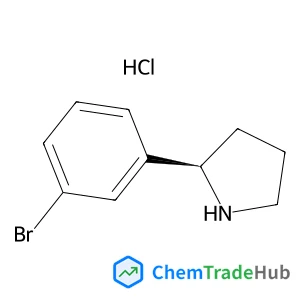
(2R)-2-(3-Bromophenyl)pyrrolidine hydrochloride (1:1)
CAS Number:
1391550-13-2
Molecular Formula:
C10H13BrClN
Recommended Suppliers






Disclaimer
This page provides academic journal information for reference and research purposes only. We are not affiliated with any journal publishers and do not handle publication submissions. For publication-related inquiries, please contact the respective journal publishers directly.
If you notice any inaccuracies in the information displayed, please contact us at support@chemtradehub.com. We will promptly review and address your concerns.