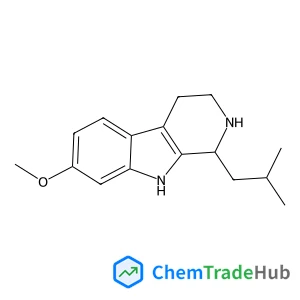
1-Isobutyl-7-methoxy-2,3,4,9-tetrahydro-1H-beta-carboline
CAS Number:
175975-76-5
Molecular Formula:
C16H22N2O
The interstellar medium is characterized by a complex chemistry, especially on the surface of ice grains in molecular clouds. In an attempt to investigate possible reactions leading to exobiologically-relevant species, laboratory experiments dealing with the formation of nitrogen- and oxygen-bearing organic molecules from precursors that are present in the solid phase, on the surface of ice grains, are of primary importance. The aim of the present work was to investigate the formation of a non-covalent complex between CH3CN and HCOOH. For that purpose, FT-IR spectroscopy was used in combination with the rare-gas matrix technique. The experimental spectra were compared with the theoretical ones obtained with the help of quantum-chemical calculations. This combination between a theoretical and an experimental approach allowed us to propose a structure for the hydrogen-bonded complexes experimentally observed.
Adrian Fegan, Pravin S. Shirude, Shankar Balasubramanian
DOI: 10.1039/B801629A
Rui Wen, Hong-Xia Zhang, Cun-Ji Yan, Hui-Juan Yan, Ge-Bo Pan, Li-Jun Wan
DOI: 10.1039/B719888D
Yoshihiko Yamamoto, Naohiro Kirai, Yu Harada
DOI: 10.1039/B802231C
Curtis J. Rieder, Ryan J. Fradette, F. G. West
DOI: 10.1039/B800800K
Suk-Wah Tam-Chang, Liming Huang
DOI: 10.1039/B714319B
Elisa Biavardi, Gionata Battistini, Marco Montalti, Roger M. Yebeutchou, Luca Prodi, Enrico Dalcanale
DOI: 10.1039/B801729H
Peng Gao, Dirk Beckmann, Hoi Nok Tsao, Xinliang Feng, Volker Enkelmann, Wojciech Pisula, Klaus Müllen
DOI: 10.1039/B717608B
N-(4-Methoxybenzyl)-2-pyridinamine (CAS: 52818-63-0) is increasingly being used ...
When handling Ethyl 4-(2-chlorophenyl)-1,3-thiazole-2-carboxylate, appropriate p...
Diethyldiselane (CAS: 628-39-7) is classified under the Globally Harmonized Syst...
The market for oxocopper (CAS: 12053-18-8) is primarily driven by its use in cat...
The market for 5-{[(2-Methyl-2-propanyl)oxy]carbonyl}-5-azaspiro[2.4]heptane-7-c...
2-(1-Pyrrolidinyl)-4-pyridinamine is a chemical compound with the CAS number 359...
2-(3-Pyridinyl)-1-azabicyclo[2.2.2]octane (CAS: 91556-75-1) is a crystalline sol...
(S)-Alpha-allyl-proline hydrochloride is usually synthesized via a Wittig reacti...
3-Methyl-1,2-oxazole-5-carboxylic acid (CAS: 4857-42-5) is an organic compound w...
Lys-SMCC-DM1 is synthesized via a multi-step process involving the coupling of S...

Physical Chemistry Chemical Physics (PCCP) is an international journal co-owned by 19 physical chemistry and physics societies from around the world. This journal publishes original, cutting-edge research in physical chemistry, chemical physics and biophysical chemistry. To be suitable for publication in PCCP, articles must include significant innovation and/or insight into physical chemistry; this is the most important criterion that reviewers and Editors will judge against when evaluating submissions. The journal has a broad scope and welcomes contributions spanning experiment, theory, computation and data science. Topical coverage includes spectroscopy, dynamics, kinetics, statistical mechanics, thermodynamics, electrochemistry, catalysis, surface science, quantum mechanics, quantum computing and machine learning. Interdisciplinary research areas such as polymers and soft matter, materials, nanoscience, energy, surfaces/interfaces, and biophysical chemistry are welcomed if they demonstrate significant innovation and/or insight into physical chemistry. Joined experimental/theoretical studies are particularly appreciated when complementary and based on up-to-date approaches.