












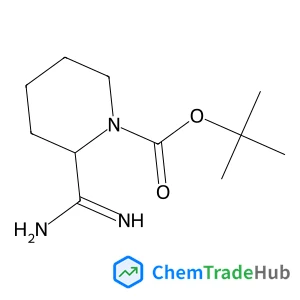
2-Methyl-2-propanyl 2-carbamimidoyl-1-piperidinecarboxylate
CAS Number:
1258640-98-0
Molecular Formula:
C11H21N3O2
Elijah G. Schnitzler, Wolfgang Jäger
The pure rotational, high-resolution spectrum of the benzoic acid–water complex was measured in the range of 4–14 GHz, using a cavity-based molecular beam Fourier-transform microwave spectrometer. In all, 40 a-type transitions and 2 b-type transitions were measured for benzoic acid–water, and 12 a-type transitions were measured for benzoic acid–D2O. The equilibrium geometry of benzoic acid–water was determined with ab initio calculations, at the B3LYP, M06-2X, and MP2 levels of theory, with the 6-311++G(2df,2pd) basis set. The experimental rotational spectrum is most consistent with the B3LYP-predicted geometry. Narrow splittings were observed in the b-type transitions, and possible tunnelling motions were investigated using the B3LYP/6-311++G(d,p) level of theory. Rotation of the water moiety about the lone electron pair hydrogen-bonded to benzoic acid, across a barrier of 7.0 kJ mol−1, is the most likely cause for the splitting. Wagging of the unbound hydrogen atom of water is barrier-less, and this large amplitude motion results in the absence of c-type transitions. The interaction and spectroscopic dissociation energies calculated using B3LYP and MP2 are in good agreement, but those calculated using M06-2X indicate excess stabilization, possibly due to dispersive interactions being over-estimated. The equilibrium constant of hydration was calculated by statistical thermodynamics, using ab initio results and the experimental rotational constants. This allowed us to estimate the changes in percentage of hydrated benzoic acid with variations in the altitude, region, and season. Using monitoring data from Calgary, Alberta, and the MP2-predicted dissociation energy, a yearly average of 1% of benzoic acid is expected to be present in the form of benzoic acid–water. However, this percentage depends sensitively on the dissociation energy. For example, when using the M06-2X-predicted dissociation energy, we find it increases to 18%.
Jun-ichi Ito, Satoshi Ujiie, Hisao Nishiyama
DOI: 10.1039/B800387D
Takaaki Tsuruoka, Rena Takahashi, Toshihiro Nakamura, Minoru Fujii, Kensuke Akamatsu, Hidemi Nawafune
DOI: 10.1039/B717732A
Justin J. Richards, Robert W. Huigens III, T. Eric Ballard, Anne Basso, John Cavanagh, Christian Melander
DOI: 10.1039/B719802G
Pravin S. Shirude, Liming Ying, Shankar Balasubramanian
DOI: 10.1039/B801465E
Szymon W. Przybylak, Floriana Tuna, Simon J. Teat, Richard E. P. Winpenny
DOI: 10.1039/B717277J
Chuan-Feng Chen, Zhi-Tang Huang
DOI: 10.1039/B800258D
Marites A. Guino-o, Charles F. Campana, Karin Ruhlandt-Senge
DOI: 10.1039/B715701K
Junwon Kim, Hye-Young Park, Jaeseung Kim, Jiyoung Ryu, Do Yoon Kwon, Regis Grailhe, Rita Song
DOI: 10.1039/B719434J
Anaïs Medina, Christian G. Claessens, G. M. Aminur Rahman, Al Mokhtar Lamsabhi, Otilia Mó, Manuel Yáñez, Dirk M. Guldi, Tomás Torres
DOI: 10.1039/B719226F
Zhaoyong Sun, Amar Kumbhar, Kai Sun, Qingsheng Liu
DOI: 10.1039/B719176F
N-(4-Methoxybenzyl)-2-pyridinamine (CAS: 52818-63-0) is increasingly being used ...
When handling Ethyl 4-(2-chlorophenyl)-1,3-thiazole-2-carboxylate, appropriate p...
Diethyldiselane (CAS: 628-39-7) is classified under the Globally Harmonized Syst...
The market for oxocopper (CAS: 12053-18-8) is primarily driven by its use in cat...
The market for 5-{[(2-Methyl-2-propanyl)oxy]carbonyl}-5-azaspiro[2.4]heptane-7-c...
2-(1-Pyrrolidinyl)-4-pyridinamine is a chemical compound with the CAS number 359...
2-(3-Pyridinyl)-1-azabicyclo[2.2.2]octane (CAS: 91556-75-1) is a crystalline sol...
(S)-Alpha-allyl-proline hydrochloride is usually synthesized via a Wittig reacti...
3-Methyl-1,2-oxazole-5-carboxylic acid (CAS: 4857-42-5) is an organic compound w...
Lys-SMCC-DM1 is synthesized via a multi-step process involving the coupling of S...

Physical Chemistry Chemical Physics (PCCP) is an international journal co-owned by 19 physical chemistry and physics societies from around the world. This journal publishes original, cutting-edge research in physical chemistry, chemical physics and biophysical chemistry. To be suitable for publication in PCCP, articles must include significant innovation and/or insight into physical chemistry; this is the most important criterion that reviewers and Editors will judge against when evaluating submissions. The journal has a broad scope and welcomes contributions spanning experiment, theory, computation and data science. Topical coverage includes spectroscopy, dynamics, kinetics, statistical mechanics, thermodynamics, electrochemistry, catalysis, surface science, quantum mechanics, quantum computing and machine learning. Interdisciplinary research areas such as polymers and soft matter, materials, nanoscience, energy, surfaces/interfaces, and biophysical chemistry are welcomed if they demonstrate significant innovation and/or insight into physical chemistry. Joined experimental/theoretical studies are particularly appreciated when complementary and based on up-to-date approaches.

![1-oxaspiro[4.4]nonan-6-one structure](https://static.chemtradehub.com/structs/134/134179-01-4-e051.webp "1-oxaspiro[4.4]nonan-6-one structure")




